Thank you, Lionel Messi: If this was your final World Cup, what a privilege it has been
From Rosario streets to global icon, a farewell written in tears and glory
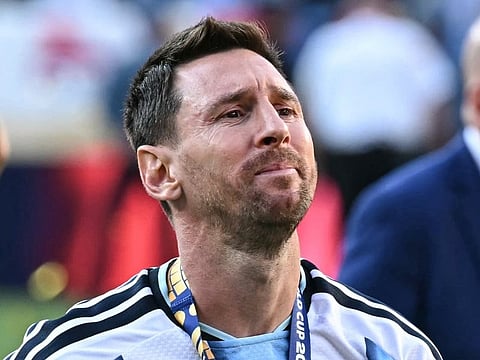
Lionel Messi stood motionless as he stared at a sea of blue and white in New Jersey. Then tears began to fall. The gravity of losing the FIFA World Cup final hit home. Football's superhero turned out to be human after all.
The player who has won everything, including hearts across the globe, could not quite get his passionate Argentina teammates yet another trophy to take back home. But boy did he try.
Fans of every nationality across the globe watched on, united by one big question: have we seen the last of Messi for the La Albiceleste?
If that emotional sea of blue and white fans, repeatedly singing 'Messi, Messi', is the final curtain on an incredible international career, then all we can say as football fans is thank you. Thank you for everything.
The mercurial captain could have chosen Spain at a young age. But he didn't. After moving to Barcelona as a teenager, he became eligible to represent Spain, and the Spanish Football Federation was keen to bring him into their national setup.
Had he accepted, he could have been part of arguably one of the greatest international sides football has ever seen; winning two UEFA European Championships and the 2010 FIFA World Cup alongside Xavi, Andres Iniesta, Sergio Busquets and many of his Barcelona teammates.
But he chose Argentina
The kid from Rosario could never think of wearing any shirt other than Argentina's stripes. For him, there was never really a choice. He chose his motherland. He chose to carry the burden of a nation that already had a footballing god in Diego Maradona.
Replicating what Maradona did for Argentina would have seemed an impossible task in those early years. Yet Messi willingly accepted that responsibility. The pressure was insurmountable. Argentina has always had a proud winning culture. But have you ever stopped to think about the pressure of an entire country expecting you to recreate what its greatest-ever player had already done?
And he failed in the beginning. He lost four major finals in an Argentina shirt. He even briefly retired from international football. He cried. The criticism was relentless.
But he came back
He had already won everything there was to win, both individually and collectively at club level. Ballon d'Ors, Champions Leagues, league titles... Records that may never be broken. Yet it still that was not enough. He needed to win for his country.
Not because that was how his greatness should have been judged, but because football has a habit of measuring players through trophies instead of what our eyes have witnessed. There are many who believe that if you do not win with your national team, you cannot truly be considered among the greatest. Maybe that argument carries some weight. Maybe it does not.
But Messi wanted to remove even that debate. He wanted to conquer football with the shirt that meant the most to him.
Football does not always reward talent immediately. Sometimes it rewards perseverance.
Then came Lionel Scaloni
More importantly, then came a group of players who genuinely believed sharing the pitch with Messi was a privilege. They were willing to run the extra mile for him in every single game.
And they did.
They won the Copa America. They won the Finalissima. They won the FIFA World Cup. They won another Copa America. And they reached another World Cup final.
Messi took Argentina to three FIFA World Cup finals. In every one of those campaigns, he was arguably the best player in the tournament. Yes, Rodri deserved to win the Golden Ball in 2026, but Messi's impact was beyond statistics.
At the age of 39, Argentina still had only one plan: Plan Messi
He carried the team once again. Eight goals. Four assists. Leading the tournament in several other attacking metrics. How is that even possible? For more than two decades, whenever Argentina needed a hero, they looked towards the man wearing No. 10.
Sometimes he failed. But he always answered. The same country that once questioned him now worships him. And rightly so.
Football always believes it has seen the last genius. Then another one arrives. Pele gave way to Maradona. Maradona gave way to Messi. Perhaps another genius will come one day.
But replacing what Messi has given football over the past two decades will be incredibly difficult. Football might not have another maestro quite at that level with his longevity, guile, clutch moments, elegance, flair and joy.
He will be 43 by the next World Cup. He will be 41 by the next Copa America. Will he play in either tournament? We simply do not know.
There is something beautifully poetic about where this journey may have ended
At New York New Jersey Stadium, Messi once cried after losing the Copa América final. It was his fourth major final defeat with Argentina. Many wondered whether he would ever lift an international trophy. Years later, he returned to the very same stadium. This time, he arrived having already completed football.
He could not make it back-to-back. Nor did Argentina deserve to. Spain were the better team throughout the tournament and worthy world champions. But as the final whistle blew and tears rolled down Messi's face once again, this time they were accompanied by the love of the fans, who chanted his name louder than ever.
That is immortality
Sometimes it feels like the footballing gods were just a little too jealous to write a script where Messi won back-to-back World Cups. That would have been almost too perfect, even for them. He may have lost his fifth major final with Argentina, but the four trophies he brought home changed the history of Argentine football forever. He has conquered hearts all around the world.
It has been a privilege to watch him play football. It has been a privilege to follow a journey filled with heartbreak, failure, redemption and ultimately glory. And if this was the final time Messi wore an Argentina shirt on the World Cup stage, it has been an absolute privilege. Thank you, Leo.


