Manuel Pellegrini looks to lay stress on pleasing football
New City manager must get to grips with ‘holistic management’
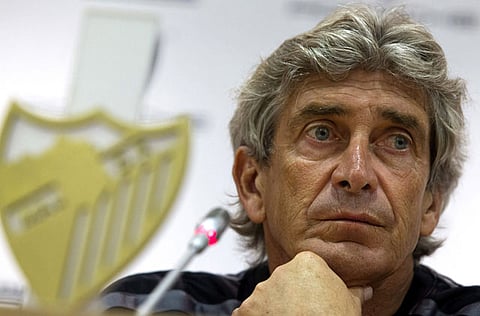
London: Manuel Pellegrini celebrates his 60th birthday in September and Manchester City is the 12th club he has coached, but the Chilean quite possibly needed to mug up on the precise meaning of “holistic management” before finally arriving at the Etihad Stadium.
Much fun was poked at City when their club statement announcing Roberto Mancini’s dismissal last month declared that his successor must satisfy a newly identified requirement to “develop a holistic approach to all aspects of football at the club”.
It sounds the sort of thing City’s corporate jargon loving former chief executive Garry Cook would have said and, sure enough, Cook recently endorsed the stance adopted by Txiki Begiristain and Ferran Soriano, City’s Catalan director of football and chief executive.
“The holistic element is understanding the way a football club runs, not just the way a team wins games,” says Cook. “When companies sign [sponsorship] agreements with a club they want access to the core proposition, which is the talent. They want the manager, they want the players, so the player and the manager have to give up their time for that.
“It puts a drain on someone who doesn’t understand the need to be commercial property, doesn’t understand the need to explain themselves in the media, doesn’t understand the need to run the business with financial management at the heart of everything they do.”
Should Pellegrini be daunted by that explanation the good news is that he will undergo a crash course in “holistic management’s” finer points during a City induction in which the squad embark on an ambitious summer tour taking in South Africa, Hong Kong, Germany and Finland.
A lot of flying is involved but if attendant fatigue, something only exacerbated by attending numerous corporate functions along the way, has to be a concern, it at least affords the former Malaga coach time to properly get to know his players while also allowing new signings to bond with teammates.
Mancini moaned that City were far too slow out of the blocks when it came to executing transfer business last summer but, this time round, Begiristain and Soriano have acted with alacrity.
In recent seasons at Villarreal, Real Madrid and Malaga, Pellegrini built speedy, fluent teams with pace in midfield an arguably, at times, rather stately department at City under Mancini regarded as a prerequisite.
Moreover, unlike the Italian, the man from Santiago has a passion for genuine wingers.
Step forward Jess Navas, an orthodox 27-year-old winger who was signed this week for about £15m (Dh86.5m) from Sevilla. Navas, whom Pellegrini must trust, has conquered the acute homesickness and anxiety disorder which hampered his early career, and arrived a few days after Fernandinho, the 28-year-old Shakhtar Donetsk midfielder.
Although City originally balked at the initial £40m-plus asking price, a compromise was reached about £10m shy of that figure.
Isco, the Malaga midfielder presently playing for Spain at the European Under-21 Championships in Israel, is next in line to sign a deal to join his manager in La Liga, and Edinson Cavani is also thought to be on the incoming manager’s shopping list as he builds a squad capable of winning the expected five trophies in five years. It will be fascinating to guess City’s starting XI for their final pre-season friendly against Arsenal in Helsinki on August 10.
The need to comply with the new European financial fair play regulations dictates that Mancini’s successor must shortly offload certain players.
He has to swiftly decide if individuals such as Edin Dzeko, Gareth Barry, Scott Sinclair, Samir Nasri and, perhaps even Carlos Tevez, are wanted on his watch.
Exactly how much autonomy the Chilean enjoys when it comes to “personnel refreshment” remains unclear but Pellegrini will want to establish defined areas of authority with Soriano and Begiristain.
One of the first hints that Mancini’s time in Manchester was drawing to a close came last December when Begiristain informed City’s network of scouts that the first team would be playing 4-3-3 not the then manager’s preferred formation next season.
Pellegrini does not appear to be a slavish devotee of 4-3-3 either, so the swift charting of specific spheres of managerial influence seems imperative.
At least Soriano knows what he wants. “We are looking to play good football and to win and I said that in the right order,” he said.
The chief executive is also anxious for Pellegrini to take an interest in the youth team and promote dressing room harmony, but the good news for City fans is that, once the fine details are ironed out, and presumably they now have been, he and the Chilean look to be on the same wavelength.
If Pellegrini’s habit of seeking his players’ counsel and listening to their opinions will be welcome after his predecessor’s rather dictatorial regime, the personal manifesto he issued on joining Malaga can now be re-interpreted as a direct challenge to the much more pragmatic David Moyes and Jose Mourinho.
“To be attacking, to try to take control of the game,” Pellegrini said, outlining that mission statement.
“To take responsibility to be attractive. There is a footballing concept and a concept of spectacle that is non-negotiable.”
Manchester United, Chelsea et al could be forgiven for fearing that a bar has just been raised.


