Food pyramid is now inverted: Here's why, what it means
World War II-era "Basic 7" food guideline gets updated for the first time
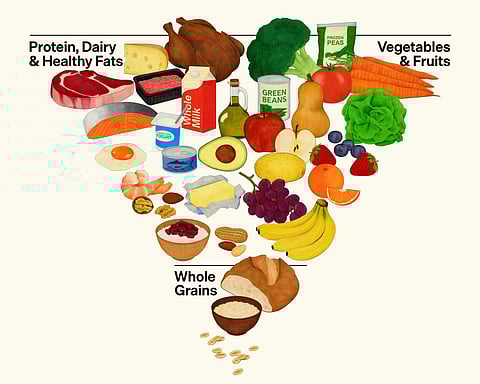
The "food pyramid" has guided human civilisation for decades. The world simple followed or adhered to the 1940s-era pyramid, deemed the ideal nutrition model.
Until December 2025.
But this pyramid — unquestioned for 82 years — has no basis in food science or good nutrition.


The underying idea: economics. Yes, it was put together at a time of severe food shortages.
A bit of history: In 1943, as Allied forces stormed Stalingrad, Guadalcanal, and Sicily, and the US Department of Agriculture (USDA) released the "Basic 7" food guide to help US citizens cope with food rationing.
It was in the middle a brutal World War II; food was scarce.
"Basic 7" food guide
As its name indicates, this guide divided foods into seven groups, among them bread and cereals, several covering fruits and vegetables, and meat and poultry.
In the 1970s, Sweden's National Board of Health and Welfare was tasked with tackling rising food costs. It came up with two food groups, titled “basic” and “supplementary.”
Problematic food guide
Like the 1943-era USDA pyramid, the Swedish one simply built on top of it. Both were nutritionally problematic.
The “supplementary” foods included fruits, vegetables, meat, and fish.
The Swedish government also relied on a dietary circle that resembled a cake divided into seven pieces. It didn't tell the reader how much to consume of each piece.
It was in this somewhat confusing context that Anna-Britt Agnsater, an educator who worked for a Swedish grocery cooperative, designed her own food pyramid, published for the first time in 1974 in an issue of the cooperative’s magazine.
Basic 7: Divided into three levels
She divided the pyramid into three levels.
The bottom level included bread and other grains, legumes, potatoes, and milk. The middle level comprised fruits, vegetables, and juices.
The top level covered eggs, meat, and fish.
Agnsater used a pyramid shape so as to indicate that a person should eat more foods from the bottom of the pyramid — the widest section — than from the top.
Other Nordic countries soon designed their own food pyramids, and the shape was also adopted elsewhere.
In 1992 the USDA rolled out its version of the food pyramid. It had four levels. The bottom level included bread, cereal, rice, and pasta, with a recommended 6 to 11 servings per day.
The second level was split between a vegetable group (3 to 5 servings per day) and a fruit group (2 to 4 servings per day).
The third level specified 2 to 3 daily servings from a group comprising milk, yogurt, and cheese and 2 to 3 daily servings from a group comprising meat, poultry, fish, dry beans, eggs, and nuts.
The top level included fats, oils, and candy, which were to be eaten sparingly.
The USDA’s version led to similar pyramids being created for specific cuisines and diets such as Asian, Mediterranean, Latin American, vegetarian, and vegan, with the focus of each remaining on grains, fruits, and vegetables.
In 2011 the USDA replaced MyPyramid with MyPlate, which displayed the basic food groups (fruits, grains, protein, and vegetables) as sections on a plate, with each section’s size representing the dietary proportions of each food group.
MyPlate did not incorporate an exercise component, nor did it include a section for fats and oils.
About the same time, the governments of Mexico, Chile, Panama, and the Philippines also adopted a pyramid.
Some countries, though, developed visual representations that were not pyramids, for cultural reasons or simply to do something different.
Canada, for example, used a rainbow, Zimbabwe a square, Guatemala a family pot, and Japan the number 6.
South Korea and China created pagodas. Australia designed both pyramids and plates.
Food pyramid reimagined
The food pyramid was reimagined by many countries in the early 21st century.
In 2005, for example, Japan inverted the pyramid to come up with a spinning top design. In the same year, the USDA created a new pyramid design, calling it MyPyramid.
This featured colourful stripes of varying widths, reflecting the relative proportions of different food groups. It also included a person running up steps to highlight the importance of exercise.
What's the science behind the inverted food pyramid?
Emerging research links higher protein to reduced sarcopenia and better insulin sensitivity, elevating animal and plant sources over grains.
The inverted food pyramid flips the traditional model. It also cites the lack of scientific data behind LDL being called "bad" cholesterol.
The new inverted food pyramid places nutrient-dense proteins, healthy fats, and full-fat dairy at the broad base for daily emphasis, while minimising whole grains and starchy carbs at the narrow tip.
Recent 2025-2030 US Dietary Guidelines reflect this shift, driven by science. It prioritises metabolic health, satiety, and muscle preservation over carb-heavy foundations that was the standard with the 1943 and 1974 models.
These changes challenge decades-old low-fat dogma amid rising evidence of ultra-processed foods' harms.
Quick takes:
The inverted pyramid structure
The pyramid's widest tier promotes proteins like:
meats
eggs
seafood, and
full-fat dairy
Under the new USDA food guide, these can be taken alongside healthy fats from avocados and nuts, aiming for 1.0-1.6g protein per kg body weight daily.
Vegetables and fruits form the middle for fiber and micronutrients, supporting gut health.
Grains occupy the smallest bottom section, used sparingly as energy based on activity.
Obesity protection
Full-fat dairy now trumps low-fat options for satiety and potential obesity protection, despite saturated fat caps. Strict avoidance of ultra-processed foods addresses inflammation and chronic disease risks, per NOVA classifications.
Sources: https://realfood.gov | USDA | https://cdn.realfood.gov/DGA.pdf | Food Tank


