Israel's conscience keepers
Oppressed human rights groups in the country hold the key to peace and the strengthening of Palestinian civil society
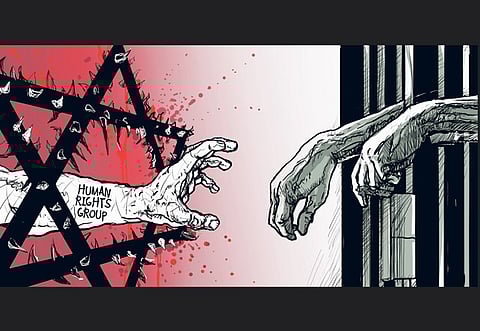
Human rights organisations are the moral voice of democracy; they expose the truth, however unpleasant, and call on decision-makers to live up to their democratic duties. Extremist groups are the ugly face of democracy; they take advantage of the democratic right to freedom of speech to distort the truth, defame and hound its defenders, and sow social discord by promoting exclusionist ideologies.
Throughout its history, Zionism contained voices that echoed both tendencies with humanist Zionism being the moral conscience of Zionism that warned against and opposed the injustice the Zionist project would inevitably inflict on the Palestinians. The extremist tendencies were represented by the fascist factions of Zionism led by Vladimir Jabotensky and his followers, including former terrorist leaders and Likud politicians Menachem Begin and Yitzhak Shamir who would later become prime ministers of Israel.
The tension between these two tendencies was resolved in favour of the extremists to whom political office gave legitimacy and a sense of respectability. Israeli Prime Minister Benjamin Netanyahu and his Likud supporters are the heirs of this extremist tradition; Israel's human rights groups are today's defenders of Palestinian human rights. Unlike humanist Zionism, however, Israel's human rights groups refuse to be silenced; and in their tense confrontations with the extremists they may have scored arguably their most important victory for a long time. That victory is the Goldstone Report which found that the Israeli army committed war crimes during the Gaza war and in its blockade of Gaza may also have committed crimes against humanity.
It is no exaggeration to say that in its tone and in its findings, the Goldstone report is more condemnatory of Israel and its actions against the Palestinians than any previous UN resolution or declaration. It is also no exaggeration to say that the Goldstone Report received more publicity than any previous UN resolution or UN declaration concerning the Israeli occupation or periodic Israeli assaults against the Palestinians.
Netanyahu recently recognised this reality in a speech to the Knesset. He identified the threats facing Israel as the nuclear threat, the missile threat, and then added "and what I call the Goldstone threat. Goldstone has become code for a much broader phenomenon: the attempt to negate the legitimacy of our right to self-defence".
One of the reasons for the unusually powerful impact of the Goldstone report is that in reaching its conclusions, it relied in no small measure on the field research and documentation of Israeli human rights groups. This strengthened the report's reliability and credibility.
Moreover, it is a measure of the added respectability of Israel's human rights groups that shortly after their role in shaping the conclusions of the Goldstone report became known, they became the object of a campaign of attacks, restrictions on movements and attempts at eliminating their sources of funding. Israeli Interior Minister Eli Yishai accused Israeli human rights organisations that work with Palestinian refugees of "aiming to destroy Israel". Deputy Prime Minister Moshe Yaalon was reported to have described Israeli human rights organisations as the "enemies … from within." The Israeli army announced it was terminating its relations with the human rights organisations operating in Gaza.
‘Dirty war'
Moreover, an Israeli group called Im Tirtzu waged a ‘dirty war' against the New Israel Fund, the foundation which made monetary contributions to some 16 Israeli organisations that provided the Goldstone Commission with crucial documentation for its report. A campaign of vilification and ridicule against the New Israel Fund's president, Naomi Chazan, forced her to resign.
B'Tselem, the Israeli information centre for human rights in the Occupied Territories, along with some 12 other Israeli human rights bodies, sent an urgent letter to the president, the Knesset speaker and the prime minister, protesting the increasing and systematic campaign against human rights organisations in Israel: "A democracy must not silence critical voices; protecting human rights is vital."
Earlier this month, B'Tselem continued to expose the shortcomings and the ‘cover up' contained in the Israeli government's response to the Goldstone report, and concluded that "Israel's report to the UN mis-states the truth".
In addition, the B'Tselem document also reported that more than one year after the Gaza war, all the Israeli investigations of the army's conduct have resulted in the prosecution of one single soldier convicted for stealing a Palestinian's credit card. This result is hardly surprising, the B'Tselem document stated, given that Israeli officials rejected the Goldstone report and repeatedly claimed that the Israeli army "is the most moral army in the world".
With dedication to the truth and to the defence of human rights, and hard work as their weapons, Israeli human rights groups scored a major victory in providing crucial documentation relied upon by the UN Goldstone report to conclude that the Israeli army committed war crimes in last year's Gaza war. They and the Goldstone Report may have already forced the Israeli government to think twice before launching another assault on the Palestinians and, in any case, to have no doubt that its military strategy of indiscriminate violence can no longer rely on the heretofore usual impunity.
There is also a lesson here for the Palestinians: Israel's human rights organisations are potentially one of your most effective partners, not only in the quest for peace, but also in strengthening Palestinian civil society as the necessary foundation for democratic governance in the future Palestinian state.
Adel Safty is Distinguished Professor Adjunct at the Siberian Academy of Public Administration, Russia. His new book, Might Over Right, is endorsed by Noam Chomsky.
Sign up for the Daily Briefing
Get the latest news and updates straight to your inbox


