Zuckerberg’s Facebook hearing was a sham
Now that the initial show trial is done, we all need the real deal and that is how trust can be regained
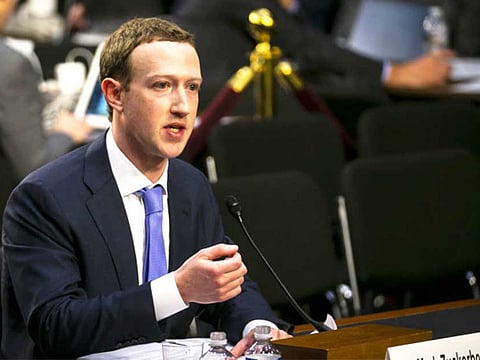
Facebook CEO Mark Zuckerberg is on the hot seat. Cameras surround him. Zuckerberg testified before the United States Congress in a marathon five-hour session about the ongoing Cambridge Analytica data privacy scandal. At last, the reluctant CEO is made to answer some questions! Except it failed. It was designed to fail. It was a show designed to get Zuckerberg off the hook after only a few hours in Washington DC. It was a show that gave the pretence of a hearing without a real hearing. It was designed to deflect and confuse.
Every senator was given less than five minutes for questions. That meant that there was no room for follow-ups, no chance for big discoveries and many frustratingly half-developed ideas. Compare that to Bill Gates’ hearing on Microsoft, where he faced lawyers and staff for several days, or the Kefauver hearings, which were over a year. By design, you can’t do a hearing of this magnitude in a day.
The worst moments of the hearing for us, as citizens, were when senators asked if Zuckerberg would support legislation that would regulate Facebook. I don’t care whether Zuckerberg supports Honest Ads, or privacy laws, or General Data Protection Regulation (GDPR). By asking him if he would support legislation, the senators elevated him to a kind of coequal philosopher King whose view on Facebook regulation carried special weight. It shouldn’t.
Facebook is a known behemoth corporate monopoly. It has exposed at least 87 million people’s data, enabled foreign propaganda, and perpetuated discrimination. We shouldn’t be begging for Facebook’s endorsement of laws, or for Zuckerberg’s promises of self-regulation. We should treat him as a danger to democracy, and demand our senators get a real hearing.
The best senators understood this was a show, and used it as such. “Your user agreement sucks,” said Senator John Kennedy. “Are you a monopoly?” asked Senator Lindsey Graham (Zuckerberg comically responded that he didn’t “feel” like it.) Senator Richard Blumenthal said we needed laws, not promises or apologies.
Because every senator was limited to under five minutes, Zuckerberg always tried to run the clock by talking about mission, or philosophy, or what he believed in. There were some good questions, but there was little chance for follow-up. You could almost see him, well-trained to count the minutes, playing for time when things got a little hot.
Senators Hironi and Booker, for instance, both pointed out the damning reporting by Julia Angwin at ProProblica, which showed that employers and landlords were using Facebook for discriminatory ads. Zuckerberg defended the company by saying they were hard to flag, and that they depend on community flagging to stop them.
The tools Facebook provides make discrimination easy. Facebook has monopoly profit margins, so it can easily provide real staffing to protect against discrimination, if it wanted to. It doesn’t want to.
Hironi and Booker’s could have shown that, but, like the rest of the senators, they each had only a few minutes for a line of questioning. Zuckerberg replied with vague answers about how their comments were “important” or “interesting” or “an important conversation to have.”
Some of the hearing seemed designed to figure out whether Zuckerberg is a good or bad man, or whether he has a good or bad — or bizarre — political philosophy. Zuckerberg strikes me as reliably self-serving. That doesn’t make him that interesting as the CEO of a corporate monopoly; it makes him a run-of-the-mill robber baron.
Asking Zuckerberg philosophical questions, like how he thinks we should deal with questions of hate speech, treat him as a thought leader, a reasonable philosopher king. Accepting his failures to catch discriminatory housing ads, for instance, treats him as a good-hearted actor with limited resources, instead of someone who is making monopoly margins and billions in profits.
In my view, we need to break up Facebook from Instagram and the other potential competitors that Facebook bought up. We need to — at a minimum — move towards opt-in, we need to hold Facebook responsible for enabling discrimination, and we need to require interoperability.
But that’s not enough. There is so much we don’t know about Facebook. We know we have a corporate monopoly that has repeated serious violations that are threatening our democracy. We don’t know how their algorithm treats news organisations or content producers, how Facebook uses its own information about Facebook users or how tracking across platforms works, to just give a few examples.
Now that the initial show trial is done, we need the real deal, one where no senator gets cut off after a few minutes. The real hearing would allow for unlimited questions from each of our senators, who represent millions of people. If it takes two months of sitting in Washington DC, let it take two months.
— Guardian News & Media Ltd
Zephyr Teachout is an American academic, political activist and former political candidate.


