What now after the Paris attacks?
Not bombing Daesh, but privileging political and diplomatic solution is likely to yield better results
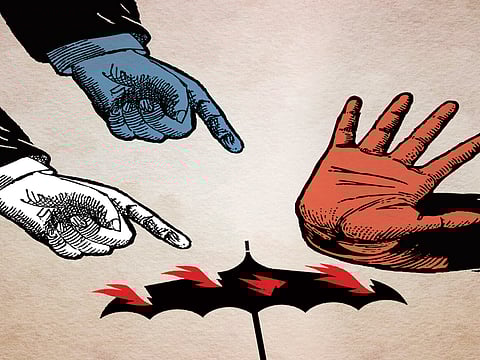
The attacks in Paris on November 13 were the worst on French soil since 1945, with 130 people killed and hundreds more injured.
Unlike the Charlie Hebdo and the Kosher store attacks in January, the perpetrators this time targeted public places, chosen not for their symbolic character, but ordinary people out on a Friday night. The intent: To cause maximum casualties and victims.
Emotions in France, and around the world, are understandably deep and very palpable now — even if some countries such as Lebanon or Iraq are living the same kind of dramas regularly without such emotions. However, as we reel from the magnitude and pain of what happened, the political parties and the French government should not shy away from asking a tough question: How best can France respond both at the domestic and international levels?
Unfortunately, the state of commotion among the French public has not permitted a frank discussion and has favoured very simplistic and demagogic answers by most of the political forces. Many have pushed to blame Muslims in France for the actions of Daesh (the self-proclaimed Islamic State of Iraq and the Levant). This plays directly into the hands of the National Front, which is already on the ascent. With regional elections held last Sunday and next week, the National Front has a high chance of coming out as the winner, especially in regions such as the Provence Cote d’Azur or Nord. It will be the first time since the Second World War that France will see such a party assuming high-level political responsibilities.
Right-wing parties, and especially Les Republicains, led by former president Nicolas Sarkozy, are calling for proposals and laws that can only be described as draconian and undemocratic and will provoke and sow divisions in French society. The answer of the French government is not much different. It has already installed a “state of emergency” and put under house arrest more then three hundred people. And it wants to continue in this way, according to the daily Le Monde, which wrote on December 3, “Exception will be the rule”.
For three weeks, we witnessed a surge in attacks targeting mosques, Islamic centres and adherents of the Islamic faith; and the police are targeting Muslims, many of them without any proof. These actions will play into the hands of Daesh if the schism between the French Muslims and the rest of the population widens.
Are we at war as the French government is saying? Antony Cordesman, a member of the Centre for Strategic and International Studies (CSIS), a Washington think-tank, wrote: “It is all too easy to call for ‘war’ against [Daesh]. There are, however, several reasons to be very cautious about doing so. First, [Daesh] is only one extremist threat, and Daesh operates in the incredibly volatile mix of other sectarian tensions within Islam and in the broad regional environment of failed secular politics, governance and economics that gave birth to the broad upheavals that began in 2011. The terrorist and extremist threat is far broader than [Daesh] and focusing on one group — rather than the broader threat — ignores the reality that it will remain and resurface regardless of what happens to [Daesh].”
France is a key target of the extremists such as Daesh because it, along with the United States, is the most engaged militarily from Mali to Syria, and from Central African Republic to Iraq. But the policy of “the war on terror” is incoherent and we should critically review the failure of this strategy for the last 15 years: There have been more attacks, not less — very often in Muslim countries themselves. Within the last few months, we have witnessed bombings in the Turkish city of Ankara; the attack on a Russia-operated plane that came down over the Sinai Peninsula in Egypt, killing all 224 people on board; suicide attacks in Beirut in a popular suburb; and the attack on a hotel in Bamako. Never have so many people, especially the youth, been more engaged in extremist and violent groups such as Al Qaida or Daesh, committed to what they believe is a resistance to international aggression against Muslims the world over. Is bombing the region the solution?
Is it not high time to think about the region as a whole and not only in military terms? The failure of French President Francois Hollande to create a coalition against Daesh is only proof that there is no political consensus between all the countries involved in the Middle East, even when they are allies. To rid the world of the Daesh menace, bombing is not a strategy. Instead, privileging political and diplomatic solution is likely to yield better results — and hopefully will be longer lasting for a region that has been characterised by a spiral of chaos and instability, especially since the US intervention in Iraq in 2003.
Alain Gresh is a French journalist, former editor of Le Monde diplomatique and editor of OrientXX1.info (online magazine).


