What Modi's 'MEGA' equation means for India and world
MEGA vision or mega illusion as Modi-Trump slogan sparks fiery debates
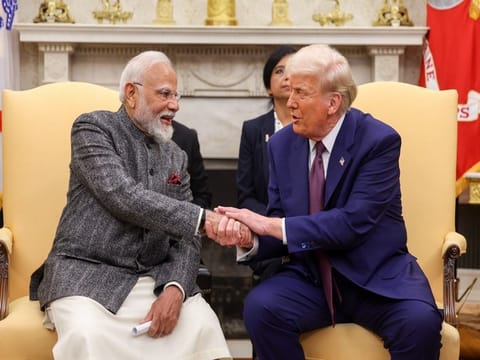
In a notable diplomatic exchange, Indian Prime Minister Narendra Modi, while addressing US President Donald J. Trump, articulated a succinct vision for global economic synergy. His catchy and clever slogan “MIGA + MAGA = MEGA” has the potential and promise to live in the hearts and minds of millions in both the US and India for years to come.
For those who missed it, “MIGA” stands for “Make India Great Again,” echoing Modi’s nationalistic push, while “MAGA” refers to Trump’s “Make America Great Again” slogan.
The equation culminates in “MEGA,” suggesting that the combined efforts of these two nations would yield huge, even exponential, benefits to the whole world. While the statement is memorable and optimistic, it invites a deeper analysis into the practical, political, even ethical implications of such a vision.
There is, after all, a considerable difference between sloganeering and real synergy. On the surface, Modi’s captivating equation suggests an aspirational alliance where the strategic and economic growth of India complements that of the United States, leading to broader global stability and prosperity.
This idea is rooted in the belief that strong and comprehensive partnerships between large democracies can drive global economic growth and a rule-based world order.
A tough call for India
However, the simplicity of the slogan belies the complexity of international geopolitical relations. Take, for instance, defence ties. India needs US technology to modernise, but it has, traditionally, been overly, almost exclusively, dependent on Russia and the erstwhile Soviet Union.
To realign quickly, when some 60% of India’s defence equipment is from this source will be difficult. Add to this, India’s bonanza of cheap oil from Russia will make it harder still to decouple from its former closest partner.
Similarly, while both nations aim for economic growth, their methods, policies, and the sectors they prioritise might not always align. Luckily, Trump’s reciprocal tariffs are not likely to hurt India that much, nor will, from the looks of it, the declining rupee.
The latter will, by necessity, make imports, especially oil, more expensive, but then India has bilateral rupee denominated petroleum deals with both Russia and Iran.
In addition, Indian software and BPO business, the biggest slice of its exports, will only benefit with weaker currency. While trade policies, tariffs, and protectionism can destabilise US-India trade symbiosis, the likelihood of major disruptions seems remote.
Also Read: What did Trump give Modi during US visit?
Will Trump rectify the balance?
The more serious issue is national interests and political priorities. Here, the supposed US intervention in Bangladesh, during the previous Biden administration, was flagrantly against India’s interests.
Similarly, India’s reluctance to come out openly against Russia upset the US when former president Biden was trying to rally international support in favour of beleaguered Ukraine.
Will India align more openly with Trump now? Again, this seems easier especially because Trump himself is seen as softer on both Putin and Russia on the one hand and harder on India’s biggest regional threat and the second global hyperpower, China.
When it comes to foreign policy, Trump’s protective tariffs and dominating tactics may lead not so much to a return of American exceptionalism but result in American isolationism. India’s MIGA, on the other, actually hides an overdependence on Chinese manufacturing.
Quite routinely, businesses find it easier to import and rebrand rather than “Make in India.” The Modi administration knows this all too well, but chooses, apparently, to look the other way. There is thus a big gap between appearance and reality.
Finally, to cultural and ethical considerations. Beyond defence, economic, and politics, there are cultural and ethical dimension to consider. Both leaders have been associated with a form of populism that emphasises national identity and majoritarianism. This can lead to cultural tensions and social divisiveness.
Blueprint for a better world
Domestically in both countries, we have seen how the political undertones of “MIGA” and “MAGA” reflect a white or Hindu nationalism both of which seem to marginalise minorities.
While there’s nothing inherently wrong with such nationalism, it must not lead to the bullying and bulldozing minorities. Mistreatment of, and injustice against, any group does not behove democracies that promise equal rights to all citizens regardless of race, religion, gender, or orgin.
In India, the anti-Muslim propaganda in some quarters is regrettably complemented by the recrudescence of white racism in parts of the US. Both tendencies are unfortunate.
While radical and extremist ideologies must be opposed in both societies, entire communities should not be targeted. In the US, a push against illegal migrants and the return to merit-based hiring does not mean that competent and productive legal workers of colour or overseas origin, especially from India, should be subjected to racial slurs.
If the slogan “MIGA + MAGA = MEGA” is really to work, it should result in a new form global leadership and responsibility arising from such a partnership between the most powerful and the largest democracies on the planet.
Modi’s equation calls for both countries to lead by example in areas like international law and peacekeeping too. It is high time that India get a seat on the UN Security Council. Will the Trump administration support this? If so, what will Trump, the dealmaker, demand in return? Will that pound of flesh be too costly for India to give?
If logistical and practical challenges are overcome, there is no limit to the Indo-US ties even in an increasingly complex, uncertain, and multipolar world, with many unpredictable and competing interests. Modi’s slogan serves as a clarion call for global cooperation, not just the national interests of two countries.
“MIGA + MAGA = MEGA” thus amounts to more than tapping into the zeitgeist of strategic, economic, and cultural nationalism of both countries. But for this equation to truly yield “mega benefits,” it would require not just the alignment of economic policies but also a cultural and ethical shift towards more global-minded governance.
Without these, the equation risks being nothing more than a catchy phrase rather than a blueprint for a better world.
Makarand R. Paranjape is a noted academic, author and columnist


