What Bin Laden wrought
Fawaz Turki writes: Al Qaida embraced a rigid doctrine that eschewed fresh ideas with followers pouring new sauce over old meat
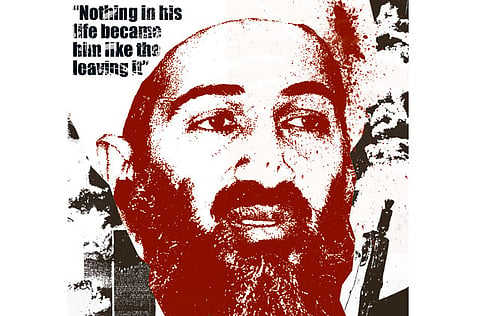
Long before Osama Bin Laden was killed, he had become irrelevant. No, not the kind of irrelevance that would have had you ask "Osama who?" — his legacy remained too searing in our minds — but the kind of oblivion that relegates a once famous ideologue to irrelevance.
Bin Laden improbably sought to bring about, in time, the unity of all Islamic countries — countries with diverse cultures, languages and historical experiences — into one territorial homeland, a commonwealth of nations not much unlike the caliphate that Islam had founded in the 7th century, clearly not just a retrograde vision but one that is anomalous in the modern age of the independent nation state that we have, like it or not, come to inhabit in our world today.
Had he left it at that, Bin Laden would have been taken as a harmless activist with an eccentric ideological paradigm. He did not. He pursued a nihilistic strategy of confrontation with the West, mostly aimed at the United States, whose goal was to kill and maim. His reign of terror before the September 11 attacks, resulting in the slaughter of nearly 3,000 people on American soil, began when his followers bombed the US embassies in Kenya and Tanzania in August 1998, killing 224 people and injuring 4,000 others, mostly civilians. Franchise groups, inspired by his movement and emboldened by his defiance, planted 10 bombs on Madrid trains in March 2004, killing 190 passengers and injuring 1,400, and the following year, on the morning of July 7, London subway and bus bombings killed 52 innocent people on their way to work.
How such heinous acts could have furthered the man's cause is beyond comprehension.
To be sure, Bin Laden appeared on the scene at a time when many Muslims, particularly Arabs, felt helpless at being a determining force in their own destiny, a helplessness they attributed to US machinations in their world. And for a time, Bin Laden gave these people a cheap thrill by hitting at a hated, seemingly omnipotent big power. And let's face it, big powers, all the way from ancient Egypt to militaristic Greece, imperial Rome to colonial Britain, were always hated by their ‘subjugated peoples', who chafed at the pitiless arrogance of their masters in the metropolis. But cheap thrills are just that — cheap. And no ideological paradigm, lacking rhyme or reason to begin with, can indefinitely sustain itself on cheap thrills. Even before the Arab Spring arrived, people showed zero interest in Al Qaida's ephemeral vision of liberation. During it, nary a word of support.
Truth be told, Al Qaida will not suffer, as a defeated hockey team does in overtime, what is known as ‘sudden death'. Its followers will go along for years, perhaps even decades, to come, canonising its departed leader, and ascribing heroic attributes to his persona. This has often happened over the last century to charismatic revolutionaries who suffered an untimely death but continued to inspire followers long after they had become dust. Consider Che Guevara of Argentina, Augusto Sandino of Nicaragua, Leon Trotsky of Russia and, closer to home, Ezz Al Deen Al Qassam of Palestine, memories of whose exploits never ceased to exercise a fascination on the minds of later generations. They changed the world. They changed history. And Bin Laden did just that too.
Reactionary outlook
We are told by American government officials, in repeated self-congratulatory statements, that an inordinate amount of patience and skill went into the Navy Seal operation that finally killed Bin Laden in his compound.
No doubt that is true. But in the words of some of these officials, ‘a lot of painstaking intelligence gathering' was involved as well — very ‘painstaking' indeed, involving waterboarding at ‘black sites' and ‘enhanced interrogation techniques' inflicted on ‘rendered' suspects.
Still, US President Barack Obama was right when he said that ‘the world is a better place without Bin Laden in it'. The man may initially have given a cheap thrill to downtrodden and alienated Muslims, living destitute lives in the countries, or an equally cheap thrill to, say, the five million North African ‘racailles' (scum) whom Nicolas Sarkozy wanted to sweep off the streets of French cities, but in the end he was exposed as a pseudo-Muslim. Bin Laden barely understood history, let alone Islam.
Whereas Islam at the time of its ascendancy was a wonderfully complex and textured faith, both tolerant and liberal in outlook, he espoused a reactionary and nihilistic version of it in our time. Muslims then, imbued as they were with intellectual inquisitiveness, were not above borrowing ideas from Greece and Persia, the Indian subcontinent and the Orient (‘Seek knowledge', their proverb had it, ‘though located as far away as China'). They borrowed freely, mastering and transforming what they learnt to their own measure, with the proud intent of surpassing what had gone before. Bin Laden's movement, on the other hand, embraced a rigid doctrine that eschewed fresh ideas, with its followers, barren of invention, simply pouring new sauces over old meat.
Osama Bin Mohammad Bin Awad Bin Laden is now dead. The Arab Spring is alive. Two different worlds. Two different realities.
Were I to suggest an epitaph for this man, I would take a line from Shakespeare's Macbeth. Responding to King Duncan's query about ‘the execution done on the Lord of Cawdor', a traitor to the throne, Malcolm says: "Nothing in his life became him like the leaving it".
So let's move on. We have other things to attend to.
Fawaz Turki is a journalist, lecturer and author based in Washington. He is the author of The Disinherited: Journal of a Palestinian Exile.


