Using similar tactics, Austrian nationalists hope for a ‘Trump bump’
The campaign of Hofer — from the nationalist, right wing Freedom Party — defied the rules of electoral civility, turning the presidential race into the bitterest in decades
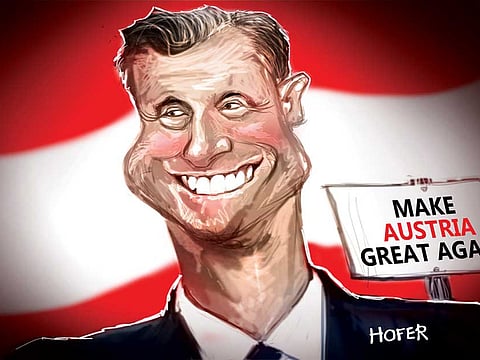
He is a political disrupter supported by right-wing websites that traffic in fake news. His campaign’s embrace of rumour defied the rules of electoral civility, turning the presidential race into the bitterest in decades.
His country is Austria and his name is Norbert Hofer. Austrians went the polls on Sunday in a rerun presidential election following a campaign displaying remarkable similarities to populist politics on both sides of the Atlantic. It is as if Hofer — from the nationalist, right wing Freedom Party — is reading from the same winning playbook as President-elect Donald Trump.
Take, for example, the question of “stamina.” As early as the spring, Hofer, 45, began exuding concern about the health of his centre-left opponent, Alexander Van der Bellen, noting the 72-year-old’s “forgetfulness.”
What followed was the kind of electioneering rare in Austrian politics. Hofer’s campaign manager then told the media that “Mr. Van der Bellen appears slow, in fact, he displays a certain exhaustion.” By June, the right wing blog ‘Politically Incorrect’ published a letter allegedly submitted to Austrian authorities and asserting that Van der Bellen was stricken with dementia and cancer. So severe was his case — the fake letter attested — that Van der Bellen required a legal guardian.
The Freedom Party denied any links to the letter. But the fake news spread so quickly — and so damagingly — that Van der Bellen’s campaign was forced to release his medical records to refute them. The health issue was only one of several false rumours and reports — including allegations of Van der Bellen family ties to the Nazis — that his campaign has struggled to put down.
Trump-like slogans, meanwhile, have popped up on the internet, including a hashtag for ‘Make Austria Great Again’ and an internet meme showing the country’s borders at the height of the Austro-Hungarian Empire. Already, the Freedom Party is cultivating ties with the Trump camp.Ahead of the US election, a Freedom Party delegation traveled to the United States and met with his senior supporters, including Michael T. Flynn, who has been tapped as Trump’s national security adviser. Several Freedom Party politicians also attended the election-night celebration at Trump Tower in New York.
“There have been a lot of insults, slander and even death threats against Van der Bellen which goes well beyond the usual scrawling on posters and campaign buses,” said Lothar Lockl, Van der Bellen’s campaign manager. “The anger and hatred deliberately spread along with fake news and false rumours in echo chambers on Facebook have been an issue.”The candidates are now in a virtual tie. Should Hofer win, he would take over a ceremonial but constitutionally ambiguous job as president that he has contentiously vowed to vest with real power.
In the wake of the American elections, calculations on his electability have changed. From the snowy Alps to the emerald wine country in Austria’s deep south, talk was of a possible “Trump bump” — a sense that Americans may have broken a key psychological barrier in their election last month.
Like Hillary Clinton’s campaign, Van der Bellen’s was asking Austrians to vote for him in part to vote against Hofer to avoid damaging the nation’s reputation on the world stage. Yet if the US can elect Trump, then why, some here argue, shouldn’t Austrians give Hofer a chance? In fact, Hofer’s supporters say, he would simply be the next pillar in a “new world order” in which right-wing nationalists could rise from Washington to Vienna, Paris to The Hague. They see the disruptive forces of the anti-establishment spreading. Italians on Sunday will vote on a restructuring referendum deeply opposed by the populist Five Star Movement. The measure’s failure could bring down the center-left government.
“Wherever the elites distance themselves from voters, those elites will be voted out of office,” Hofer told Reuters last month. “One comparison could be that Trump also had strong [political] headwinds in the US and he won the election anyway.”
As if in an alternate reality where Trump lost and contested the race, Hofer’s Freedom Party did just that — successfully overturning his defeat by just 31,000 votes last May.
If made the first far-right head of state in western Europe since the Second World War, Hofer could exercise his duties in unprecedented ways, his campaign says. He might refuse, for instance, to sign Europe’s free trade deal with Canada and could call a referendum on the Paris Agreement to combat climate change.
He has also flirted with a referendum on European Union membership — a possible deathblow to the bloc following Britain’s vote to exit.
Birds of a feather
As with Trump’s tactics in the US, Hofer’s methods have upended politics here. Hofer tends to present the hosts of debates as well as his opponents as foolish when asked critical questions, and, in Trump-like fashion, launches into unrelated attacks. When asked during a debate whether he should distance himself from Austria’s nationalistic fraternities long linked to racists, Hofer, for instance, attacked the questioner.
“You are so desperate and depressed today. When I saw you six weeks ago you were such a happy person,” he retorted. While somehow maintaining a guy-next-door demeanour, Hofer drops innuendo like bombs and takes seemingly contradictory positions. He has courted Jews and Israel. Yet during a debate, he accused Van der Bellen of being supported by the Freemasons — which some observers saw as an anti-Semitic reference to a Jewish power structure
In manner, Hofer is wholly unlike the bombastic Trump, speaking in an aw-shucks style that comes off as downright neighbourly. Last month, he told Austrian broadcaster ZIB 2 that Trump’s election campaign had been “horrible.”
“I’m happy that we don’t have anything like this in this style in Austria,” he said.
Yet Hofer has embraced an uncannily similar platform. He is pro-Russian, speaks of migrant-blocking fences, says Islam is “not part” of Austria and wants to increase surveillance on mosques.
His single biggest issue is immigration. He argues that at current birthrates, Muslim immigrants would soon overwhelm native Austrians. A 2013 study put the number of Muslims in Austria at 574,000, an almost 70 per cent increase since 2001 that saw them reach 7 per cent of the total population.
Hofer’s campaign maintained a complex, synergistic relationship with Austria’s Identitarian activists — a far-right movement supporting ethno-European nationalism.
While he has distanced himself from the movement, his party leadership has also cultivated it — sharing, for instance, stories sympathetic to their group on social media.
Martin Sellner, a university student in Vienna and Identitarian who sports an undercut hair style with a sharp part that is popular with far-right youth, is a living bridge between Trump and Hofer.
He proudly owns a ‘Make America Great Again’ hat and, on the night of the US election, busted in on a Democrats Abroad pub party in Vienna to shout “Lock her up” and “Build that wall.”
Austria’s nationalists, he hoped, got their chance yesterday. “We want to disrupt the firewall of multicultural societies,” he said. “You did it in the US with Trump, now we want it here.”
— Washington Post


