To oppose a nuclear deal, make a case
A question that is not often asked in Washington is: Who favours war as a method of stopping the Iranian programme?
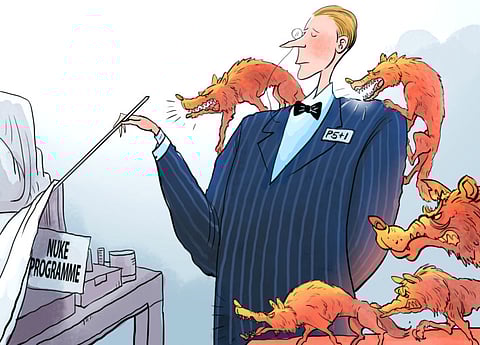
Last week, 47 Republican senators sent a letter to Iran’s leaders in a transparent (and somewhat passive aggressive) attempt to derail the nuclear talks between Tehran and the P5+1 (US, Britain, France, Russia, China + Germany).
Lost in the resulting political tempest was an essential, if rather basic fact: For all of the progress the two sides have made over the last 18 months, there is still a real chance that no deal will eventually be reached (by which I mean a real, long-term, deal as opposed to another extension or interim agreement). Just as important is the fact that even if a deal is struck hardliners on both sides may manage to kill it without any extra help from Senate Republicans.
The key question is whether anything that may come out of these talks can win acceptance in the relevant capitals, which, in practice, means Tehran and Washington. I do not mean to dismiss the importance of the other P5+1 capitals, but it is only realistic to acknowledge that the mere idea of an agreement faces institutional obstacles in America and in Iran itself that are (mostly) not an issue in London, Paris, Moscow, Beijing and Berlin.
Since I do not pretend to any expertise in Iranian politics, this analysis will focus on Washington, but it is worth saying that whatever else the Senate Republicans may have done last week, they have surely handed talking points to anyone in Tehran who believes America is not negotiating in good faith or that its word cannot be trusted.
US President Barack Obama captured the situation well when he told reporters “it’s somewhat ironic to see members of Congress wanting to make common cause with the hardliners in Iran”. In a separate interview with Vice News a few days later he said of the letter’s signatories: “I’m embarrassed for them.”
According to numerous media reports the broad outlines of the agreement being negotiated between Iran and the P5+1 involve an easing of sanctions in exchange for Iran cutting the number of centrifuges it possesses/operates, agreeing to a strict inspection regime and shipping most of its existing nuclear material out of the country, probably to Russia. The result would be to lengthen Iran’s ‘breakout window’ — the period of time it would require to produce a nuclear weapon — from a few months to a year or more, at least as long as the agreement remained in place. The change in the time frame is important because it buys the western powers time to do something about an Iranian nuclear breakout, at least in theory.
Most reports say the agreement currently being negotiated would be time-limited (Iran is said to want it to last no more than seven years while the P5+1 supposedly want a 10-15 year time frame) and when it expires Iran could, in theory, start making all the nuclear fuel it wants. The hope is that by that time enough confidence would have been built up on both sides that this would no longer be an issue. Opponents of an agreement assume it will allow Iran time to hone its technical expertise while waiting for the moment when enrichment can begin again.
As Henry Kissinger succinctly put it: “The impact of this approach will be to move from preventing proliferation to managing it.” Whether or not that is a good and desirable depends a lot on one’s point of view.
The argument put forward by Israeli Prime Minister Benjamin Netanyahu when he addressed the US Congress earlier this month explicitly rejects this. Netanyahu called for any agreement to require a complete, verifiable dismantling of all Iranian nuclear infrastructure along with significant changes in Iranian foreign policy, both practical and rhetorical. Many Americans on both the left and the right back this approach.
The counter-argument is that countries that are truly determined to obtain a nuclear weapon will, eventually, succeed in getting one (cases in point: Pakistan and North Korea). So the question ought not to be ‘how can they be stopped’ but, rather, ‘how can they — and their ambitions — be contained?’ It is an approach that is less dramatic, but more realistic.
A blunter question that is not often asked in Washington, but ought to be, is who favours war sooner rather than later as a method of stopping the Iranian nuclear programme? Many members of the US Congress openly advocate a hard line, but very few also openly support military action against Iran, despite the fact that it is clearly implied in the ‘hard line’ they espouse. Yet, in rejecting diplomacy, or at least an achievable diplomatic agreement, these same members are implicitly supporting the use of force against Iran. What few are willing to address is the question of what would happen next. Until that question is confronted directly and rationally, it is difficult to make the hardliners’ case against a nuclear deal.
Gordon Robison, a longtime Middle East journalist and US political analyst, teaches political science at the University of Vermont.


