The Oscars and Hollywood’s race problem
The American movie industry continues to ignore audiences of colour, to its own detriment, given the box office success of films that do feature diverse casts
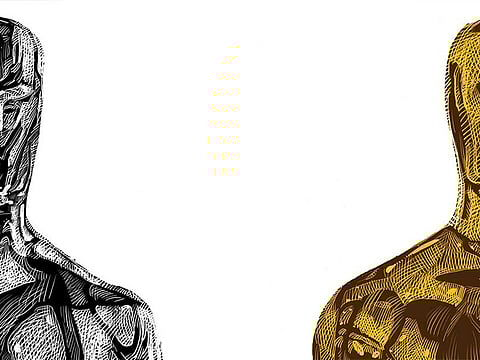
When we talk about diversity, or the lack thereof, we refer to it as “a problem”. This or that industry, organisation or group has a gender problem or a race problem or some other kind of diversity-related problem. We identify the problem and discuss it, exhaustively, often contentiously, because the problem is significant, pervasive, and for those of us who are most affected, the problem is personal.
Another year, another set of Oscar nominations. For the second year in a row, no black actors have been nominated. This profound absence is compounded by the Academy of Motion Picture Arts and Sciences’ robust history of overlooking the work of actors, writers, directors and other film professionals who are people of colour.
Hollywood has a race problem. Hollywood has always had a race problem. The movie industry continues to ignore audiences of colour, to its own detriment, given the box office success of movies that do feature diverse casts. It continues to ignore the simple fact that people of colour want to see their lives reflected in the movies they watch. Representation is not a lot to ask.
I love movies unabashedly. I always have. The cinematic spectacle grabs hold of me every time. Han Solo frozen in carbonite and Princess Leia choking Jabba the Hutt with the chain binding her to him. The defiance of Private Trip in pursuit of dignity in Glory. Julia Roberts as Vivian Ward in Pretty Woman triumphantly returning to the Rodeo Drive boutique that snubbed her, laden with shopping bags from other stores — big mistake, Monica Wright-McCall, at centere court, while her husband and daughter cheer her on in Love and Basketball. The ensemble of Furious 7, parachuting, in cars, from a cargo plane.
When I am at the movies, I lose myself. There is electricity running through my body. When I saw The Hunger Games, I wanted to jump up and shout because I couldn’t contain the emotion I was feeling. During Whiplash, I was speechless. Nostalgia and then sorrow overwhelmed me when I watched “The Best Man Holiday, not once but three times. I am awed by what it takes to make a movie, so many people and practices that have to come together. Movies, the best and worst of them, offer me indelible memories and so much pleasure. They offer escape. They are an art form to which I, as a writer, aspire.
That aspiration is thwarted, though, because movies don’t often feature people who look like me. I am not interested in writing movies about a sylph looking for love, living in New York in an improbably large apartment with a lot of natural light who never seems to spend much time at an actual job. I am not interested in writing movies about a white man who is on some kind of journey to find himself or avenge a wrong, whether in Brooklyn or the wilds of Montana and South Dakota. That there seems to be no place for people who look like me in movie making doesn’t keep me from writing or working, but I am constantly aware of the iron ceiling above me.
As of 2012, 94 per cent of academy voters were white and 77 per cent of those voters were men. The demographics of who makes movies, writes movies, edits movies, produces movies and stars in movies are equally stark. According to a 2014 report by the University of California, Los Angeles, on diversity in Hollywood, only 10.5 per cent of lead actors in movies from 2011 were people of colour and only 7.6 per cent of movies from that same year were written by people of colour.
When this year’s Oscar nominations were released, I wasn’t surprised. I was tired. I was, despite my fatigue, disappointed to see Ryan Coogler overlooked as best director and Michael B. Jordan overlooked for best actor for their work in Creed. I was frustrated that even if these men had been nominated, the Oscar nominations would still have been unbearably white.
Yet again, people of colour were told, both implicitly and explicitly, that our stories and ways of seeing the world are not as valuable. We were told we should be satisfied with the scraps of recognition received in years past.
There is, perhaps, some hope. A little more than a week after the all-white slate of nominees was unveiled, the academy’s governing board announced last Friday that it was going to make changes that might address the problem. It said it was committed to doubling the number of women and academy members of colour by 2020. Members will have their voting status reviewed every 10 years, and that status could be revoked if a member hasn’t been active in the industry within that decade. These are not immediate solutions and they may do little to improve matters, but at least the academy is acknowledging the problem. Meanwhile, we still must face Hollywood’s race problem as it currently stands.
In the debate that has followed the 2016 Oscar nominations, there is the usual outrage, disgust and, in some parts, indifference or thinly veiled contempt. Robert Redford, from the Sundance festival, said: “I’m not focused on that part. To me, it’s about the work, and whatever reward comes from that, that’s great. But I don’t think about it.” Redford, of course, already has his Oscar, and he doesn’t think about “it” because he has the luxury of not needing to.
Charlotte Rampling, who is nominated for a best actress Oscar this year, suggested that all this talk of Hollywood and diversity is racist against white people. “But do we have to take from this that there should be lots of minorities everywhere?” she asked. Let that sit for a minute. Hear what she is saying.
Michael Caine also had some insight, asking black actors to be patient because, well, it took him a long time to win his first Oscar. He also noted: “In the end, you can’t vote for an actor because he’s black. You can’t say, ‘I’m going to vote for him, he’s not very good, but he’s black, I’ll vote for him.’” Caine trotted out that old canard that the desire for diversity is the desire for the elevation of mediocrity.
Here, we have three veterans of the industry who appear to be positioning their white skin as the norm, as what deserves merit before anyone else receives consideration, as a marker of people whose experiences should be represented.
In the aftermath of the nomination announcements, the filmmaker Spike Lee and the actor Jada Pinkett Smith and her husband, Will Smith, have all stated that they plan not to attend the awards ceremony next month in protest.
The thing about a boycott is that there needs to be something at stake. I am not entirely clear what’s at stake if we skip the Oscars. The root of the problem is not the academy, which selects the Oscar nominees, though certainly we should turn our critical eye to those voters who seem to favour white filmmakers and who tend to reward only a kind of “diverse” movie that centres struggle as the mainstay in the black experience. They are just one part of a much larger, wholly diseased, industry.
The root of the problem is that there just isn’t enough filmmaking by people of colour. There isn’t enough work in the pipeline. And not only are black actors and filmmakers overlooked by the academy, so are artists of other races and ethnicities. As often as we have conversations about this problem, the conversation remains desperately narrow. There are a great many of us demanding a rightful place in the filmmaking world while the burden of keeping “problem” conversations alive, and the burden of providing solutions, also falls to us.
Actors and filmmakers of colour can and should take the stands they choose, but white people in the movie industry need to step up and spend less time complacently revelling in their privilege. White actors and filmmakers need to do more than offer a few thoughtful words in interviews. They need to unequivocally acknowledge the very real diversity problems that continue to go unsolved. They, too, need to stay home from the Oscars. They need to turn down projects that are monochromatic both in front of and behind the camera. They need to take on this problem as their own.
If we’re going to boycott the Oscars, we also need to boycott the movie studios determined to ignore the box office success of movies featuring people of colour. We need to boycott the people who are so reluctant to produce movies made by people of colour. We need to boycott this system that refuses to acknowledge life beyond the white experience as rule and not exception. As a movie lover, I take no pleasure in the prospect of staking out such a hard line so that people of colour might be heard and ultimately represented on the silver screen, but Hollywood has left us with little choice.
— New York Times News Service
Roxane Gay is an associate professor at Purdue University, the author of An Untamed State and Bad Feminist.


