Tackling Karachi's recurring turmoil
The government must find a solution to the unrest along with Pakistan's diverse political parties
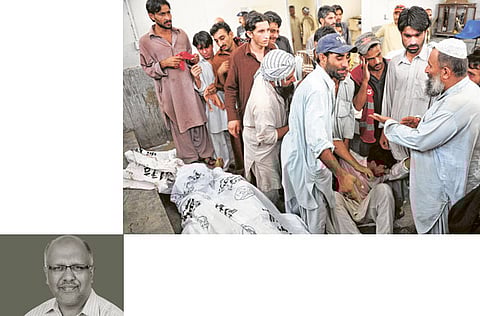
The recent bloody violence in Pakistan's city of Karachi has once again raised questions about the country's stability. Though exact details of what triggered this latest round of bloodshed remain unclear, anecdotal evidence clearly suggests that the killings and counter-killings have involved members of the Urdu speaking ‘mohajir' community many of whom belong to the Muttahida Qaumi Movement (MQM) versus the ethnic Pashtun community members.
It is still not clear, exactly how this latest round of bloodshed in a city which is Pakistan's economic hub, will eventually play itself out. The government of President Asif Ali Zardari in its first reaction has promised to enforce the law at all costs. Responding to the escalating violence, Pakistan's Interior Minister Abdul Rehman Malek ordered 1,000 fresh paramilitary troops to be deployed on the streets of Karachi. But the violence and its aftermath is much more complex than a simple matter of law and order which needs to be curbed through firm action.
It is clear that continued turmoil of the kind seen in Karachi in the past few days is just not a sustainable trend when juxtaposed against the need to move Pakistan forward. Karachi is home to Pakistan's financial empire, business interests and the country's main stock market. Sustained violence on the streets of Karachi will likely cripple the country's already weak economy at a time when the economic performance is in clear need of an improvement.
With the stakes running so high, it is clear that events in Karachi cannot be treated like business as usual. The government's resort to the use of force through the deployment of additional paramilitary soldiers appears to be more of an administrative step which will likely not tackle anything but the immediate symptoms of this ordeal. A series of longer term measures must be built upon several vital pillars.
To begin with, the ruling coalition led by Zardari's Pakistan People's Party (PPP) must accept its own responsibility for letting conditions slip to the point where they lie today. Till recently, the PPP ran the government in partnership with the MQM. That association meant, there were times when instead of ordering tough action against powerful groups in Karachi which may now be fuelling the violence, the government chose to ignore the threat. A similar attitude was adopted towards the Awami National Party (ANP) — the main national political party with most of its supporters drawn from the Pashtun community. Additionally, a succession of Pakistan's ruling political parties including the coalition which presides over the country today, have all chosen to ignore the socio-economic dimensions of a recurring crisis. By some accounts, up to one third of Karachi's population lives below the poverty line with many impoverished people potentially fuelling the unrest.
Bloody cycle of violence
They include young, unemployed youth and many who have become drug addicts and turned to crime to earn their livelihood. Left without the hope of living a life of promise and prosperity, it is clear that these individuals will be ready candidates to join an abrupt but vicious and bloody cycle of violence.
While some of the challenges faced by Karachi may not have an immediate solution, there has to be a next step to begin curbing the violence. Measures such as a strong push to bring a diverse group of political parties to the table including the MQM and ANP must be the top item on the government's agenda in dealing with the situation. Given the discord between the PPP and the MQM, that may sound like a tall order. But it is important to understand that unless a strong enough political push gathers momentum quickly, measures like deploying more troops will only bring about limited results. In achieving this objective, Zardari may be forced to expend some of his own political capital but doing so is important in the interest of achieving a higher objective.
While the PPP-led government deals with events in Karachi, the ruling coalition must also appreciate the wider challenge it faces across Pakistan. Some of the most important issues related to human welfare, notably the need to revamp basic services like healthcare and education are waiting to be tackled.
This is an urgent challenge in the light of some powerfully compelling realities such as the fact that one-third of Pakistan's population is living below the poverty line. Left unattended indefinitely, each one of these situations can return to haunt the future of Pakistan just as the country is reconciling itself today with the events in Karachi.
Farhan Bokhari is a Pakistan-based commentator who writes on political and economic matters.


