Standing united against Isil extremists
Today the average Muslim is realising that fundamentalism is a serpent that once created cannot be controlled and will finally bite its creator
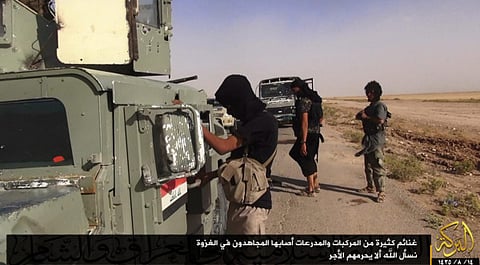
Benefits of Islamic State of Iraq and the Levant (Isil)? What benefits could this bunch of criminals have, who kill in the name of religion, who cut the hands of an eight-year-old boy, who capture women under 35 to make them sex slaves? Yet everything has a benefit, even the worst disasters.
Many factors led to the radicalisation of Sunnis. This started with US pro-consul Paul Bremer’s decision to disband the Iraqi army following the fall of Saddam Hussain’s regime in 2003. Officers and soldiers who served under the Baath regime became outlaws. To add to the calamity, the US-backed Prime Minister Nouri Al Malki, who installed a sectarian regime that excluded Sunnis and further persecuted the former Baath officers and their families. Eleven years of persecution resulted in embittered Sunnis, who were ready to make a deal with the devil in order to seek salvation. This is how initially Isil was able to attract former Baath loyalists.
In Syria, the conflict that started between the Bashar Al Assad regime and the secular rebel group — the Free Syrian army, whose members were mostly soldiers who defected from Syrian army — metamorphosed into a sectarian confrontation. Hezbollah joined the fight to back up Al Assad, and Islamist groups like Jabhat Al Nusra intervened on the other side and diluted the secular opposition. Clerics in Iran started issuing fatwas that those who fight with Al Assad will be martyrs as they are fighting the Takfiris. Hassan Nasrallah, the leader of Hezbollah, stated that he was sending fighters to protect the tomb of Zainab, the granddaughter of Prophet Mohammad (PBUH) from the assault of the “Umayyads”.
In Lebanon, the rise of Hezbollah and its involvement in Syria led to a reaction on the Sunni side. The Salafist movement that had kept a low profile for years and avoided politics became politically active following this intervention. The Ahmad Al Assir phenomenon was a byproduct of this wave of radicalisation.
All these factors provided a fertile ground for Isil: impoverished, persecuted people make perfect recruits for the fundamentalists. However, Isil took fundamentalism to a new level.
Today, Isil is the face of fundamentalism, However, it is such an ugly face that every single Muslim will refute it and fundamentalism with it. This can be noticed in Lebanon, by comparing the polarised reaction to the confrontation between Ahmad Al Assir and the army two years ago with the reaction to the current army confrontation with Isil in Arsal. Today, the Lebanese — Christians and Muslims, Sunni and Shiite — stand united in denouncing Isil and their fundamentalist agenda.
In Iraq, Ayatollah Ali Al Sistani blamed sectarianism for the instability plaguing the country and asked all Iraqis to stand united to fight it. Therefore, Isil was the main reason behind the rejection of Al Maliki, who finally resigned on Thursday night. He had become a Shiite Saddam Hussain and had instituted sectarianism. Isil even gave a wakeup call to the American administration, that realised that the sectarian government was partially responsible for the emergence of a group like Isil. This is why Obama called for a unity government that “does not exclude anyone”.
Fighting fundamentalism has been a tedious task for all Arab governments. Saudi Arabia launched a counterterrorism programme which, in addition to detecting the channels of financing and the recruitment and training locations of terrorists, aimed at fighting fundamentalism and at promoting the concept of moderation and tolerance in order to undermine any justification for extremism. Though the Saudi effort was quite successful in containing terrorism, fundamentalism remains a threat to Saudi Arabia as well as to other Gulf and Arab countries.
The Arab Spring revealed many fundamentalist trends that were dormant during the reign of the dictatorships. People who were oppressed under brutal regimes saw in fundamentalism a refuge. The Muslim Brotherhood gained support with the slogan “Islam is the solution”. Given the miserable realities of Arab societies and the despair the Arab nation experiences, many looked at the previous caliphates, guided by the Islamic rule, as the golden era of Arabs and Muslims. However, when Arabs and Muslims see the barbaric actions of Isil, who seek to restore the caliphate, they will reject them and their scheme.
Today the average Muslim is realising that fundamentalism is a serpent that once created cannot be controlled and will go back and bite his creator. The other benefit of Isil is that Sunnis and Shiites are realising that they need to stand united to fight the ailment that is eroding their societies: Sectarianism.
Dania Khatib is a communication specialist. She was recently awarded a PhD in politics from Exeter University, UK.


