Senators Rand Paul and Marco Rubio: The Republican future
It will be interesting to see if both men will make sharper ideological pitches, since that is the attribute they can point to that shows the greatest differentiation
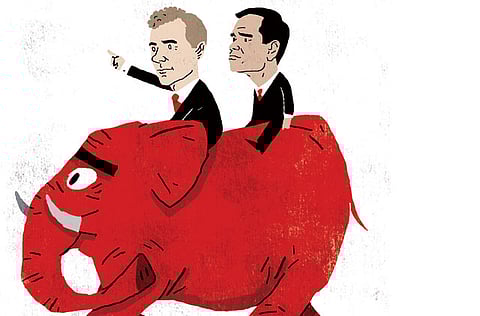
The fascination with Senators Rand Paul and Marco Rubio is understandable. Both are young and ambitious Republicans in a party looking for its next leader. They are charismatic risk-takers who can talk to the media beyond just Fox News. Also alliteration may be destiny. Headline writers cannot resist writing the Rand-and-Rubio combination. Both men are also considering running for president. We should leave them to their hobbies. It is three years until the next primary and it is silly to assign too much presidential weight to anything they do now. (Though it is not crazy to imagine people returning to the Rand Paul filibuster of 2013, the way they did Barack Obama’s convention speech in 2004).
However, even now, the presidential jockeying of these two men is interesting in another context. It tells us something about the Republican Party they would hope to lead. The GOP [Grand Old Part] is going through a molting period. The route each man charts and how successful he is in capturing arguments of the moment — on immigration, drones and whatever else comes up — will tell us something about what the emerging Republican Party values and what it might look like as it tries to get in shape for the next national contest.
If the Republican Party of 2016 embraces either of these two senators, it will be a radically different party. If either is elevated into a serious national candidate, it will reverse two old truths about presidential politics: That opposition parties promote candidates who are distinct from the sitting president and that governors have the advantage over senators. Parties often nominate candidates that represent a clean break from whoever is in the White House. The youthful John F. Kennedy was a contrast to the ageing Dwight Eisenhower.
Ronald Reagan, the man of certainty, came after the always vacillating Jimmy Carter. The feel-your-pain governor Bill Clinton was a counter to the aloof patrician George H.W. Bush. Bob Dole, the war hero of the Greatest Generation, was supposed to be an antidote to Clinton the Baby Boomer and in 2000, after four more years of Bubba and his personal transgressions, Republicans nominated the born-again George W. Bush who promised at the end of every speech to restore honour and dignity to the Oval Office.
Simply having a different ideology than the sitting president is generally not enough. Opposition parties always offer a different policy view, but in picking their standard bearer, they have historically decided he should also be made of different stuff. This extra differentiating attribute is one of the reasons moderate candidates have often beaten more liberal or conservative candidates: Mitt Romney over Rick Santorum, Barack Obama over John Edwards, John McCain over everyone else, John Kerry over Howard Dean, George W. Bush over Steve Forbes, Bill Clinton over Tom Harkin, Bob Dole over Phil Gramm and Pat Buchanan. The search for differentiating attributes makes sense when the president has been in office for some time. That is because the other party has been consistently tying his policy failures to his character flaws. That allows the opposition to wrap its partisan criticisms within deeper truths.
So, Obama has been a bad president because he has no executive experience. He does not know how to make decisions because he has never run anything. Another flaw is that his political success was built on a series of good speeches. That should have warned Americans all along that he was only good at “playing” a politician, not at actual governing. Finally, Obama is a radical. He came to prominence with the support of the far left that opposed the Iraq war. That connection with the party’s extreme wing has always defined his essential character. These are three of Obama’s flaws.
They are also three attributes of Marco Rubio and Rand Paul. Neither has really run a big enterprise. Both will rise to national prominence on the strength of their speeches — that is all that senators can do — and both are seen by activists as the true representatives of their core beliefs — though obviously Paul and Rubio are favoured by different kinds of activists.
If a candidate holds the very attributes his party has been arguing are so damaging, you may think that will undermine his pitch. Fortunately for these candidates, politics is not rational, so partisans will just stop believing these are catastrophic shortcomings when their favourite fellow happens to have them.
Still, these similarities to Obama leave fewer ways for these two men to distinguish themselves from the Obama years (and each other) in a national contest. It will be interesting to see if both men will make sharper ideological pitches, since that is the attribute they can point to that shows the greatest differentiation.
If either of theses two senators makes a serious go of it, he will also challenge the historical preference for governors. Both parties have liked men that hail from the statehouse: Jimmy Carter, Reagan, Michael Dukakis, Clinton, Bush. Four of the last five US presidents have been governors. That is logical: Governors do a lot of things that presidents do. They have to pick a staff and delegate enormous responsibility to them, negotiate with interest groups, battle with a legislature and make hundreds of decisions when avoiding them is not an option.
There are very few senators who prefer their life in the Senate to the sense of accomplishment and agency they had as governors. Governors also shoot straighter, if for no other reason than they are habituated to explaining actions where they cannot duck accountability. The buck stops at their desk.
Legislators are expert at diffusion. They take more credit than they deserve for the collective legislative process and elude blame on controversial matters by citing the process. “I was for it before I was against it,” as former senator John Kerry once said. There is also a political reason to pick a governor. They work outside Washington. Voters are often looking for figures unstained by the system.
The authors of the recent GOP “autopsy” report are also enamoured of governors for another political reason. They represent a synthesis between GOP principles and a reality that has led to electoral success. There are 30 Republican governors and the Congress is less popular than head lice. Which is the better farm team? It seems only natural that GOP voters will pick from their stable of Republican governors or former governors — someone like Chris Christie, Bobby Jindal, Jeb Bush or Scott Walker.
If Republicans do not rally around their governors, they will be making a conscious choice to ignore all of these arguments in favour of some other attribute they value more highly. And we see that happening as Governor Christie of New Jersey and Governor Bob McDonnell of Virginia are heckled for not being conservative enough. At the moment, ideology trumps experience in the Republican Party, which is extraordinary since a lack of executive experience has long been presented as one of Obama’s signature flaws.
Rubio and Paul have three possible roads they can take. They can reach the usual historical place occupied by the likes of Senator Howard Baker, Senator John Glenn and Senator Bob Kerrey — men who looked like presidential material until a governor came along. Or, they can wind up like Senator John McCain and win their party’s nomination, but flame out in the general election. The best possible outcome is to follow Obama’s route. But it is not entirely up to Rubio and Rand. Which road they have available to them will depend on how much the Republican Party is willing to change.
— Washington Post
John Dickerson is Slate’s chief political correspondent and author of On Her Trail.


