The most important people in our lives may be the easiest to overlook
In a fast-moving world, gratitude begins with paying attention to those around us
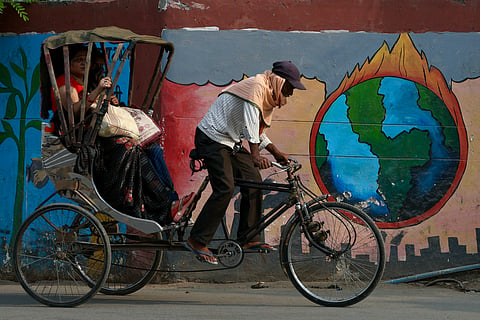
I still remember sitting in the back of a cycle rickshaw and being taken to school as a child. I was around eight years old, and for nearly two years it became part of my everyday life. The same man, the same morning route, the same silence between us. A few coins exchanged at the end, a brief nod, and I would get down and walk away, as if that journey had taken nothing from anyone.
Only now does that moment stay with me and I often think of that man and the life he probably led.
There are some names from my childhood I still remember clearly, as if they belong not to a distant past but to something still quietly present in memory: my ayah (housemaid), the cook, and the rickshaw puller who took me to school every morning without fail. And yet, when I think back, I cannot recall ever truly thanking them in a way that matched what they gave and what they did for our family by way of loyalty, dedication and commitment .
Awareness that arrives late
That thought does not come as regret. It comes as awareness that arrives late — when life slows down just enough for us to notice what we once moved through, without noticing at all.
Also Read: We don’t always learn from people we admire
As a child, life is not something you observe. It simply happens around you in a way that feels natural and fixed. Food appears on the table, clothes are ready when needed, the school bag is packed, the tiffin is ready, and transport arrives like clockwork. You move through it all without ever pausing to ask what makes any of it possible.
Slowly, people begin to fade from attention — not because they matter less, but because life trains us to move faster than reflection.
That pattern continues as we grow.
The taxi driver who takes us home when we are too tired to even speak. The delivery rider in Dubai standing outside a building in the heat, waiting quietly with a parcel in hand while life continues indoors. The watchman at the society gate who opens the barrier with the same calm nod every morning, whether he is noticed or not. The supermarket staff packing our bags while our mind is already elsewhere.
We see them, but we rarely register the person behind the role.
It is not unkindness. It is speed. We begin to believe that once payment is made, the interaction is complete.
But it never really is.
A pause in our pace
Because a thank you is not just politeness. It is a small pause in our pace, where we recognise something easily forgotten: there is a person behind a role, a life behind a task, and a day that continues long after we have moved on.
I was taught this early. Adults around me insisted on “thank you” and “please” until it became instinct. That habit has stayed with me, and I am grateful for it. But habit is not awareness, and I often catch myself saying the words without fully seeing the person in front of me.
And I suspect I am not alone in that.
Also Read: What my mother gave the economy for free
We are not people who refuse to thank. We are people who often forget to mean it while we do. Are we, as a species, becoming callous?
Those who carry, serve, and quietly hold up the background of our lives are often the least seen as individuals, even when they are most present in our days.
This is where something quieter enters — not just life, but leadership.
Leadership - the ability to notice what others overlook
Because leadership is not only about direction or decisions. At its simplest, it is the ability to notice what others overlook.
A good leader notices the watchman at the entrance who greets every morning without recognition, the cleaner moving through corridors without being seen, the person opening gates before the day begins. A small greeting, a nod, a moment of acknowledgment — these are not small to the person receiving them. They restore visibility where it is easily lost.
In that sense, noticing is already a form of leadership.
And then there is another layer that sits much closer to home.
Our parents.
We all know that they are the first and longest-running example of people who give without keeping count. Food, care, safety, stability — it all arrives so consistently that it begins to feel natural, almost effortless.
Lifetime of effort
But behind that ease is a lifetime of effort that only becomes visible much later in life — worries carried quietly, sacrifices made without announcement, needs postponed without hesitation - all out of unadulterated love.
And slowly, what was once love begins to feel like expectation. We stop saying thank you- not because it is unimportant, but because it feels unnecessary.
Yet maybe that is exactly where gratitude matters most.
Not when it is obvious - but when it is forgotten.
So perhaps the real question is not whether we say thank you. It is whether we are still paying attention.
Because I still think of those years in the cycle rickshaw, the morning road already moving before the world felt fully awake, and a gaunt old man pedalling quietly as if my beginning depended on his effort.
And I realise how often life still moves in the same way — people carrying moments of our day forward while we step out of them without noticing.
And I no longer want to let that pass without seeing it.
Michael Guzder is Executive Vice-President ‑ Education at GEMS


