Replacing leaders isn’t a ‘disease’, it’s a normal part of Australian democracy
The last time New South Wales had a premier who won an election and then left office by losing an election was 1927-30. Is that such a bad thing?
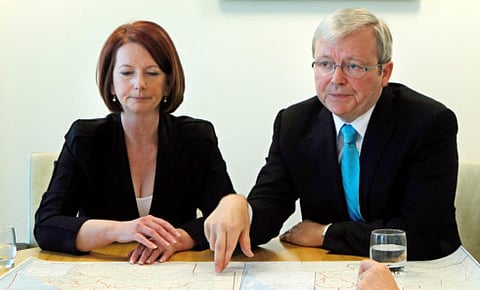
Much has been made of the so-called ‘New South Wales disease’ of chopping and changing leaders. The Queensland premier, Anna Bligh, coined the phrase in 2010 as she fought to stave off a challenge to her leadership amid poor poll results. The ‘NSW disease’ has been blamed for the revolving door of prime ministers during the Rudd-Gillard-Rudd years, and the Coalition’s willingness to mimic the tactic by dumping Tony Abbott for Malcolm Turnbull.
History shows, however, that NSW’s habit of losing premiers outside elections is not so much a disease as a lifelong condition. Consider the 10 premiers who served NSW in the past 40 years. Only three left office by losing an election: Barrie Unsworth, John Fahey and yours truly. Not one of us became premier at an election.
Two — Neville Wran and Bob Carr — won elections, served a few terms in office, but then resigned before the negative impacts of long-termism set in.
Another two — Barry O’Farrell and Nick Greiner — won elections but then resigned under an Independent Commission Against Corruption (ICAC) cloud. O’Farrell resigned for misleading ICAC. Greiner resigned after ICAC questioned his integrity in the Metherell affair. The NSW court of appeal subsequently overturned ICAC’s findings against Greiner.
Two more premiers resigned when their parliamentary colleagues lost confidence in them: the election-winning Morris Iemma resigned when his caucus refused to back a proposed reshuffle, and his successor, Nathan Rees, resigned when he lost a leadership challenge. Mike Baird won an election but then resigned for family reasons. While this is undoubtedly true, it is also the case he left a few gnarly problems behind for his successor, Gladys Berejiklian.
When Baird resigned, my teenage son asked me, “When was the last time in NSW that a premier came to office by winning an election and then left office by losing an election?”
The answer: 1927-30, Thomas Bavin (Nationalist party).
NSW Labor gets criticised for having four premiers in its last 16 years in government. By NSW standards, that’s amazingly stable. Consider that on 20 December 1921, NSW had three governments in 24 hours. Sir George Fuller was premier for a whole seven hours that day.
The current NSW Coalition government hasn’t come close to this record but it is doing its level best to beat four premiers in 16 years. Six years in and they are up to their third premier and I wouldn’t bank on them being done yet.
I’ve heard more than once that, when meeting with stakeholders, Coalition ministerial staffers in NSW openly canvass leadership frustrations and potential replacements for Berejiklian. This is ridiculous behaviour from staff but it goes to show that the leadership tensions still simmer. Berejiklian hasn’t had the smoothest of starts, with one member of her party already threatening to defect. It is unfortunate that she was elected leader unopposed. Without a ballot, she cannot point to the strength of her support in the caucus.
Two factors will protect Berejiklian for a little while: one, she only just got there, and two, the leadership of the federal Liberal party is a more live and febrile situation. Malcolm Turnbull is tracking too comfortably towards his own benchmark of losing 30 Newspolls in a row. (As of Tuesday, he’s up to 10 consecutive losses.) He needs to land the upcoming budget and land it well. He needs to find a new pitch and a policy platform that will excite voters. It may be too late, with predictions that Turnbull will be replaced before the next election already being made.
Before the wailing about the revolving door of prime ministers starts up again — and the finger pointing to NSW for infecting the nation with this “disease” — let’s remember a few things. Just because Malcolm Fraser, Paul Keating and John Howard won and lost elections doesn’t mean that this is the norm in Australian democracy. Maybe these three PMs just loom large in the memory of everyone under 50. Maybe we’ve all forgotten the record of our other prime ministers: Bob Hawke (resigned), Gough Whitlam (sacked), William McMahon (won a leadership challenge, lost the next election), John Gorton (lost a leadership spill), John McEwen (fill-in after Harold Holt’s disappearance), Holt (lost at sea), Robert Menzies (resigned, twice), John Curtin (died), and on it goes.
Here’s the thing about my son’s question: the premise is wrong. It assumes that Australian democracy operates like the US system. He can be forgiven for this, as this is how Australian political parties campaign, how Australian media report, and how most Australians think about who to vote for: witness the persistence of the “preferred prime minister” question in polling.
But Australian democracy is a Westminster system. As one astute political observer, Niki Savva, notes: when unsuitable leaders are removed, it isn’t a sign that the system is broken. It is a sign that the system is working as it should.
To that, I would add, working as it always has.
By the way, my pick for the fourth NSW Coalition premier since 2011: Anthony Roberts. Keep an eye on him, Gladys.
— Guardian News & Media Ltd
Kristina Keneally is a former premier of New South Wales


