Redefining contours of a peace dialogue
The motors that tip the scales in India-Pakistan relationship are already at work
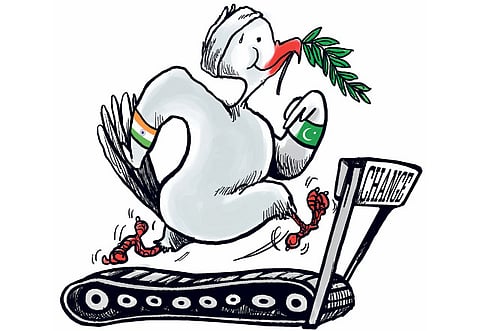
As the secretary-level talks between India and Pakistan wound down to a brusque finish, headlines all over the world scrambled to draw a red line between success or failure. The Indian prime minister's remarks in Riyadh brought some emollient to a crusty diplomatic stand-off, while the terrorism precondition still hung in the balance. Islamabad's response to coercive diplomacy remained cool.
Despite all the posturing, both sides are aware of the need for talks to go on. New Delhi and Islamabad know that they need to negotiate a shade of grey that invests in the process as much as its progress. At the foreign secretaries encounter, no date was announced for resumption of dialogue, but no closure was stated either. Both sides said talks must focus on stated priorities, while neither yielded ground on tangible means. The fact that there was no joint press conference, or even communique, brought forth alarm from all over the globe.
No surprises, actually. Did anyone really think that the two countries' top diplomats were mandated for even a minor breakthrough? After three major wars, two smaller battles, and half a century of conflict and bitterness, choices for change are not made at any level less than the head of both governments. The Saarc (South Asian Association for Regional Cooperation) summit in April is where the leaders of both warring nations can either let the ice begin thawing, or reinforce the culture of rivalry.
By then, though, we may have many more buttons being pushed as many countries now seem invested in this dialogue, including a pro-active Riyadh. One critical factor is that in the new regional equation, Pakistan holds many of the cards. By leveraging its role as the key neighbour in Afghanistan, Islamabad has begun to redefine the contours of the conflict in a theatre where almost all counterinsurgency plans by the US-Nato alliance have gone pear-shaped. There is no denying that the only game-changer in the battlefield can now be a shift in anti-Taliban operations across the Durand Line. By arresting over much of the dreaded Quetta Shura Taliban, Islamabad has demonstrated two things: that it can swoop down tactically where the US has been unable to tread, and that if given the right strategic incentive, it can draw down on fresh reserves of political will. India was at pains to avoid the word mediation, but clearly, New Delhi hopes that the Saudi card may give it a seat at the Afghan table, as well open a channel as interlocutor to Islamabad.
As it stands, the motors that work to tip the scales on this razor-edge between war and peace are predictably already at work. Almost as soon Pakistan's Foreign Secretary, Salman Bashir, crossed the Wagah border into Lahore, the debris from the Taliban attack in Kabul, where Indians were also killed among others, infected the air. The Jaish-e-Mohammad disclaimed their hand in it, blaming it on a fidayeen Afghan attack, but the terrorists who always seek to disrupt talks reminded everyone how they can affect both headlines and deadlines in this terrain.
At the same time, New Delhi chose a bad moment to test its $32 billion (Dh117.69 billion) war machine and its readiness near the Pakistan border. Nor did it invite Islamabad to send a military attache to witness the exercises, when 30 others were called in as observers. But in the mixed signalling so typical of both players to this tango, the Indian prime minister opened a track by stating that there is no alternative to dialogue with Pakistan.
So what are the prospects for building the "greater trust" that both players seek in such a fraught environment? Even though home-made labels do stick best, dialogue-failure marks a long history of bilateral engagement. New Delhi is overtly allergic to international players entering the room, more so when Kashmir is flagged. Islamabad is peeved about the fact that New Delhi was able to make Washington drop Kashmir from its special agenda in the region. And now we have the Saudis in the room. Although New Delhi denies it, all bets are on that the US played a quiet role in bringing the two nuclear adversaries to the table and there's little money on the talks going further without more prodding.
If New Delhi wants bilateralism to succeed, it must seize this opportunity to move everyone out of a dangerous curve in the neighbourhood. Islamabad too, must wake up to its responsibilities and finish what it started at cleaning up terrorist outfits at home. India must not let insecurity fuel its responses because it sees itself strategically finessed out of the formal Afghanistan endgame. In any matrix for regional stability, New Delhi will still remain a major player. It is the one looking most skittish now and if the talks flounder on the old bedrock of bilateral posturing, the entire region will pay the price in further instability and greater international meddling.
(Sherry Rehman is Pakistan's Former Information Minister. She is currently Member of Parliament's National Security Committee.)


