Palestinians show solidarity
With the peace process going nowhere, common experience on both sides of the Green Line is creating a new reality
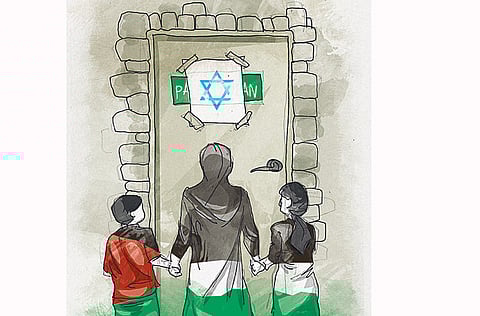
In a quiet street in the Shaikh Jarrah district of Occupied East Jerusalem 88-year-old Rifka Al Kurd is explaining how she came to live in the house she and her husband built as Palestinian refugees in the 1950s. As she speaks, three young ultra-orthodox Jewish colonists swagger in to stake their claim to the front part of the building, shouting abuse in Hebrew and broken Arabic.
There is a brief physical confrontation with Rifka's daughter as the colonists barricade themselves in to the rooms they have occupied since last winter. That was when they finally won a court order to take over the Kurd family's extension on the grounds that it was built without permission — which Palestinians in Occupied Jerusalem are almost never granted. It is an ugly scene, the colonists' chilling arrogance underpinned by the certain knowledge that they can call in the police and army at will.
But such takeovers of Palestinian homes in Shaikh Jarrah have become commonplace, and the focus of continual protest. The same is true in nearby Silwan, home to upwards of 30,000 Palestinians next to the Old City, where 88 homes to 1,500 Palestinians have been lined up for demolition to make way for a King David theme park and hundreds of colonists are protected round the clock by trigger-happy security guards.
Throughout the Arab areas of Occupied Jerusalem, as in the West Bank, the government is pressing ahead with land expropriations, demolitions and colony building, making the prospects of a Palestinian state ever more improbable. More than a third of the land in Occupied East Jerusalem has been expropriated since it was occupied in 1967 to make way for Israeli colonists, in flagrant violation of international law.
Israel's latest colony plans were not "helpful", Barack Obama ventured on Tuesday. But while US-sponsored Israeli-Palestinian negotiations go nowhere and attention has been focused on the brutal siege of Gaza, the colonisation goes on. It is also proceeding apace in Israel proper, where the demolition of Palestinian Bedouin villages around the Negev desert has accelerated under Benjamin Netanyahu.
The Israeli writer Amos Oz calls the Negev a "ticking time bomb". The village of Araqeeb has been destroyed six times in recent months and each time it has been reconstructed by its inhabitants. The government wants to clear the land and move the Bedouin into designated townships. But even there, demolitions are carried out on a routine basis.
The awakening of the Negev Bedouin, many of whom used to send their sons to fight in the Israeli army, reflects a wider politicisation of the Arab citizens of Israel. Cut off from the majority of Palestinians after 1948, they tried to find an accommodation with the state whose discrimination against them was, in the words of former prime minister Ehud Olmert, "deep-seated and intolerable" from the first.
Common cause
That effort has as good as been abandoned. The Arab parties in the Israeli Knesset now reject any idea of Israel as an ethnically defined state, demanding instead a "state of all its people". The influential Islamic Movement refuses to take part in the Israeli political system at all. The Palestinians of 1948 areas, who now make up getting on for 20 per cent of the population, are increasingly organising themselves on an independent basis — and in common cause with their fellow Palestinians across the Green Line.
Palestinian experience inside Israel, from land confiscations to colony building and privileged ethnic segregation, is not after all so different from what has taken place in Occupied East Jerusalem and the West Bank. The sense of being one people is deepening.
That has been intensified by ever more aggressive attempts under the Netanyahu government to bring Israel's Arab citizens to heel, along with growing demands to transfer hundreds of thousands of them to a future West Bank administration. A string of new laws targeting the Palestinian minority are in the pipeline, including the bill agreed by the Israeli Cabinet last month requiring all new non-Jewish citizens to swear an oath of allegiance to Israel as a Jewish state.
Pressure on Palestinian leaders and communities is becoming harsher. Meanwhile Israel is also demanding that the Palestinian leadership in Ramallah recognise Israel as a Jewish state as part of any agreement. Few seem to believe that the "peace process" will lead to any kind of settlement. Even Fatah leaders such as Nabil Shaath now argue that the Palestinians need to consider a return to armed resistance, or a shift to the South African model of mass popular resistance, also favoured by prominent Palestinians in Israel.
As for the people who actually won the last elections, Mahmoud Ramahi, the Hamas secretary general of the Palestinian parliament, reminded me on Monday that the US continues to veto any reconciliation with Fatah. He was arrested by the Israelis barely 24 hours later, just as talks between the two parties were getting going in Damascus.
The focus of the Palestinian-Israeli struggle has shifted over the last 40 years from Jordan to Lebanon to the Occupied Territories. With the two-state solution close to collapse, it may be that the Palestinians of Israel are at last about to move centre stage. If so, the conflict that more than any other has taken on a global dimension will have finally come full circle.
Seumas Milne is a Guardian columnist and associate editor.


