Pakistan's unfinished reform agenda
An increasing number of people see the nation's supreme court as their last ray of hope
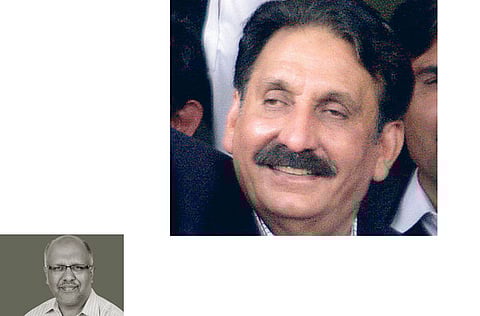
The tussle between Pakistan's ruling alliance and the country's supreme court and the apex court's principled stance on matters affecting the nation has done much to lift the feeling of uncertainty across the country.
While the court has repeatedly sought to press the government on matters ranging from constitutional affairs to allegations of corruption, Pakistan's ruling regime appears to have defied every such call.
In a recent development on this front, a key leader of the ruling alliance went as far as reportedly implying that the supreme court's posture may threaten Pakistan's democracy. In reality, nothing could be further from the truth.
The fact of the matter is that Pakistan's democracy would remain as shaky without a free and active supreme court as it would without a freely functioning parliament. One must complement the other in building the relevant pillars of a democratic civilian order.
But Pakistan's present-day rulers have done a great disservice to the cause of democracy by choosing to ignore the full spirit of the supreme court's orders. In choosing to defy the court, Pakistan's rulers have in fact chosen to harm a key institution of the democratic framework on which their own future rests. For the supreme court, which is ably led by Iftikhar Mohammad Chaudhary, the chief justice, it is vital to ensure the compliance of its orders by all concerned, notably the country's top elected leaders. Chaudhary, to his credit, returned as chief justice of the supreme court in 2009, two years after he was unceremoniously and illegally dismissed by Pakistan's former president Pervez Musharraf. His return as chief justice only materialised after Chaudhary inspired the most memorable movement by Pakistan's lawyers to not only press for his return but more importantly to demonstrate that there must be accountability for the country's head of state.
It is hardly surprising that Pakistanis across the country now eagerly look towards Chaudhary as not only their source of salvation from much that goes wrong across the country but equally vitally as the single vital individual who can force the government to mend its ways. This development could not have been more timely.
Across Pakistan, there is much evidence of a rapidly spreading breakdown of governance while the population at large appears increasingly disgusted over widespread corruption in high places.
Meanwhile, there is much to make ordinary Pakistanis feel traumatised in their daily lives. The breakdown of governance is clearly evident in Pakistan's essential services going haywire, a collapsing economy and a rapidly growing disintegration of the security environment.
Civilian rule
Despite the country surviving one of the most troubled times that it has ever seen, Pakistanis appear to be equally dedicated to continuing with their journey towards democracy.
While the Pakistan army has ruled the country for more than half of its life as an independent state, the popular yearning remains only for the continuation of civilian rule. Yet, it is clear that this democratic governance has to bolster its ability to improve lives for the ordinary Pakistanis.
In this background, the posture adopted by Pakistan's supreme court appears to have only won it popular admiration. As the court presses the government to mend its ways, it only gains popular approval for its choice. Going forward, it is essential for Pakistan's supreme court to continue upholding the rule of law, irrespective of how this is seen by some in the ruling circles.
Ultimately, Pakistan's supreme court will only win the day by upholding its principled stance rather than backing away from its present course. In the process, the best possible outcome will indeed be that of the government learning a lesson or two from the way it continues to mismanage Pakistan, all in the country's best interest.
But going by the history of Pakistan's present-day rulers since they came to power more than three years ago, it is difficult to imagine how an introspection will lead to reforms in the best interests of the country.
Tragically, deep-rooted reforms of the kind that are essential to take Pakistan forward may not necessarily suit the country's present-day rulers. With this dilemma stalking the people, it is not surprising that an increasing number of Pakistanis see the supreme court as being their last ray of hope in pushing for a long-awaited turnaround, in a country badly in need of reform.
Farhan Bokhari is a Pakistan-based commentator who writes on political and economic matters.


