Pakistan must ramp up foreign policy
The country has to widen its security dialogue not only with China but also with Iran
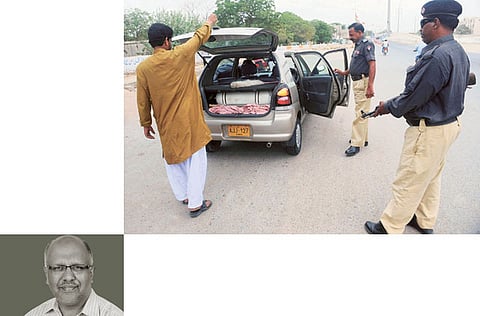
Pakistan's foreign policy in the past week has been dominated by an unusual challenge. A terrorist attack in western Chinese city of Kashgar on July 31 was quickly followed by claims, attributed to local Chinese officials, who pointed the finger of responsibility at Chinese militants trained in camps in Pakistan.
China and Pakistan have quickly sought to distance themselves from the attack while underlining the close nature of their relationship. Given that the two countries have been the closest of allies for almost five decades, it is likely that the fallout, if any, from the Kashgar episode will quickly become a half forgotten story.
But the event itself and links between militants in China and their supposed patrons in Pakistan raises multiple questions not just over the future of this critical relationship but indeed the future of Pakistan.
A similar challenge for Pakistan in the past have been accusations from Iran, pointing fingers at militants who carried out attacks on Iranian soil, allegedly with the backing of supporters based in Pakistan. Such cases raise the possibility of an alarming link between Pakistan's ability to deal with its domestic challenges and the way these could potentially undermine relations with some of its vital neighbours.
The need to track and destroy such links stares Pakistan right in its face at a time when the country is facing multiple domestic challenges. To name just a few, Pakistan's rulers today preside over a collapsing economy, a powerful insurgency along the Afghan border, disarray surrounding domestic politics and the failure of the government to improve governance. Taken together, it is not difficult to conclude that the country has become rudderless and simply incapable of rising from the ashes.
With this powerful combination of challenges also lies an equally powerful compulsion to survive. Pakistan, a country with a population of at least 180 million, also prides itself as the world's only Muslim country armed with nuclear weapons.
Many players
Given its significance to global affairs, there are many players outside Pakistan who would much rather see it come to grips with its challenges than simply erode as a state. But the lead to oversee a turnaround must come from Pakistan's own ruling elite.
Tragically though, so far, the ruling class appears to be caught in modes ranging from fighting fires to planning for the short haul. Given the scope of challenges faced by Pakistan and the intensity with which these challenges are growing, it is vital that the country's future interests are seen both through the prism of its internal as well as external circumstances.
New approach
As a matter of principle, Pakistan must take every conceivable step to prevent groups based on its soil from causing harm to any of its neighbours or even distant partners. Tolerating the presence of hardline groups, including those who claim to be nationalistic and pro-Pakistan in character, must only be done at the expense of Pakistan's best future interests. A new policy approach must be based on targeting all such groups, whether armed with agendas that are intrinsically against Pakistan or for that matter any other country.
The event in Kashgar and the subsequent entanglement of Pakistan-based groups in allegedly harming China's interests, must not be allowed to slip away as a one-off incident. Even if the alleged links between Chinese militants and their patrons in Pakistan are exaggerated, this is far too serious a matter to be easily ignored.
Pakistan's ongoing security cooperation with China needs to be improved further. Towards this end, it is additionally vital to widen the China-Pakistan security dialogue to include representatives from different parts of the public and private sectors. The end objective must be to work quickly towards creating more voices in both countries who are not only determined to preserve and promote this relationship, but to speak out publicly in each others' defence.
A similar exercise needs to be done in the case of Iran — a country with whom Pakistan has a variety of shared goals. At the same time, Pakistan needs to work vigorously too on improving its relations with India as well as Afghanistan — both of whom are among the country's important neighbours. While relations with India remain locked in the historical dispute over Kashmir, Pakistan needs to work aggressively with India to build up confidence as rapidly as possible.
The danger however is an obvious one. Looking back at Pakistan's history, a short-lived reaction based on lip service has often been followed by complacency. In Pakistan's best national interests, that complacency must not mark the road ahead following recent reports from Kashgar.
Farhan Bokhari is a Pakistan-based commentator who writes on political and economic matters.


