Obama must get tough
The president's leadership could depend on challenging his Republican rivals
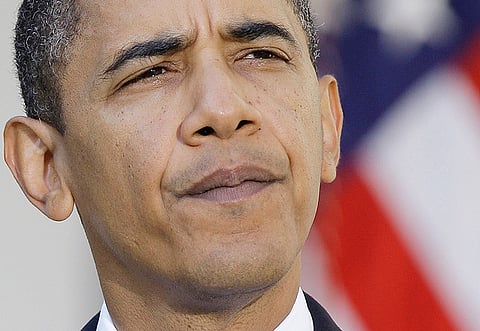
US President Barack Obama's political predicament is perhaps more serious than he understands or appreciates. He appears to see opponents as rivals to be charmed. What he should see are enemies determined to destroy his presidency.
To save the agenda for which he was elected, he must give up the pretence of being a post-partisan professorial president and start acting like an Oval Office tiger. He must get tough, not because populist rage polls well, but because his leadership depends on challenging those who challenge him.
It is pointless to extend a hand to those who desperately want him to fail. There is nothing Obama can say or do to satisfy Republicans. On January 30, he went to a GOP conference to enlist their support to be "partners for progress." Does he really think Republicans want to be his partners?
In his brilliant book, Shakespeare: The Thinker, the late Oxford scholar A.D. Nuttall notes, "It is sometimes said that political leaders require a ‘demonised Other' to retain control of their citizens. If the people are to be ruled they must first be scared." Nuttall cites the example of England's King Henry V needing a war with France to control insurrectionists at home.
Fear has its uses, then and now. George W. Bush had a colourless presidency until the 9/11 attacks. Then he acquired two enemies: Osama Bin Laden and Saddam Hussain.
Bush's vice-president, Dick Cheney, revelled in creating more enemies to enhance the administration's power: Muslims, Europeans, liberals, even ordinary American citizens who merely questioned the war in Iraq. This cynical strategy won Bush and Cheney four more disastrous years in office.
For several reasons, Obama can't or won't follow suit. It would be out of character for someone more scholar than brawler, more conciliator than demagogue. One of his heroes is Abraham Lincoln, who assembled a "team of rivals" Cabinet and who said: "I destroy my enemies when I make them my friends."
Even more salient is the fact that Obama is black and risks being seen as ‘uppity' and combative in a country still acclimating to its first African-American president. White congressional Republicans can savage him, but a black president can't reciprocate.
Convenient enemies
There is a grand tradition in Washington of creating enemies for the sake of political expediency.
No one was better at making or finding enemies than Richard Nixon. For decades, he accused opponents of being cozy with communists, a menace he greatly exaggerated. But, when he became president and later pals with the communist leaders of China and the Soviet Union, he exploited white fears of black street crime.
Harry Truman used the same communist threat to get his way with a miserly Congress.
Shortly after the Second World War, a depleted Britain needed reconstruction loans. Professor Walter Burdick of Elmhurst College told me: "Senator Arthur Vandenberg [Republican] of Michigan advised Truman to ‘scare the hell out of Congress' to get the money other Republicans wanted to use to balance the budget and pay for the war. Harry did it, and it worked."
Truman and every Democrat who ran for the White House for the next half century berated Republican Herbert Hoover for the Depression. Decades after the 1929 crash, I recall Jimmy Carter confiding that he "hated" to have to castigate "poor old Herbert Hoover," whom he confessed he really liked.
This is a crucial moment in Obama's presidency. It requires an element of leadership that he's so far not shown. Obama has read too much law and not enough Shakespeare. In Henry V, King Henry says, "In peace there's nothing so becomes a man as modest stillness and humility."
But Obama's political enemies war against him daily, so his only option may be to follow Henry's next words: "But when the blast of war blows in our ears, then imitate the action of the tiger; Stiffen the sinews, summon up the blood, disguise fair nature with hard-favor'd rage; Then lend the eye a terrible aspect."
Presidential politics is not for the faint of heart.
Walter Rodgers is a former senior international correspondent for CNN.


