Nation-building can never be achieved at gunpoint
The US has failed miserably in Iraq and Afghanistan
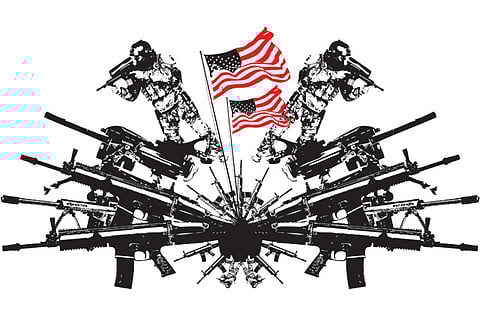
Many years ago the British historian and strategist B.H. Liddell Hart pointed out that the object of war should be to produce a “better state of peace”. If that is what earns a war a passing grade, then the US deserves a failing grade for Afghanistan and Iraq.
During the American occupation in Iraq between 2003 and 2011, as many as 250,000 Iraqis died and 1.4 million were displaced. Nearly 5,000 members of the American military were killed, with many thousands more suffering life-altering wounds, both physical and mental.
By most estimates, the US has spent about $3 trillion (Dh11.01 trillion) on its nation-building efforts. What has this huge investment of blood and treasure achieved? Iraq is still mired in low-grade civil war, with worrisome indications that it is escalating. By invading Iraq to depose Saddam Hussain and occupying the country for nearly nine years to rebuild it, the US has replaced one dictator with another strong-arm leader. And that leader, Nouri Al Maliki, is closely aligned with America’s primary foe in the region, Iran.
Then there is Afghanistan. Since early 2002, more than 2,000 Americans have been killed there, with many more seriously wounded. Thousands of Afghan civilians have been killed too. The US has spent close to $1 trillion trying to turn Afghanistan into a modern, functioning state.
What has the US achieved? The place is more violent today than it was at the height of the Afghan surge of troops under Gen Stanley McChrystal in 2009, the government is one of the most corrupt in the world, and the ability of the Afghan security forces is dubious at best.
Would Afghanistan have been worse off today if the US had left soon after toppling the Taliban and crushing Al Qaida? Remember, the US had essentially accomplished its core political objective in Afghanistan — the destruction of Al Qaida there — by early 2002.
Vietnam hangover
Yet, even with all this evidence that nation-building operations conducted at gunpoint don’t turn out well, some policymakers hold fast to the idea that these kinds of operations are crucial, arguing that the US has achieved many of its goals in Iraq and Afghanistan. The purveyors of this notion are deeply attached to a narrative that emerged from analysis of the Vietnam War and took hold during this past decade of American wars in Iraq and Afghanistan.
This story holds that nation-building wars in foreign lands can be won, as long as the hide-bound conventional armies that fight them then transform themselves, led by “saviour generals,” into nation-builders. This is the view embraced by popular historian Victor Davis Hanson, who has argued that by the end of 2006, it appeared the war in Iraq was lost, only to be saved by the “maverick saviour general, David Petraeus”.
Considering the current conditions in Iraq, it is hard to take Hanson seriously. But the narrative is important because it continues to be deployed to convince people that American wars in the troubled spots of the world can be made to work as long as the US military tweaks its tactics under the tutelage of generals like Petraeus.
One of the leading proponents of the efficacy of American nation-building operations, retired Army Lt Col John Nagl, has acknowledged that America’s wars in Iraq and Afghanistan and future wars of this type are likely to be “unsatisfying wars”. Nagl’s point is that these wars of American foreign intervention to “change entire societies” take a long time, they cost a lot, and the results are often inconclusive, or as he says, “unsatisfying”.
Yet the question needs to be asked, why should the US fight an ‘unsatisfying’ war in the first place?
The American people have fought satisfying wars in their past: The Second World War and the American Civil War are two examples. The Civil War satisfied because it ended the greater evil of slavery. The Second World War defeated the evil, expansionist regimes of Nazi Germany and imperial Japan. War is ugly and brutal in the best of cases, but under Hart’s definition of a successful war as one that produces a better state of peace, these were unquestionably successful.
Nagl correctly notes that “messy and unsatisfying” have become “the hallmarks of success in modern counterinsurgency wars.” And therein rests the biggest problem with the nation-building narrative: Success is measured by the tactics of these wars and the saviour generals who supervise them. Did a surge produce some signs of success? Were fighting forces able to pivot from war-making to nation-building?
These things seem to be enough for some policymakers, even when over the long run the truth points to the futility of transforming a foreign nation at the barrel of a GI’s gun.
The proof is America’s very unsatisfying wars in Iraq and Afghanistan. The American people should not accept a narrative suggesting that nation-building wars are worth fighting simply because they have been fought. Instead, they should demand that their senior military officers and elected representatives commit themselves only to wars that stand a chance of creating, as Hart put it, “a better state of peace.”
— Los Angeles Times
Gian Gentile is an army colonel who commanded a combat battalion in Baghdad. He holds a doctorate in history and is the author of Wrong Turn: America’s Deadly Embrace of Counterinsurgency.


