Modi must walk the talk on Indian army
Symbolism, such as the Prime Minister’s visit to Siachen, is one part of the political effort — he has to methodically enhance tangible national military capability in the four years ahead of him
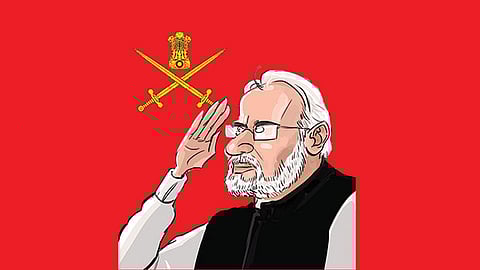
A Prime Minister Narendra Modi made a surprise visit to the Siachen Glacier on the festive occasion of Diwali last Thursday to spend time with the Indian military units that are deployed at altitudes of 22,000 feet in what is often described as the highest battlefield in the world.
From the base camp located at 12,000 feet to the icy glacial heights, the deployment of Indian troops to defend Siachen for three decades and more is an extraordinary testament to the professionalism of the Indian Army and the Air Force.
Rich in symbolism, Modi’s visit effectively reminded both the troops deployed and the nation at large about the institutional relevance of the military in the larger national effort and this is a marked contrast from the UPA tenure under then Prime Minister Manmohan Singh and Defence Minister A.K. Antony where the civil-military connect was formal and limited.
Communicator par excellence, Modi used social media and other outlets to highlight the purpose of his visit and observed: “I have specially come on the occasion of Diwali to be with you. I am aware how it feels like to spend Diwali with your family... my coming to this place will not fill the void of your family members, but as a representative of 125 crore [1.25 billion] people... after being with you I feel proud and satisfied.”
This is not the first visit by an Indian prime minister or defence minister to Siachen, and it may be recalled that soon after India established control of the glacier in 1984, then Prime Minister Rajiv Gandhi took keen interest in the aviation-related aspects of accessing the glacier. Subsequently, during the first NDA regime, defence minister George Fernandes was an ardent Siachen visitor and Manmohan Singh also paid one visit to the glacier in 2005.
Hostile environment
Apart from raising the morale of the troops and conveying his government’s commitment to national security and sovereignty, and suitably acknowledging the sacrifices made by the military, the Modi visit would also have accorded the prime minister an opportunity to get a first-hand appreciation of the extremely hostile physical environment in which the Indian military units operate and the human and material costs entailed in defending the glacier.
Siachen is strategically located along the northernmost slant of the composite Jammu and Kashmir state and opens up beyond grid reference NJ 9842 into the un-demarcated and hence contested territorial claims of India and Pakistan. In 1984, the Indian Army consolidated its position on the icy heights. The line dividing the Indian and Pakistani militaries is referred to as the AGPL, or the Actual Ground Position Line. The Siachen region also has a China-related strategic relevance for India. In 1962, China had already occupied the disputed Aksai Chin area, thereby giving Beijing a stake in this complex and differently contested territorial issue.
Thus, for the political leadership in Delhi, the Siachen issue is not merely a bilateral India-Pakistan matter but part of the larger strategic challenge that the Sino-Pakistan axis poses. These are some of the politico-strategic elements embedded in Siachen and Modi’s visit will help him and his cabinet to acquire a more nuanced understanding of the issues involved, and thereby take a comprehensive policy approach to India’s principal neighbours — China and Pakistan — that is both equitable and sustainable.
One of the fundamental challenges of statecraft for the leader of a democratic nation is to harmonise the dialectic between the inexorable principle of power and the inherent power of principle. Few leaders have been able to successfully harmonise these compulsions and Indian prime ministers from Nehru onwards are no exception. Will Modi be the exception?
The Indian military today faces a wide spectrum of internal challenges and inadequacies and these would have been brought to the attention of Modi in his recent interaction at the combined commanders’ conference. Notwithstanding these gaps — both material and human resource — national commitments like Siachen have to be effectively addressed.
Symbolism is only one part of the political effort. Modi and his cabinet colleagues entrusted with the national security responsibility have to methodically enhance tangible national military capability in the four years ahead of them.
At the moment earnest, patriotic intent has been repeatedly articulated by Modi; but the litmus test will be in empathetic political and budgetary support to the various military-related initiatives that have been announced in Siachen and elsewhere.
The tweet for the #PMModi: ‘The nation is watching. Deed must match word.’
–IANS
C. Uday Bhaskar is Director, Society for Policy Studies, New Delhi.


