Michel Temer, Brazil’s new ‘black box’ President
He has assumed office following Rousseff’s impeachment, but the public knows worryingly little about him or his political agenda
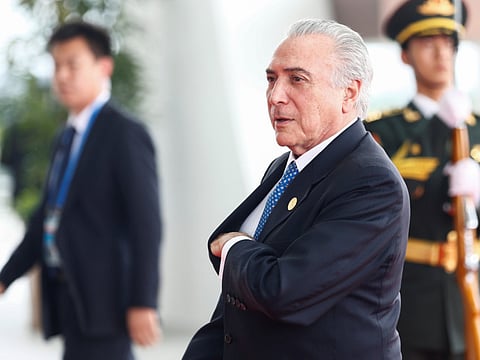
Michel Temer, now officially Brazil’s President after Dilma Rousseff’s impeachment, is the political equivalent of a ‘black box’. We know little, almost nothing in fact, of his project for the country.
There are various reasons to explain such a lack of information. First of all, his Brazilian Democratic Movement Party, or PMDB, hasn’t bothered to choose a presidential candidate since Orestes Quercia’s trouncing in the 1994 election.
As a result, the party, and by extension Temer himself, never needed to put forward a government platform during these past 22 years — not even one of those fantasy manifestoes that are made and distributed for each election, only to be forgotten or betrayed after the victory.
Second, Temer has always been a politician of extraordinary discretion. If the 75-year-old had been more notable, somebody would have thought of him at some point in his long public life to be a presidential candidate — or at least to lead the Sao Paulo state.
Because of his discretion, the new president’s views on the greatest issues facing the nation have never been solicited. What we know from him, it’s true, are some noteworthy efforts on legal issues, but you’re allowed to expect much more from a president.
Temer couldn’t even be explicit about the many issues that are worrying the country because PMDB isn’t a party, but rather a confederation of regional chieftains that’s divided on pretty much everything, even around the vote on Rousseff’s impeachment.
To top it all, Temer, in his few months as interim president, couldn’t come up with a minimal political platform. The only priority he announced — to balance the books — isn’t a personally selected agenda, just reality imposing itself.
Such was the deterioration on that crucial front that even Rousseff, had she been allowed to stay on as president, would have had to tackle this issue. She actually threatened to take austerity measures when she began her second term, but she was so hesitant and awkward about it that it ended in total failure.
Resolving the mess
From my point of view, what will in the end define the new president’s success or failure is less the fiscal issue than whether Brazil manages to make it out of the recession. Which brings us to the following question: Will the sole fact of the impeachment suffice to resolve the mess Brazil finds itself in?
Joao Augusto de Castro Neves, the Latin America director of the Eurasia Group, calls the combination of recession, fiscal woes and corruption scandals “a perfect storm” that makes the new government’s challenge enormous.
This will all unfold down in a marshy land, with a political sphere rotten to the core, in which Temer has been able to move without too many constraints. We will soon find out whether Brazil’s new president has the vision and project to lead the country to higher ground.
— Worldcrunch 2016, in partnership with Folha de Sao Paulo/
New York Times News Service
Clovis Rossi is a veteran Brazilian journalist.


