Kremlin's biggest threat
The thousands of middle-class protesters are not quite a full-fledged political opposition yet. They are a civil rights movement
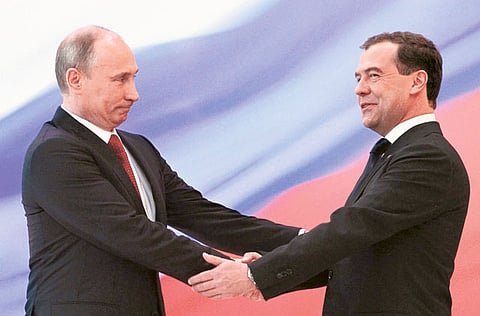
With Vladimir Putin's return to the Russian presidency last week, the pageantry surrounding his inauguration aimed to portray a picture of unassailable strength, a confident master of his domain invulnerable to pressures from within or without. But things are not quite as stable as they seem.
Over the next few years, Russia's domestic and foreign policies will be shaped by an unfolding and increasingly sharp conflict between the consequences of the two events that took place in the past four months: Putin's reelection and the ensuing mass protests that erupted in more than 100 of the largest Russian cities.
What we may be seeing is a Russian version of a familiar post-authoritarian democratisation that swept through Greece, Portugal and Spain in the 1970s, South Korea and Taiwan in the 1980s, and Mexico in the 1990s. Having reached unprecedented prosperity and personal freedom, the middle class in each of these countries began to demand a say in how its country was governed. This is not just a political conflict. It is a clash between two moral sensibilities, two political moralities, and two visions of what constitutes meaningful and dignified citizenship. This means that neither side is likely to give up, retreat or compromise. It will be a struggle to the bitter end, no matter how long it takes. But it may not be that long. Before Putin's reelection, a poll showed that 35 per cent of Russians polled said they thought the election was ‘dirty' — i.e., fraudulent. That means that, with all the caveats and margins of errors, millions of Russian citizens do not consider Putin a legitimate president.
In the short term, Russia's most serious risk stems from a near-fatal dependence on the price of oil. Twelve years of Putinism have moved Russia perilously close to being a petrostate, with all the political, economic and social niceties those are known for.
According to UBS analysts, a $10 (Dh36.70) change in oil's per-barrel price changes the price for balancing the budget by 1 per cent of Russia's GDP. Last September, Alexei Kudrin, then finance minister and deputy prime minister, estimated that if the price falls to $60 a barrel, Russia's economy would register zero growth or even contract. To balance the national budget in 2004, Russia needed oil at $27 dollars a barrel. Last year the break-even point was $115. Thus far, the projection for this year is $117.
Worst nightmare
This is why Russia is likely to face a severe fiscal crisis as early as 2014, even with the world's third-largest hard currency reserves. In the words of one of Russia's most respected economists, Sergei Guriev in a recent talk at the Centre for Strategic and International Studies in Washington, the state may ‘run out of cash' to pay for the huge increases in the defence budget and the social commitments Putin ratcheted up on the way to reelection, first and foremost the pensions of retiring baby boomers.
The regime's worst nightmare is that millions of angry pensioners may join the hundreds of thousands of middle-class protesters. These protesters are not quite a full-fledged political opposition yet. But they are already something more threatening for the regime. They are a civil rights movement. They reject the system not so much because of specific political or economic grievances, but because they find it indecent, undignified, offensive and unworthy of them as people and citizens. This is a morals-based movement against effective disenfranchisement and inequality before the law, owned by the state.
In a total surprise, opposition and independent candidates won 71 seats in Moscow's 125 district municipal legislatures — about 1,500 seats total. Almost all the winners were under age 30 and ready to struggle for a long time. One of them was a 20-year-old journalism student named Vera Kichanova, who won a seat on the district council in Moscow's Yuzhnoe Tushino district. She was a member of Russia's tiny Libertarian Party and an admirer of the American Tea Party. Ideally, she said, she would like Putin to say, "I'm tired; I am leaving." But as this is not going to happen, her plan was to follow small steps. "If you see a breach in the iron wall," she said, "it makes sense to try to go through it."
— Washington Post
Leon Aron is director of Russian studies at the American Enterprise Institute. His new book Roads to the Temple: Truth, Memory, Ideas, and Ideals in the Making of the Russian Revolution, 1987-1991 will be published in June.


