Iraqi Kurdistan must make its choice on independence
It is time to recognise that the forced inclusion of the Kurds in Iraq has not worked
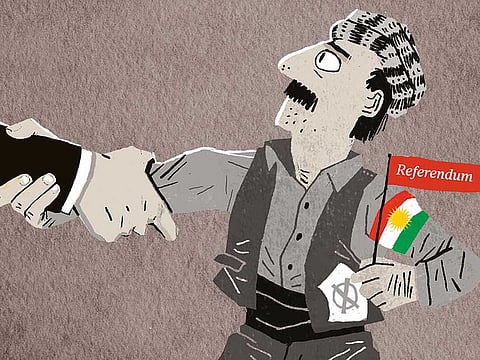
On September 25, the people of Iraqi Kurdistan will decide in a binding referendum if they want independence or to remain part of Iraq. The vote will resolve a conflict as old as the Iraqi state itself between the aspirations of the Kurdish people and a government in Baghdad that has long treated Kurds as less than full citizens of the country.
Iraqi Kurdistan’s exercise of its right to self-determination threatens no one and may make a volatile region more stable. It will not alter the borders of any neighbouring state and, if done right, will make for a much stronger relationship between Iraq’s Arabs and Kurds. We are determined to do everything possible to accommodate Iraqi concerns in the likely event that the vote is for independence.
Kurdistan’s case for independence is compelling. One hundred years ago, in the peace negotiations that followed the First World War, the Kurds were promised their own state. Instead, they were divided against their will, their lands carved up among Turkey, Iran, Syria and Iraq. The newly-established state of Iraq was supposed to be an equal partnership between Arabs and Kurds. That hopeful dream soon gave way to a grim reality. All Iraqi governments suppressed the Kurds. The resulting atrocities culminated in the 1980s, when former Iraq president Saddam Hussain used poison gas extensively on Kurdish towns and villages, levelled more than 5,000 Kurdish villages and deported Kurds to the south, where they were murdered and buried in mass graves. One hundred eighty-two thousand Iraqi Kurds (nearly 5 per cent of the population), including members of my own family, perished in this period.
With the overthrow of Saddam’s Baath regime, the Kurds worked hard to build a new Iraq, including drafting a constitution that guaranteed Kurdistan’s autonomy and protected the rights of all Iraqis. Fourteen years later, Baghdad has failed to implement key provisions of that constitution, and we have good reason to believe that it never will. This failure of the political system is also responsible for the rise of Daesh (the self-proclaimed Islamic State of Iraq and the Levant), with disastrous consequences for all Iraqis, including the Kurds.
The principal argument for Iraqi unity is that a single Iraq is better able to protect its citizens. But this claim is not supported by experience. When Daesh attacked Kurdistan in 2014 — using advanced American weapons abandoned by the Iraqi army in Mosul — the Iraqi government refused to give Kurdistan its constitutionally mandated share of the federal budget or to provide its soldiers (known as the Peshmerga) with weapons. As an independent country, Kurds could have financed and equipped their own troops and brought this fight to a swifter conclusion.
The war on Daesh since then provides a model for how Kurds and Arabs might cooperate in the future. In the battle to drive Daesh from Iraq, the Peshmerga and the Iraqi army have been in an alliance of equals. Each army has its own chain of command. The Peshmerga’s joint operations with the Iraqi military support each other in ways that never occurred in an Iraq where Baghdad sought to dominate and control Kurdistan. Regardless of the referendum, Kurds will continue with their close cooperation with Iraqi and western forces until the final victory over Daesh.
An independent Kurdistan could have a much stronger relationship with Baghdad. Kurdistan will be a great neighbour, cooperating against terrorism and sharing resources — including water and petroleum infrastructure — in ways that benefit both countries. Without the sanctions that Iraq has applied to Kurdistan’s imports and exports, the Kurds could jointly develop their human and natural resources in a common market to the benefit of both Kurdistan and Iraq.
While the results of the referendum will bind future Kurdistan governments, the timing and modalities of independence will be subject to negotiation with Baghdad and consultation with Kurdistan’s neighbours and the wider international community. In our negotiations with Baghdad, we will be practical. The issue of what territory joins Kurdistan will be the most contentious in the separation. Despite a December 31, 2007, deadline, the Iraqi government refused to implement a key constitutional provision, Article 140, that would have the people of the disputed areas decide their future democratically. Nearly ten years later, we propose to give them that opportunity. We wish to incorporate into Kurdistan only those territories where the people overwhelmingly want to be part of Kurdistan as expressed in a free vote. The last thing Kurds want is a long-lasting territorial dispute with Iraq that could poison future relations.
Since Kurdistan became self-governing in 1991, it has worked hard to develop good relations with its neighbours. Turkey is the largest foreign investor in Kurdistan’s economy and has built oil and gas pipelines that benefit both countries. We understand the anxieties that the Kurdistan referendum may cause with the neighbours and will do what we can to assure them that a democratic and stable Kurdistan is the best possible partner.
Kurdistan values its diversity. We are home to Christians, Yazidis, Turkmen and Shabaks whose separate identities are recognised in Kurdistan’s laws. Since 2003, many Iraqi Christians have moved to Kurdistan to escape violence and persecution elsewhere in the country. And since Daesh seized large parts of Iraq in 2014, we have provided for more than 1.5 million Iraqi refugees, with only minimal help from Baghdad or the international community.
After a century of trying, it is time to recognise that the forced inclusion of the Kurds in Iraq has not worked — neither for the Iraqis nor for the Kurds. We ask that the United States and the international community respect the democratic decision of Kurdistan’s people. In the long run, both Iraq and Kurdistan will be better off.
— Washington Post
Masoud Barzani is the president of the Kurdistan region of Iraq.


