India elections: Baggage or not, Narendra Modi is the BJP’s best hope
His supporters say polls are his to lose. But victory is not a foregone conclusion
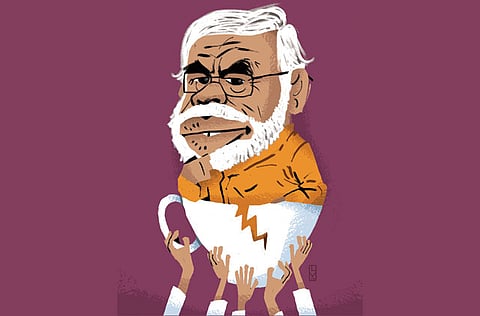
India’s next prime minister could well be someone who once sold tea at train stations in his childhood. The self-proclaimed former tea boy is today a towering political figure in Indian politics and potentially in line for the coveted post. Polls after opinion polls are pointing to a Bharatiya Janata Party (BJP) victory led by its controversial but popular Prime Ministerial candidate Narendra Modi in the parliamentary elections to be held by May.
Modi, chief minister of Gujarat state, is attracting big crowds in all his political rallies across the country. His camp believes that the magical number of 272 Lok Sabha (Lower House of Indian Parliament) seats out of a total of 543 looks within reach. There is a swagger in the step of Modi’s millions of supporters, who are boldly proclaiming that his rising fame will catapult him to power in Delhi. There is a buzz around Modi as much on social media as on conventional ones. It is being seen as his election to lose.
Indeed Modi got a shot in the arm recently when the US Ambassador in New Delhi Nancy Powell came knocking on his door for a meeting. Europeans had already demonstrated their intentions of working with Modi. But the American ambassador’s visit has clearly signalled the end of a decade-long US boycott of the controversial Indian leader who was denied entry to the US in 2005 for an alleged deliberate inaction on his part during the 2002 Hindu-Muslim riots in his state in which more than 1,000 people were killed, mostly Muslims. This is a charge he has always denied. Some see the change of heart by the US as an endorsement of Modi’s candidature for the top post ahead of the elections.
But despite seemingly favourable conditions for Modi’s victory, there are strong voices, albeit less audible now, who say it is too early to project him as the winner. Those who caution against hasty conclusions predict victory neither for his party nor for the ruling Congress.
Unease in the camp
Their caution is based on two major developments — the rise of the Aam Aadmi Party (AAP), or the Common Man’s Party, which sprung a big electoral surprise late last year by winning the Delhi assembly elections, and the quiet resurrection of the Third Front — an informal coming together of a clutch of strong regional parties.
Arvind Kejriwal, leader of the AAP, has emerged as a real threat to Modi’s prime ministerial ambitions. He had for a few weeks dislodged Modi from prime time TV coverage with his unconventional politics during his brief 49-day stint as Delhi’s Chief Minister.
Kejriwal has now put all his energy in the parliamentary elections. His effective challenge to what he calls a corrupt political establishment, of which the BJP is a part, has caused considerable unease in Modi’s camp. Kejriwal didn’t even figure in the BJP’s electoral strategy until three months ago. But following his victory in the Delhi assembly elections in December, there is a fear among Modi’s supporters that Kejriwal and his brand of unusual politics might spoil his chances in the elections.
While many have already written off the Congress Party, they also don’t see a BJP victory as a certainty — despite Modi’s growing popularity and pollsters’ predictions in his favour.
The proposed Third Front, a broad alignment of secular parties, is sure to keep reminding Modi of his alleged failure to stop the 2002 communal violence. The riots have become an albatross around his neck, which he cannot throw away even if he becomes the prime minister. They will ensure that this remains a political and moral issue for him. Leaders who are working for a Third Front, such as Bihar state’s chief minister Nitish Kumar, will not shy away from highlighting how divisive a political figure Modi is.
Interestingly, in the 1990s Lal Krishna Advani, who has ironically been eclipsed by Modi in the BJP, was arguably a much bigger and a more towering personality than Modi is today. His aggressive pro-Hindutva (Hindu nationalist) campaign, which led to the demolition of the historic Babri Mosque in December 1992, eventually brought his party rich electoral dividends. The BJP, which once had only two seats in Parliament, reached 182 in 1998 following the mosque demolition.
Advani, who was then widely regarded as a hardline Hindu leader and who was kept at arm’s length by most political parties, was seen as the biggest polarising and divisive force — even bigger than how Modi is perceived today. And yet his ‘politics of hate’ could never win the BJP an election on its own. Such was Advani’s charisma among urban Hindus following the destruction of the medieval Babri mosque that many of them deified him. He was loathed by many but loved by many more. He was indeed a nationally recognised political figure.
Modi has that kind of an aura in his home state. But the tag of a national-level leader still sits at odds with him. He has tried hard to shed the image of a regional leader, but this still seems to be a work in progress. The BJP, which has lost two previous general elections, is desperate to come to power. It had no real crowd-pulling leader. Therefore the party seems to have done the right thing by declaring Modi its prime ministerial candidate much before the elections. But it is also a big gamble.
Zubair Ahmed is the political correspondent for bbchindi.com. You can follow him on Twitter at www.twitter.com/Zubair_BBC


