In defence of democratic rights
Protesters have sought to restore fundamental liberties to the people
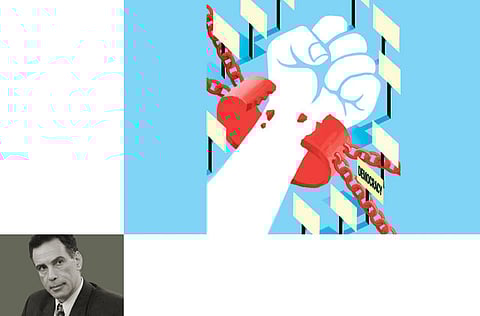
The year 2011 is likely to go down in history as an important turning point, even if history, in one of its quirks, refuses to take the turn. It started with the Egyptian revolution and is ending with the Occupy Wall Street movement — two defining and unique peaceful events that poignantly illustrate the fundamental relationship between people and democracy. The two support each other. Democracy that does not serve the people is reduced to empty slogans. People deprived of fundamental liberties and democratic rights are denied life with dignity.
Earlier this year a group of young people in Egypt called for a demonstration to protest Egyptian police brutalities and the repressive nature of the Mubarak regime. The demonstration attracted large numbers of participants.
A protest movement was born — peaceful, spontaneous, and resolute. The repressive response of the regime only strengthened the resolve of the demonstrators whose demands now grew as their numbers multiplied; growing from hundreds of thousands to one million. A revolution, like no other in the history of Egypt, was dramatically changing the political landscape of Egypt. Demonstrators, as diverse as the people of Egypt itself, were demanding nothing less than the fall of the entire regime and the dismantlement of its repressive structures. To the surprise of much of the world, within 18 days the entrenched Mubarak regime had fallen, its power base collapsed, and its principal figures arrested including former president Hosni Mubarak himself.
Last month a group of mostly young people from North America, who had been discussing, through various networks and social sites, the urgency of action-based social revolt, were joined by other concerned citizens to form the Occupy Wall Street movement. They chose Wall Street in New York where the stock market is located to protest the power of the financial elites, corporate greed, executives’ excesses and the growing economic inequalities in the US.
Within days similar movements had sprung in the major American cities and in some 85 major cities around the globe. The protesters encamp in symbolically significant locations, carry signs, interact with people and are anxious to avoid violence and chaos and, with the exception of Italy where the protest degenerated into violence, the demonstrators have kept their pledge to be a non-violent movement and to be good neighbours to local businesses.
One of the intriguing reactions by pundits and commentators was to deny the obvious connections between the Egyptian revolution and the Occupy Wall Street movement.
Writing in the Jerusalem Post an Israeli writer rejected the notion that the global protest movement is likely inspired by the Egyptian revolution. All analogies are absurd, he opines, because Cairo’s rallies attracted millions, while the American protest movement and its global extensions rarely involved more than several thousand people. But the difference in the number of participants does not negate the fact that the Egyptian revolution in many ways inspired this protest movement. If anything, it reinforces that contention.
In fact there are a great deal of commonalities between the Egyptian revolution and the global protest movement beyond the obvious role of networking through social sites for organisational purpose. Traditional protest demonstrations, even the massive global demonstrations against the 2003 American invasion of Iraq, are usually circumscribed in content and in time: that is the object of demonstration is one particular theme and the demonstration itself begins and finishes in the same day.
The Egyptian revolution and the Occupy Wall Street movement freed themselves of these limitations: Both occupied a physical place that in different ways symbolised the object of their revolt: Tahrir Square and Wall Street; both put time on their side. They were in for the long haul. The prospect of drawn-out confrontation was unsustainable and helped bring down the regime in Egypt. It must be unsettling for the establishment in the rich world. Both made demands related to democracy and its fundamental nature: Dismantling an authoritarian regime and replacing it with democracy to fight corruption and create social opportunities in Egypt; social opportunities and reduction of inequalities in the USA (“The top 1 per cent of Americans possess more wealth than the entire bottom 90 per cent”), to restore democracy where it belongs, not with the financial elites, not with the lobbies and special interests, but with the people.
Another intriguing feature of the views of many commentators is the notion that the Occupy Wall Street movement does not have clear demands.
This may seem to be true on the surface because of the absence of clear leadership for the movement. But this is a most unique movement not to be compared with the usual protest movement and subjected to the same traditional tests.
And yet, it is remarkable that these commentators were not able to deduce from the myriad signs carried out by the protesters what their demands are. One sign carried by a New Yorker read: “Young, Educated, and Unemployed.” Another sign carried by a protester in Berlin read: “We shouldn’t bail out the banks. We should bail out the people.”
Another sign carried by a young protester in Rome summed up the feeling of democracy betrayed: “We don’t feel represented by the government. We feel made fun of.”
James Madison, the father of the American constitution, thought that democracy could only work if republican virtues — placing public interests above private interests — and liberty, were preserved through the participation of the citizen in the political process.
From Tahrir Square to Wall Street and its global extensions, the citizens took to the streets and rejected denial of democracy and the absence of republican virtues; a dramatic and historic demonstration has been given: Only an empowered citizenry can defend fundamental democratic rights as natural rights, and promote social justice; and in the process rescue democracy from its abusers.
Adel Safty is Distinguished Professor Adjunct at the Siberian Academy of Public Administration, Russia. His new book, Might Over Right, is endorsed by Noam Chomsky, and published in England by Garnet, 2009.


