Era of military rule coming to an end
The past six decades have shown that this system of governance has wreaked havoc on the Arab world
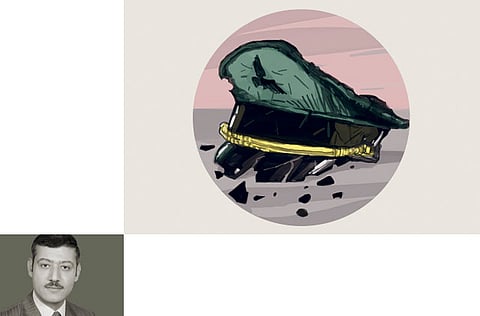
The removal of three military-originated Arab regimes over the past few months and the possible collapse of two more indicates that military or semi-military rule in the Arab world is coming to an end.
Former president Zine Al Abidine Bin Ali of Tunisia was a former officer and was minister of defence when he led his November 1987 coup against the country's first president and leader of the liberation movement against the French, Habib Bourguiba.
Former president Hosni Mubarak of Egypt came also from the military establishment. He was appointed vice-president by President Anwar Al Sadat in the late 1970s to replace him after his assassination in 1981.
Colonel Muammar Gaddafi of Libya was the leader of the Free Officer Movement which overthrew the monarchy in 1969. At the time, military rule was the norm in the Arab republics. That included Syria, Iraq, Algeria, Sudan, Yemen and Mauritania. Even the leadership of the PLO came from a military background.
Military rule in the Arab world was in fact supported by the West, particularly the US. In the post-independence era in the Arab world, the ability of the traditional conservative Arab elites to establish modern and functioning democracies was very much in doubt. Acting on this belief, the US government received positively the coup of the free officers in Egypt and did not seem to be bothered by the toppling of the Iraqi royal family in 1958.
It, furthermore, assisted the first Syrian military coup in 1949 and is believed to have had connections with the third one. The overriding argument was that an Ataturk-like leader was better equipped to start a modernisation process from the top, attempting to change, forcibly if necessary, the conservative culture of Middle Eastern societies.
These assumptions proved baseless. The past six decades have shown that military rule wreaked havoc on the Arab world. In Egypt, Libya, Syria and Iraq, where western-oriented military officers overthrew traditional or conservative regimes, a police state was established, corruption became institutionalised, poverty increased and the state-central planning lagged far behind the annual rate of population growth.
In Algeria, Tunisia, Yemen, Sudan and Mauritania, the record was not much better, as the governments of these countries handled the development process so badly that they ended up becoming prisoners to the socially-destructive agenda of the IMF and the World Bank.
Most have failed to adapt quickly to the rapidly changing regional and international conditions, including the collapse of the Soviet Union and the democratisation of Eastern Europe. Some have undertaken very limited steps toward the establishment of a more plural political system. Others, resisted change and tried to thwart any attempt toward democratisation, or at least start some sort of political liberalisation.
Turkish model
By the time the failure of Arab military rule became apparent, Turkey was moving slowly but steadily towards a more democratic government. Since the ascendance of the ruling AKP to power in November 2002, Turkey has been consolidating its democratic credentials, presenting itself as a unique model of a Muslim nation ruled by democratic means. It has shown that liberal values and conservative Islamic concepts are not only compatible but complementary.
Turkey's democratic experience put an end to the epochal debate about whether an authentically Islamic government can respect individual freedoms and the equality of all citizens. The best possible refutation of the claim that Islam and democracy are incompatible was to point to an existing government where liberal and Islamic values work together.
This experience drew significant attention in the west wherein a new argument emerged: if Turkey acted in the 20th century as an example for the Arab world to start a modernisation process from the top by the junta, why cannot it serve as an example of Islamic democracy in the 21st century?
In his waning days as president, George W. Bush embraced this idea. He was motivated by the catastrophic invasion of Iraq and the failure of the Greater Middle East Plan. US President Barack Obama followed the footsteps of his predecessor and acted accordingly. He made his first foreign visit as president to Istanbul, implying how important Turkey is for his Islamic world policy. US support to the so-called "Arab Spring" indicates that Washington can no longer tolerate military or authoritarian rule in the Arab world. It also shows that Turkey will once again play a key role in the transition to democracy in this vital world region.
Dr Marwan Al Kabalan is Director of the Damascus Centre for Economic and Political Studies.


