Confusion galore around Macron’s conscription plans
French President wants to bring back compulsory military service for young people nearly two decades after it was scrapped
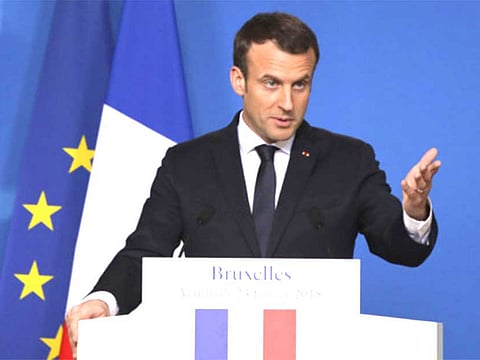
In France, the ideal of serving the republic is as old as 1789 and the revolution that created it. It is only fitting, then, that Emmanuel Macron, whose campaign book was titled Revolution, made obligatory national service a centrepiece of his run for the presidency. There’s a reason the proposal resonated during the election campaign. The French Revolution’s founding document, the Declaration of the Rights of Man and of the Citizen, insisted upon not just rights of man, but also the duties of the citizen.
Since becoming president, Macron has maintained his vow. He seems to believe the programme has become critical to his reputation as a man of his word, though he does accommodate necessary tweaks. Just as Trump now concedes that his wall does not necessarily translate into 2,000 miles of translucent ramparts, Macron no longer describes this obligatory service as military. Last month, in a speech to the country’s military leaders, Macron swapped out the adjective “militaire” for “national.” But, he quickly added, the promise would be fulfilled: “I want to reassure all of you that this project will be acted upon and seen safely to port.”
A Senate report last year the price estimate for 800,000 young conscripts ballooned to 30 billion euros (Dh135.4 billion), while a member of the National Assembly’s finance committee estimated that renovating the infrastructure alone for this programme would be between 10 and 15 billion euros.
The projected costs are all over the place partly because the project itself is all over the place. Last week, a parliamentary commission that included members of Macron’s party, La Rpublique En Marche!, outlined a kind of national service lite. The length of service would be divided into three phrases, beginning with an intermediate school course in “civic and moral education.” At the age of 16, all students would attend a weeklong affair dedicated to “defence and citizenship.” Students can fulfil this requirement at various places, ranging from the local fire station to undefined “fraternity schools.”
The final stage, for all youths between 18 and 25, is a so-called l’incitation l’engagement — which translates to “a plea to get involved.” As the name suggests, young men and women would be urged, not compelled, to join already existing civic organisations. The reasons are several: Not only did the commission want to avoid a popular uprising, but it also wanted to avoid a clash with the European Court for Human Rights, which as one commission member noted, might rule that such a law would constitute “forced labour.” Also playing a role, no doubt, was the resistance of military leaders, who fear their budget will be raided to pay for Macron’s pet project. The brass didn’t take kindly to Macron’s proposal last year to freeze the military budget. Publicly expressing their worries about inadequate means to finance a growing list of military operations, they eventually forced him to backpedal.To a group of reporters, Macron reaffirmed that the universal national service would, indeed, be mandatory. At the same time, however, the president adopted his signature “at the same time” (en mme temps) approach. The length of service might be as short as three months, he observed, or as long as six months. Moreover, it could be served with a civic organisation or, if one preferred, in the military. In any case, Macron declared, these details have yet to be ironed out.
No matter how thick the rhetorical fog, the phrase “service obligatoire” stands out. In a public statement, Fage, France’s largest student union, denounced Macron’s “demagogic proposition which aims to ‘set right’ a generation thought to be the source of every social ill: radicalisation, delinquency, abstention, apathy and subversion.” Citing studies that reveal record levels of civic participation among the young, the statement concluded that Macron’s plan was a campaign gimmick “profoundly disconnected from the needs of France’s youth.” As for the military, its representatives agree that it is the government’s priorities that need to be set right. The previous minister of veterans’ affairs, Jean-Marc Todeschini, sent a warning shot across the government’s bow: “The armed forces do not have the capacity to assume the cost of universal national service.”
Despite the swelling scepticism, Macron maintains he is undaunted. With a Napoleonic flourish, he declared: “Many say [the national service programme] is impossible to achieve ... which in fact reinforces my conviction that it is a necessity.” Perhaps. But, of course, the man who said “impossible” is a word found only in a fool’s dictionary eventually met his Waterloo.
— Washington Post
Robert Zaretsky is a professor of history at the University of Houston’s Honors College. His most recent book is Boswell’s Enlightenment.


