Blair hasn't told the real story
The voice of New Labour is lost in a plot that centres on the villainy of a certain Gordon Brown
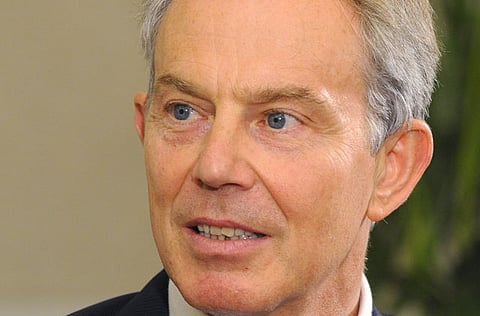
In the summer of 2006, a year before Tony Blair resigned as prime minister, I was at a big sporting event in the company of various establishment figures enjoying some corporate hospitality. One of them, who I knew to be close to Blair, took me aside and asked what I was intending to do to help prevent Gordon Brown succeeding him. I was a little taken aback.
I first met Tony Blair in the mid-1980s and got to know him quite well. I liked him and, if I ever had the chance to see him these days between his non-stop foreign travels, would unquestionably like him now. I never voted for him or his party, but I understood this: he was a politician of unusual talent, based on a serious intelligence and a powerful charisma. He was a man people on the Right like me warmed to precisely because he was so much like us.
When, in his rather peculiar memoirs, he rails against Brown for having betrayed New Labour, he is saying Brown stopped governing Britain in a way that natural conservatives did not find too offensive. Indeed, the Tory-voting middle classes had a soft ride during Blair's 10 years in office, which is why it took the Conservative Party so long to recover.
Blair's reputation is tainted by the Iraq war. Much is made of his failure to give, even now, an unequivocal apology for his policy of involving Britain in America's schemes in the Middle East.
His memoirs do not admit to a policy of craven subservience to America; nor do they own up to the deception of his own party and parliament in the early spring of 2003, when the threat of attack from weapons of mass destruction helped him get approval for Britain's part in the war. Without the ‘dodgy dossier', the support in his own party to take this course would not have existed. British lives would have been spared. The special relationship might have been fractured, but would have been repaired by now, with America run by a man who was opposed to the war. It was, at the least, a grave miscalculation by Blair; and we are still not sure whether it was a spectacular act of dishonesty.
Amusing admission
It is that, more than popular jealousy about his money-making activities, that tarnishes his place in history. I do not know that he has polished it by these memoirs. It is amusing that Blair admits in his book that he is a manipulator, not least because he is also adept at being manipulated. Bill Clinton did it. George W. Bush did it. The adulation Blair received (and still does receive) from American public opinion did it. Closer to home, Gordon Brown did it — whether Blair likes to own up to that or not. Alastair Campbell, a forceful personality and quite accurately described by the autobiographer as an "alter ego", did it monumentally. Mrs Blair did it.
Tony Blair was this mixture of massive self-confidence, massive ability and massive pliability. That, at least, is reflected accurately in his book. There have never been prime ministerial memoirs like this. They are the memoirs of a man who tries to marry two conflicting impulses — wanting to be liked (that was always another of Blair's traits, and one that, for a time, he managed very successfully) and wanting to settle scores.
Earning potential
He has certainly settled the most majestic score of all, with the man he failed to stop succeeding him. The battle between them is still on, being fought now to decide their places in history. Brown's was already looking shaky, despite whatever he might come up with in the book about how-I-saved-the-world-in-the-banking-crisis that he is writing.
Blair has followed the sage advice that there is no better time to kick a man than when he is down: and, my word, has he kicked him. The rules have been rewritten, perhaps because of the link between the projection of ego and earning potential. How much this is the result of an instruction from his publishers to provide something that will make money, and how much it is the product of Blair's own personality, one cannot be sure. There is a titanic self-belief in him that has blossomed further since he left office. It may be fashionable to revile him in Britain, but on much of the planet he is held in awe and respect. He sees how quickly the wheels came off Britain after he left office and reflects, with some justification, that things would not have reached such a pass had he stayed in charge. This absence of self-doubt allows him to forget his own culpability in being manipulated by Gordon Brown — which, given the results of Brown's economic stewardship, is both considerable and damning.
This feels like a book written after sessions with a psychotherapist, or a priest, or perhaps both.
On the morning after the 1992 election, which Labour had expected to win, I saw Blair being interviewed on television, looking utterly miserable. I rang him straight afterwards and suggested lunch. Over a sandwich in his office, he spoke frankly about the disappointment — he had expected to be in Neil Kinnock's cabinet — and said that if it happened again he would leave politics. Even though he had no intention of running in the leadership race that John Smith won, he outlined a clear vision for his party, to take it to the Right, to connect it with the middle classes of the south of England, and to put Labour into power next time.
His chance to do so came two years later and he grabbed it. It is, therefore, a shame this gifted but complicated man has produced a book of such tone and, in places, such randomness, when the story he really has to tell is so significant: it has not been properly told yet.


