Barack Obama in Israel: US President visit a missed opportunity for Mideast peace
Leader was in a position to censure Israel, but did nothing
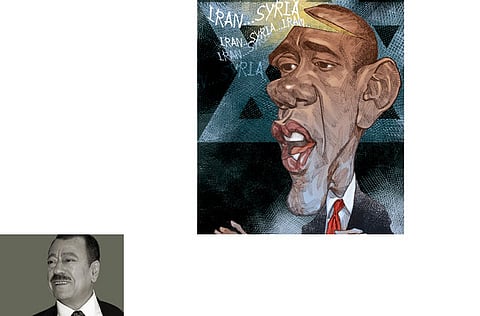
Barack Obama’s visit to Israel this week came at a time when the Jewish state was facing escalating threats from an expanding number of exterior elements and increasing diplomatic isolation.
Israel desperately needed a guarantee from the US that it will back it up militarily if it takes the step of unilaterally striking any one of its growing number of enemies, in particular Iran or Syria.
Despite their legendary mutual dislike, Israeli Prime Minister Benjamin Netanyahu greeted the US President with smiles and jokes as soon as his plane touched down. Obama, too, had clearly put behind him Netanyahu’s humiliating support for his Republican rival, Mitt Romney, in November’s presidential race.
Even though he was in a position to put pressure on the Israeli regime to freeze illegal colony-building and resume negotiations with the Palestinians on reasonable terms, he did not. Instead, he delivered a speech in occupied Jerusalem on Thursday that can only be described as bellicose, biased and unreasonable. It could have been scripted by Aipac, the powerful pro-Israel Washington lobby.
By way of a warning to Iran, Obama declared that, “Israel is the most powerful country in the region … and has the unshakeable support of the most powerful country in the world”, affirming Israeli President Shimon Peres’s claim in a CNN interview to mark the visit that, in the event of an attack on Israel, Obama would stand “shoulder to shoulder” with it.
In the same speech, Obama declared that the Arab world must “normalise relations with Israel”, and that the Palestinians must “recognise that Israel will be a Jewish state”. The latter an overtly racist proposition given that there are 1.5 million Arabs living inside Israel.
On March 5, US House Representatives Ileana Ros-Lehtinen and Ted Deutch introduced a bill, backed by 13,000 Aipac lobbyists, which would grant Israel a newly-created ‘major strategic ally’ status which would ‘compel’ the US to back Israel militarily. It seems that the pro-Israel lobby in Washington now has Obama in its grip.
Israel has also been working hard to rehabilitate its tarnished image in Europe. Last week, Peres became the first Israeli president for 28 years to address the European Parliament, using highly emotional rhetoric to persuade his audience that he is a moderate leader who longs for peace.
The last Israeli leader to address members of the European Parliament (MEPs) was Chaim Herzog, the Zionist lawyer and polished speaker, who sought to convince the West that the 1975 UN resolution 3379, which asserted that ‘Zionism is Racism’ was wrong and should be repealed (it was, in 1991).
Peres, of course, is not moderate at all, and has a long history of culpability in war, and acts of violence starting with the 1996 Qana Massacre. Peres was the architect of Israel’s nuclear weapons programme, and when Israel was condemned by the UN for using banned white phosphorous during its war on Gaza in 2008-09, in which 1,500 Palestinians died, Peres refused to apologise, saying Israel had the right to “protect” itself.
Israel’s present charm offensive towards the West comes in response to a growing list of enemies and dangers. Iran, of course, and also Syria, where both regime and rebels pose a threat: Assad might attack Israel if he is cornered; if his chemical weapons fall into the hand of Islamist extremists within the opposition, they too, may use them against Israel.
Obama’s arrival in the region was, co-incidentally, accompanied by reports of chemical weapons having been used by the Syrian regime, a development he described as potentially “game-changing”. To date, the US president has been reluctant to undertake a costly, military adventure in Syria, particularly given the disastrous results of interventions in Iraq, Afghanistan and Libya.
Egypt is another source of anxiety. Israeli military and security experts are closely observing internal instability, fearing that it may prompt the Egyptian leadership export the crisis abroad by revoking the Camp David Accords.
Israel’s most elusive enemy, however, remains the extremist groups (often linked to Al Qaida) which have proliferated as a result of the Arab Spring and are banking up alarmingly close to its borders in Sinai and in the Golan Heights, where Syrian rebels have now overrun several towns.
Israel has been beefing up its security, building new fences in the Sinai and mining the area around colonies in the occupied Golan Heights. Such measures would not, however, protect Israelis against chemical or biological weapons.
The Obama administration has provided Israel with unprecedented levels of military aid and weapons, including the Iron Dome missile defence system — to which the US contributed $300 million — and which two rockets from Gaza manage to circumvent during the Obama visit, landing inside Israel at Sderot.
It is possible that Obama’s visit has paved the way for an attack on Iran, or Syria, or both. Yet, paradoxically, he observed in his speech at occupied Jerusalem that “the only way to protect the Israel people is through the absence of war”.
Israel’s diplomatic isolation and the proliferation of its enemies is born of exasperation with — and anger at — its enduring, inhumane, degrading and vicious treatment of the Palestinians and its refusal to honestly and sincerely negotiate a just and fair settlement to a problem which is now more than 60 years old.
It is lamentable that Obama completely neglected the Palestinians during this visit which presented a real opportunity to kick-start the peace process.
Abdel Bari Atwan is editor of the pan-Arab newspaper Al Quds Al Arabi. His latest book is After Bin Laden: Al Qaida, the Next Generation.


