Are Daesh militants unstoppable?
Spate of suicide attacks seen as group’s weakness. In fact, it demonstrates its long-term survival skills
Before Fayad Tayih abandoned Daesh (the self-proclaimed Islamic State of Iraq and the Levant) earlier this month, he detected a striking trend: More people inside the self-declared ‘caliphate’ were signing up to become suicide bombers. Tayih had been working in an administrative job for the extremist group in Deir Al Zour, in eastern Syria, at the time. “Those who were working with me noticed the same thing,” he told me over Wickr, an encrypted messaging app.
Statistics released by Daesh confirm his observations. According to monthly updates from Amaq, the group’s official news outlet, Daesh was carrying out 50 to 60 suicide attacks per month in Iraq and Syria last November. Today the number of such attacks is 80 to 100 per month, an average of two to three operations a day. The trend peaked in March, with 112 members blowing themselves up in Syria and Iraq.
Daesh is shifting tactics and not just on the battlefields of Syria and Iraq. The group is reverting to insurgency tactics it relied on before June 2014, when it took over Iraq’s second-largest city, Mosul, and declared the formation of a ‘caliphate’. This operational change has been on plain display in recent weeks: Hundreds of civilians were killed in a spate of suicide attacks attributed to Daesh in Turkey, Iraq, Bangladesh and Saudi Arabia. In Baghdad last week, more than 280 civilians were killed when a car bomb exploded outside a shopping mall.
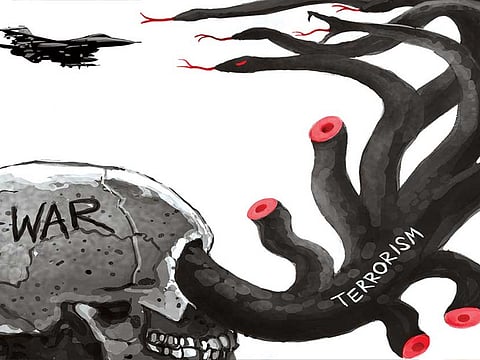
Some people have suggested that this is a sign of the group’s desperation and weakness. In fact, it demonstrates its strength and long-term survival skills. Daesh has known for years that it would suffer setbacks and have to find ways to adapt. In The Management of Savagery, a foundational text for Daesh’s ideology and strategy published in 2004, the author pointed out that in the 12th century, Muslims defeated the Crusaders with “small bands” and “separate, disparate organisations”. The group has not forgotten that message.
When Daesh’s leaders declared the formation of a ‘caliphate’, they opened a new phase in global extremism. The promise of living in an Islamist utopia reportedly attracted new members from some 90 countries. In interviews, Daesh members have told me that they joined because of the group’s military victories, its puritanical governance and its clear ideology.
Since the United States-led air war against it began in July 2014, Daesh has lost around 50 per cent of its territory in Iraq and 20 per cent in Syria. In the summer of 2014, it controlled an area roughly the size of Britain. Today, the ‘caliphate’ is closer to the size of Greece — and shrinking. Many of those who joined Daesh in the wake of the declaration have since left, as indicated in a speech by Abu Bakr Al Baghdadi, the group’s leader, in December: “The more tribulations increase,” he said, the more his group “spews out the pretenders and the hypocrites.”
Daesh has long been prepared for changing conditions. When I met a man using the name Abu Adnan in November 2014 in the town of Urfa, Turkey, near the border with Syria, he told me that he was part of Daesh’s intelligence apparatus and was in charge of setting up sleeper cells and spy networks in Turkey.
“Our enemies are clever and determined,” he told me. “What we can do is to make sure the body of the state is strong, so that it can heal no matter how far they weaken it. So even if they destroy us in one area, you can be sure we’re still there. We don’t have to be exposed and visible.” Men like Abu Adnan have been responsible for planning suicide operations in Turkey and beyond.
Daesh grew out of Al Qaida in Iraq, a terror group that was formed after the US invasion in 2003. Its main priority at the time was sectarian warfare and fighting foreign invaders. But after the group found new footing in the chaos of Syria’s civil war, its operational abilities expanded. Thanks to its claim as a ‘caliphate’, Daesh was able to overshadow Al Qaida. Since then, Daesh’s ambitions have grown as it has tried to claim leadership of global terror, not only setting up foreign cells and organising attacks from inside Syria, but also encouraging sympathisers to carry out strikes in its name.
Still, the Sunni areas of Iraq and Syria remain Daesh’s heartland. Even if Chechens are suspected of bombing the Istanbul airport, or Bangladeshi sympathisers took hostages in Dhaka, a majority of the group’s rank and file and leadership are still Iraqis and Syrians. A generation of young Syrians and Iraqis living under the rule of the ‘caliphate’ has been brainwashed. The political, social and sectarian issues in these countries that gave rise to the group still exist. Some may even be worsening.
The government in Baghdad continues to use Shiite militias to fight in Sunni areas, pushing some Iraqis into Daesh’s waiting arms, or at least encouraging people to view the group as their sole defender. Meanwhile, Syria’s civil war rages on and new conflicts emerge within it, attracting fresh recruits. Even American officials have told me privately that the political changes necessary to stem the group’s appeal in Iraq and Syria are lagging behind the military advances. The number of members volunteering to blow themselves up is not a sign of a dying group.
The threat is not going away. The group’s ultimate goal remains unchanged: Control of the Muslim world. The apocalyptic idealists who form Daesh’s core believe that they are ordained by God to accomplish this. And they will change their tactics as often as they need to in order to get closer to that goal — whether that means increasing the number of suicide bombers or shifting the front-lines in Syria.
In May, Abu Mohammad Al Adnani, Daesh’s spokesman, released a statement: “Do you think, America, that defeat is by the loss of towns or territory? Were we defeated when we lost the cities in Iraq and retreated to the desert without a city or a land?” he asked. “No, true defeat is losing the will and desire to fight.”
— New York Times News Service
Hassan Hassan is a resident fellow at the Tahrir Institute for Middle East Policy and the author of ISIS: Inside the Army of Terror.


