America can stop the ‘barrel bombs’ in Syria
America can stop the ‘barrel bombs’ in Syria
Recently, schoolchildren in the northern Syrian city of Aleppo made an art presentation that provided a creative outlet and a respite from their war-torn surroundings. Some children drew cheerful scenes of birds carrying the Syrian flag on a sunny day. Others depicted traumatic scenes of war they had witnessed. One drew Aleppo’s iconic citadel. On April 30, a barrel bombing demolished the school just hours before the exhibition was set to open. A number of children were killed before they could present their work. Others who were “luckier” spent a day they had eagerly anticipated in agonising pain under intensive medical care.
Americans may be interested to know that the US flag was a repeated motif at the ill-fated exhibition. Drawings showed Old Glory atop a house with inviting yellow windows, on the body of a bird soaring towards a hilltop and above a young girl smiling with outstretched arms. These Syrian children admire the US. In the midst of a horrifying war, they look to America with hope and expectation. But, has America fulfilled their hopes for the type of secure childhood that most Americans take for granted?
According to the Syrian National Council, at least 20,000 people have been killed in barrel bomb attacks since anti-government protests in Syria began in March 2011. These devices are large containers filled with explosives and shrapnel that, when dropped from high altitudes, explode upon impact and cause massive destruction. Since the Bashar Al Assad regime has a monopoly on air power, it is the only party capable of deploying barrel bombs.
United Nations Security Council Resolution No 2139 demands an end to “indiscriminate employment of weapons in populated areas, including shelling and aerial bombardment, such as the use of barrel bombs”. The resolution, passed on February 22, marked a rare moment of unanimity on Syria from the Security Council. But barrel bomb attacks have continued unabated. According to Human Rights Watch, the Al Assad regime has unleashed barrel bombs on at least 85 distinct locations in Aleppo since February 22. The Syrian Network for Human Rights estimates more than 920 deaths due to barrel bombings between February 22 and April 22. Resolution 2139 included the threat of “further steps” if its provisions were not abided. But UN spokesmen have stated that any further action would require a Chapter 7 mandate from the Security Council — where Al Assad’s staunch ally Russia holds veto power. Unless the US is willing to act outside the UN framework, it consigns children across Syria to the horrors of barrel bombings.
It will not take much for the US to make a difference. A man whose neighbourhood has endured numerous bombings reports that, after one regime helicopter was shot down by opposition forces, all attacks from the air ceased for 15 days. So a slight increase in the opposition’s capacity to target helicopters could have an enormous payoff in lives saved.
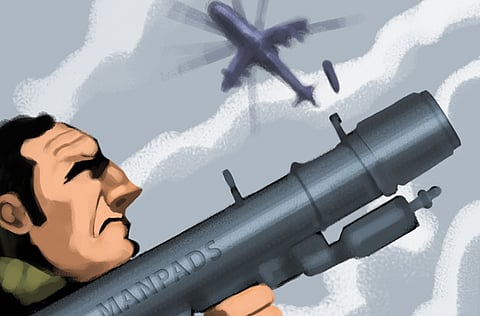
For this reason, Syrian opposition representatives have repeatedly requested the transfer of anti-aircraft weapons to moderate rebel groups. Syrian Opposition Coalition head Ahmad Al Jarba began his first visit to Washington last week specifically to make this appeal to US President Barack Obama and the American public. Reports have indicated that White House is reconsidering its previous refusal to furnish Syria’s opposition with man-portable air defence systems, or MANPADS. MANPADS are portable, shoulder-fired surface-to-air missiles that will enable Syrian rebel groups to target regime aircraft. A major objection to their provision has been that terrorist groups could later obtain them and use them against civilian airliners. Administration officials are currently studying technological fixes such as fingerprint-keyed security locks, GPS tracking and “kill switches” that could instantly disable the devices.
Often lost in the MANPADS debate is the fact that the weapons are already in wide circulation, including among terrorists. In 2004, the US Government Accountability Office estimated that around 6,000 MANPADS were in the hands of hostile non-state organisations. The intelligence firm Stratfor in 2010 included among these organisations Al Qaida, Al Shabab and Hezbollah.
As few as 20 MANPADS distributed to moderate Syrian rebel groups would make Al Assad regime pilots think twice before agreeing to decimate civilian areas through barrel bombings. And the added risk to civilian airliners would be extremely small, especially if the MANPADS were outfitted with the technological fixes under discussion. For the sake of the thousands of Syrians killed or injured by barrel bombings — including schoolchildren in Aleppo who believed in the US — the American people should support the provision of MANPADS to carefully vetted elements of the Syrian opposition.
— Washington Post
Mohammed Alaa Ghanem is the senior political adviser and government relations director for the Syrian American Council in Washington, a board member of the Coalition for a Democratic Syria and a fellow at the Syrian Centre for Political and Strategic Studies.


