All people are ready for democracy
Motives of those who say Egypt is not prepared for free polls uninformed and racist
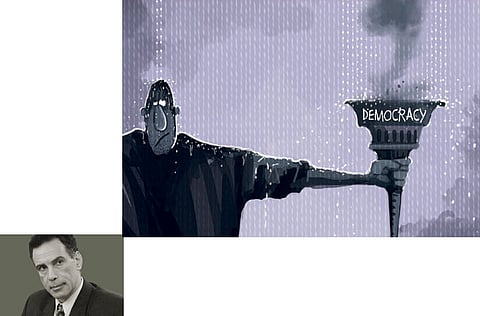
I have recently arrived in Cairo, coming from Washington, DC. In Washington I watched democracy corroded by politicians who forgot the meaning of democracy; in Cairo I saw hopeful expectations mixed with apprehensions about the future of democracy in Egypt.
The American debt ceiling saga pitted the president of the United States — the most powerful man in the world — against congressional leaders in a painful, prolonged deadlock until literally the last minute before the August 2 deadline. This deadlock in a mature democracy is illustrative of an important feature of the democratic compact on which governing structures are founded: when politicians place their self-interests above national interests, democracy is diminished. That is because fundamentally democracy is government by the people for the people, not for the elected politicians.
In Cairo I went to Tahrir Square. It was almost unrecognisable. It had become a tent city for various revolutionary groups intent on continuing their sit-in until their different demands are met. A few days later, the military intervened and forcibly removed the protesters. A few days later the protesters were back with their tents.
While talking with a number of Egyptians with different levels of education about the revolution, one of the recurring comments is that yes the revolution was necessary to put an end to corruption, but frankly, my interlocutor would say, I am not sure the Egyptian people are ready for democracy. When I ask why not, the more educated interlocutors would explain that a democratic environment would create opportunities for dangerous demagogues to manipulate a gullible electorate; the same people would also cite the absence of a strong civil society in Egypt, and point out that having lived under political oppression and denial of freedoms for over 30 years, Egyptians have lost faith in their governing institutions.
Other interlocutors make the point that democracy requires enlightened citizenry, and the high level of illiteracy in Egypt (almost 40 per cent of the population) makes the requirement for enlightened citizenry impossible to satisfy. These answers suggest a sophisticated knowledge of democracy, and an unjustified lack of trust in the Egyptian people's capacity to adapt to a new democratic environment. The fear that Egypt might not be ready for democracy is largely based on confusion of cause and effect. It is precisely because Egyptians want a strong civil society, need to restore faith in their governing institutions and must fight poverty and illiteracy, that Egypt is ready for democracy.
Strident criticism
The statement that Egypt is not ready for democracy has been used as a less benign argument to promote self-interest. Thus, Omar Sulaiman, whom Mubarak appointed as vice-president in an effort to stem the tide of rising popular anger and hang on to power, famously stated, at the height of revolutionary upheavals, that Egypt was not ready for democracy.
The claim that Egypt and the Arab states in the Middle East are not ready for democracy has had a tumultuous history and has come full circle, and in the process exposed the ideological agenda of the promoters of this claim. For instance, throughout the post-1948 Arab-Israeli conflict, one of the pillars of Israeli propaganda designed to justify and perpetuate Western European and American unquestioned aid to Israel, has been the claim that Israel was the only democracy in a sea of dictatorships. When the Egyptian revolutionaries demanded the dismantlement of the old dictatorial regime and the departure of Mubarak himself, Israel was quick to come to his support, and along with Saudi Arabia, lobbied the White House to stand by Mubarak. When after some hesitation President Barack Obama refused to save Mubarak, Israeli criticism of Obama became strident — and confused. Consider the following criticism by popular Israeli journalist Eitan Haber who wrote, "America, which waves the banner of ‘citizens rights,' ‘democracy,' has turned its back in a day on one of its most important allies in the Middle East". What is he saying? Is he actually saying that because America champions democracy and citizens' rights, it should have supported a dictator in Egypt?
In a typical orientalist fashion, substituting himself for the people of the Middle East and ‘representing' them to the West, the anti-Arab and apologist for Israel, historian Bernard Lewis had to insert himself into this debate. In an interview with the Jerusalem Post he opines that the Arabs are not ready for democracy because democracy is a political concept "that has no history, no record whatever in the Arab Islamic world." As a statement of fact, this is totally wrong; one example will be a sufficient rebuttal: The parliamentary system in Egypt during the inter-war period. Lewis makes some reductive generalisations, such as the Arabs "are simply not ready for free and fair elections" or the language of Western democracy "is not intelligible to the great [Arab] masses". Unperturbed by the simplistic character of his arguments, which pale in sophistication next to the arguments expressed by the average Egyptian, Lewis presses on with his ideological message — uninformed, propagandastic and racist. Lewis concludes not only that the Arabs are not ready for democracy, but that most of them would be better off living in Israel as second-class citizens.
Clearly the principles of liberty and equality have no special value for Lewis. And since these two principles are among the main pillars on which democracy is founded, one must conclude that Lewis's views are not only racist, they are also anti-democratic. In fact, there is no such thing as a people not ready for democracy. If we conceive of democracy as substantively based on rule of law, respect for human rights and fundamental liberties, and equality before the law, then all peoples are ready for democracy.
Adel Safty is Distinguished Professor Adjunct at the Siberian Academy of Public Administration, Russia. His new book, Might Over Right, is endorsed by Noam Chomsky, and published in England by Garnet, 2009.


