A theatre of war turning on itself
Pakistan seems to be at a loss on how to deal with this problem
Three attacks within 10 days killing nearly 150 people in Pakistan’s northwest city of Peshawar is an escalation even by Pakistani standards — an escalation in a war that has killed 45,000 civilians over the last 10 years in attacks as random as they were brutal. Coming in the backdrop of the government’s efforts to initiate peace negotiations with Taliban militants, a hugely controversial initiative which seems to have divided Pakistani opinion makers along seemingly irreconcilable lines, these attacks have thrown up questions that go beyond the obvious and all-encompassing label of terror.
None more so than the deadly suicide attack on a Sunday mass in one of the oldest churches in the city which killed more than 80, left thousands mourning and a nation stunned at its own inability to stop the bloodbath. Never before has the country’s Christian minority been targeted with such deadly intent. Always a discriminated minority, they have been a silent witness to the country’s steady retreat against hardline Islamist ideologies espoused by a mushrooming array of militant groups. At times, they have fallen victim to Pakistan’s contentious blasphemy laws, but by and large they have gone about their business even as the sphere of social, cultural and religious tolerance around them has continued to shrink.
But on September 22, as two suicide bombers positioned themselves among the 400-odd worshippers at the conclusion of the ceremony, this under-2 per cent minority suddenly found itself on the frontline. As Pakistan mourned its latest tragedy analysts went into overdrive, with some arguing there was no reason why the Christian community had been singled out for this outrage. Like their 180 million fellow Pakistanis, irrespective of their caste, creed or religion, they were just caught up in a war that seems to be pushing its boundaries with every passing day. Confirmation of the feeling that anyone and everyone could be a target came with an attack on a bus carrying civil servants a few days later, followed by an attack in the city’s oldest bazaar whose inhabitants shared everything with their attackers — religion, ethnicity and nationality.
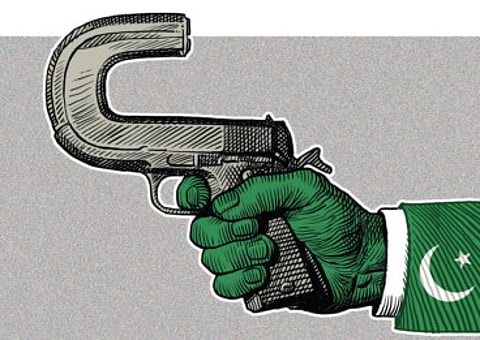
This is a theatre of war turning on itself. For years, Pakistan has bet on the Taliban as the glue that could bind a fractious Afghanistan together once international troops withdraw from the country. It has sat by and watched the Taliban’s ideological merger with Al Qaida in the hope that the latter would melt away once Afghanistan stabilises, with the Taliban as part of the ruling mix.
In the process, it has allowed militant outfits to seek refuge, and indeed legitimacy, under their umbrella. Pakistani analysts identify as many as 15 different Islamist outfits that now call themselves Pakistani or Punjabi Taliban. And more keep springing up. During this period, the Taliban leadership has changed many hands either because of US drone strikes or internecine power struggles.
Answerable to none
The resultant mix has spawned groups that have no discernible ideology, no constituency and no support. They are militias that thrive on a war economy. From kidnapping for ransom to extortion to car theft to blackmail, they have found the freedom that every criminal craves and only lawlessness can afford. The last thing they want is peace. The Taliban has issued a denial that they were involved in any of the attacks over the last 10 days. These groups appear to be answerable to none and will not be dictated to. This could well be the single most worrying outcome of Pakistan’s continued procrastination over how to deal with the spill-over effect of treating a volatile entity like the Taliban as a strategic asset. The “good Taliban” that Pakistan will not touch because they are needed in the post-Isaf Afghanistan are fast losing control of the “bad Taliban” that have now turned their guns on their host country. And no one seems to know how to deal with them.
More significant, this means that even if Pakistan and the Taliban’s mainstream leadership do negotiate some kind of a peace deal, there is no guarantee that it will bring peace as long as these militias within the Taliban cadres are not reined in.
At the moment, Pakistan seems to be at a loss on how to deal with this problem. The Pakistan Army says it has the capability to wipe out these militias if given a go-ahead by the government. However, the government is nervous about the backlash from any military operation against these militias. And with every passing day, Pakistanis are losing patience with the government’s dilemma. This is a government they elected with great fanfare less than six months ago. They would like to see it act, not to be held in terror by a small band of disparate militias that seem to be in no one’s control.
Aamer Ahmed Khan is BBC World Service’s Hub Editor for West and Central Asia and Editor of BBC Urdu.


