A crisis of credibility
Pakistani leaders should help country find its internal strength to face catastrophe
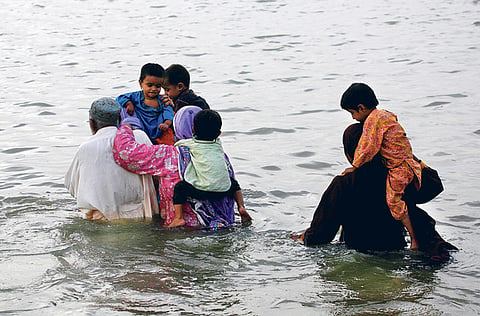
Pakistan's leaders are stepping up calls for billions of dollars in global assistance for victims of worst floods in the country's history.
It is not unusual for countries in similar distress to seek generous external help when catastrophes threaten the very foundation of their existence.
Yet, there are many controversial elements in the pleas, making them sound hollow for the domestic and external audience.
Within Pakistan, there appears to be a rapid build up of momentum among ordinary people eager to support flood victims. Yet, there is also a visible popular scepticism towards joining relief efforts which have to do with supporting government-led initiatives.
This only confirms a widely held view suggesting a lack of popular trust in Pakistan's ruling elite, though the needs of the 20 million displaced in the floods is indeed genuine.
But the risk from domestic and foreign donors essentially appears to be that of refusal to pass on support through Pakistan's ruling structure, led by its tainted elite with backgrounds linked to financial impropriety.
The same ruling elite have added to the controversy by losing focus on prevailing circumstances and instead politicising the situation. Prime minister Yousuf Raza Gilani last weekend publicly chose to take pot shots at Pakistan's past army generals for staging coups previously. Speaking on the issue, he claimed that such ambitious generals were known to have teamed up with corrupt elements and then ended up ruling the country for up to a decade.
Gilani's remarks, in response to suggestions from some Pakistani politicians urging the army to intervene, essentially suggests a failure to even mildly appreciate the severe erosion of his own credibility and that of his fellow elite. Instead of being confrontational, Pakistan's leaders must choose the moment to forge strong national unity.
Photo opportunities
That unity must then be followed up by a far sharper focus on dealing with the challenge that confronts Pakistan today. Instead of travelling from one location to another mainly for photo opportunities, someone in Gilani's position ought to concentrate on overseeing the response to the crisis.
Measures such as forming empowered teams of politicians as well as experts to streamlining the relief effort, and demonstrating an improvement in the disbursement process will eventually bring recognition for the ruling structure's efforts, both within and outside Pakistan.
But making this transition is easier said than done. Gilani and the political class that he represents have far from an established long term track record of pulling together progressive policies for the benefit of mainstream population. Time and again, the target of benefit from policies in key areas has essentially been already well-endowed interest groups. In spite of that history though, the moment of change may have finally arrived in Pakistan, with or without the liking of the country's top rulers. The widespread destruction and displacement from the floods have thrown up the biggest challenge confronting any government in the country's history.
Left neglected, it is possible that these displaced people will become increasingly restless and choose to agitate. This is a threat that remains a central challenge for Pakistan's stability amid reports of slums of some of the country's larger cities are already becoming destinations for flood-affected people.
Faced with a truly grim outlook for the future, Pakistan's leaders still have the choice of pulling up their socks, rising to the occasion and changing their own destiny as well as that of their country. But given the penchant of Pakistan's leaders to seek out quick fixes to complex issues, it is likely that they will not read the writing on the wall.
However, to continue on the same tangent and respond in ways such as seeking more external help to rid Pakistan of its crises, will simply aggravate the worsening situation. The central lesson from the crisis is that foreign-supported financial fixes can never fill the gaps that need to be addressed by nurturing a robust domestic environment.
Farhan Bokhari is a Pakistan-based commentator who writes on political and economic matters.


