That's entertainment!
"Life is far too important to be taken seriously." This quote seems to have become the guiding principle of Jeff Gordon's life. .
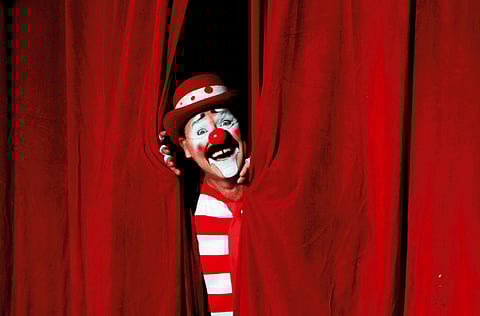
Oscar Wilde once said, "Life is far too important to be taken seriously." This quote seems to have become the guiding principle of Jeff Gordon's life. Gordon, widely considered one of the leading circus clowns of today, performed at the Big Apple Circus, which concluded in Abu Dhabi recently. He has performed across the globe with the Big Apple Circus, Cirque du Soleil, Ringling Bros and Barnum & Bailey Circus and at the Walt Disney World Resort. He has acted with world-famous American actor and clown Bill Irwin in the Broadway production of Largely New York. In 1998, he was the director of clowning in a show called Circus Diva.
"I thought it would look good on my bio if I joined the circus after college. I thought I could stay for a year and when I am an old man, I could say I was in circus. Lo and behold, it became my career. I have been with circuses for 30 years now. My only true home is the Circus Ring! My heart, mind and soul are sold to the laughter in the gallery when I am on stage."
1 I ‘ran away' from home to join the circus.
My father was a carpenter and my mother was into retail. After completing a bachelor's degree in art and anthropology, I was selected for a prestigious sponsored class of 60 from around 10,000 applicants at the Ringling Brothers and Barnum & Bailey clown college in Florida. In my undergrad college I was an NCAA (National Collegiate Athletic Association) All-American springboard diving champion. I was looking to travel and having adventures as a young man. When I was offered a place at the clown's college, I thought it was the perfect intersection between sports, travel and theatre. I spent that year running down a ramp, jumping on a springboard and somersaulting over three elephants during shows at the Ringling Bros and Barnum and Bailey Circus.
A friend of mine who taught at the Clown College called me from New York one day and told me about a small circus called the Big Apple Circus. They didn't audition me to be a clown, but just to be part of the whole show. I think Big Apple Circus was in its second year with just three or four months of performances the previous year. I joined the Big Apple Circus in 1981. I was willing to do anything with the Big Apple Circus to be a part of the show such as run the spotlight or walk behind the elephants with a shovel. I created and portrayed "Le Clown Gordoon", a new American-style clown character. I shared the spotlight with Michael Christensen (Mr Stubbs) and Barry Lubin (Grandma) and together we became the Big Apple Circus' most celebrated clown trio.
What I intended to do for a year has become my lifelong passion.
In 1989, I left the Big Apple Circus after around ten years of performing with them, in a quixotic attempt to run away from the circus to be at home.
I was looking for some sort of a balance in life. I was tired of travelling. I wanted to collect things and set up a home. You can't collect things when you live in a mobile home. Now I don't leave home for a year at a time. I take small chunks of work regionally so that I can balance the security of home life and the adventures on the road.
I did a Broadway show with Bill Irwin who is a brilliant clown actor. There were no words in the show, just dance and mime.
I played The Dean in Bill Irwin's Largely New York on Broadway and on tour. It ran for about six months and also played at the Kennedy Centre in Washington and Seattle Theatre.
Later the pull of the circus was too strong for me to resist so I went back to it in 1991.
2 Some people tell me that I don't look like a clown.
Or they ask me to do something funny. It just goes on to show that there is a certain disbelief in having a career as a clown.
Rarely a few people are freaked out. I stop the conversation then and there. If a child is afraid of an outlandish costume, I would forgive him. But when an adult pretends to only see the stereotype associated with a costume, I quit conversing with them. Clowns choose to look different. It's a tradition that we choose to look comical. The villainy associated with a costume is just a marketing ploy strategised by film makers and television directors to pull the crowd.
I would rather focus my energy on the goodness in this world. I want the audience to appreciate my world of clown magic. Most indigenous societies have a clown-like character in their rituals that has licence to make fun of authority, to stand outside of the action and comment on it, then step inside and participate. I am just a growing link in that history.
3 There isn't much that I want.
Probably my only regret is not having a child of my own. I am a very good uncle and I am proud of that. But as a teacher, as a performer, as a clown backstage and on stage, I have been able to make many children laugh. I take pride in that. I could literally say that I have contributed to the cultural welfare of millions and millions of children around the world. A lot of parents can't say that. So I have nurtured the world in my own way.
The more experienced I get as a clown, the more I have problems with my age and body. It's the law of diminishing returns. I am 56 and I can't do two or three shows a day. At the Big Apple Circus Show for the Abu Dhabi Summer Surprises, organised by Abu Dhabi Tourism Authority, we did one show per day. It's a really good thing for circus people because we can go on a full-blown performance and there is no need for pacing our energy.
4 I am used to working in chaos. That is the nature of circus.
I am always nervous before a show. If I am not, then I have reasons to be concerned. Nervousness sharpens my senses and I give my best.
5 It is my job as a clown to be a mediator between the audience and the marvel of the show.
I stand outside of the action, stumbling, creating mischief and commenting on it. I take the audience along with me on a roller-coaster ride. The clown is on the audiences' side but has entry into the ring. Being able to be on both sides of the ring is a special theatrical dynamic and breaks the barriers between viewers and the viewed.
When the audience sees the amazing tricks and drama of the circus, they tend to put it on a pedestal. It is the clown's job to bring them down to earth and show that these artists are ordinary people who are highly skilled and have perfected their skills with practice and hard work. The clown shows them that it isn't computer generated graphics or recorded video. Clowns make the physicality of skilled shows accessible and human.
6 Even though I have the most bizarre costume and make-up - I am the most human when it comes to the spectrum of emotions.
The clown lives in a world of paradoxes. It's the clown's job to hold a mirror to the audience wherein they say, ‘Yes, I have been frustrated, I have been in that situation and I have been laughed at!' The audience identifies with the foibles of the clown. That gives me the licence to misbehave and be mischievous.
To quote Oscar Wilde ‘Life is far too important to be taken seriously.' which I think is a wonderful insight.
I would advise people to teach humour. Laugh at yourself. Don't take yourself too seriously. Embrace your humanity. We are but on this planet for a blink of an eye. To encourage a child to find humour is to encourage that child to test his intellect. One of my greatest inspirations as a child was my maternal grandfather, Earl Schaum. He taught me to do simple magic tricks. Later he taught me a bit of acrobatics and built some stilts for me. I am sure he never did a backhand spring in his life, but he saw how agile I was and taught me to be physically clever.
Looking back, I think it was my grandfather who cut this path for me.
7The hardest work I have done is at hospitals.
Michael Christensen founded the BAC (Big Apple Circus) clown care unit in the US and I was a co-founding member. We visited terminally ill children on their hospital beds. To bring humour in a hospital situation is very tough. But we went bumbling down the hospital corridors dressed as doctors and it lit a smile on the children's faces. Often people forget that little children in hospitals are not just patients. They want to just be a child, play and have fun. The children were happy because we weren't taking blood samples or putting needles into them.
It made the parents and doctors happy too. What we did was needed for every child to heal. It was a bright spot in their life - to just laugh and be human. It gave the parents and the doctors a new perspective of life. The programme was a huge success and is currently acknowledged and funded by medical insurance companies.
8 I conduct workshops for students aged between five and 85 teaching them to develop a sense of humour and a sense of play.
I am not only teaching people juggling skills but also creativity.
In Pittsburgh, I have a furniture shop called Who New? Retro Mod Decor where I sell antique furniture with designs from the 1950s and 1960s. It's very collectible and architect designed. That's the architect and collector side of me.
9 I am crazy about Abu Dhabi.
I think the architectural development is phenomenal. I am impressed by the fact that the UAE has a global vision and is working to be a cultural centre and choosing what it wants to be portrayed as in the international culture scene.
10 I like to write too. I have been encouraged by my family to write my autobiography.
If I had taken a different path, I might have been a dancer. I have worked in a ballet company even though I am not a great dancer by any stretch of imagination.
Sign up for the Daily Briefing
Get the latest news and updates straight to your inbox


