New species: 2011 Ford Explorer's evolution
Is the gigantic new Ford Explorer a great SUV, or a dying breed?
What if the dinosaurs had survived? What if the asteroid missed, and those cold-blooded dimwits managed to make it through the ice age as well?
Well, scientists say that some of them would have developed brains bigger than ping-pong balls, and become warm-blooded to an extent. They'd still be the biggest, baddest animals on the globe, but they wouldn't be as moronic and they'd manage to survive a planetary recession, such as an ice age.
So, basically, they're exactly the same as SUVs. These behemoths started out as tractors with electric windows and evolved into technologically advanced family vehicles with economical engines, lighter construction and luxury amenities. They're the motoring dinosaurs of our world.
And here we have the new Ford Explorer and it's basically the biggest, toughest dinosaur of all.
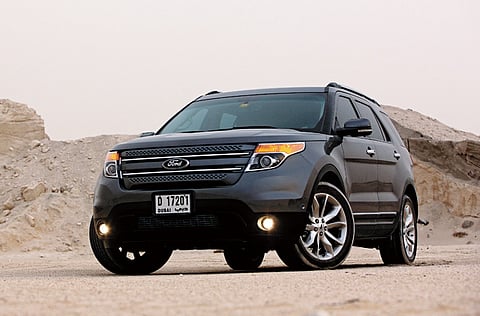
The 2011 Ford Explorer has been improved by leaps and bounds upon the old model, with better fuel efficiency, safety, more technology, and higher quality. It's evolved, basically. It's also huge: longer and wider than the old one, but lower, and yet offering more headroom for all passengers. All this space for its occupants has robbed the Explorer's cargo capacity a little, but only when the seats are folded flat or (practicality points here), stowed down.
Any which way you look at it though, this thing is not a mid-size SUV. It dwarfs everything this side of an apartment block, including Land Cruisers, despite sitting on a car platform and in spite of Ford's designers trying hard to conceal its size through the strokes of their pens.
But they have succeeded in making it handsome, with a clean profile highlighted by the forward-surging C-pillar and that wraparound rear windscreen. There are also some LEDs and 20in ten-spoke alloy wheels.
Nobody buys this for the styling though, so moving on to the interior and you slip into an opulent cabin awash with soft-touch surfaces, leather, mood lighting and, most of all, acres and acres of that ultimate luxury: space. Everything is power-adjustable, including the pedals — which is crucial in a huge car, especially for women drivers — and the seats are padded with Sealy Posturepedic, I presume. The level of kit is also exemplary, with enough cup holders to host a Dubai Little League baseball team, a panoramic roof, keyless entry, eight airbags, as well as two USB ports.
And then what should be the shining beacon of this interior turns out to be the disappointment, with the MyFord Touch display in the middle that operates pretty much everything. There's no sat-nav (yet), but the 12-speaker sound system is fantastic. You can set-up whatever you want, whether that be the colour of your interior lighting, the air conditioning or the phone and voice controls.
The problem surfaces when you actually try to put a command through. The ‘buttons' are too small and the system isn't quite as responsive as you'd expect.That's the dinosaur element of its personality resurfacing... Even flipping between pages becomes wearisome. The graphics are gorgeous, but the system just can't cope quickly enough to make the transitions as smooth as flicking through the screens on your iPhone for example.
However, the customisable instrument cluster is a redeeming feature. It is filled with information so detailed that it will take a while to get used to it, which is something I didn't have the chance to do in the 48 hours that I had with the car. But everything does seem to be there, in beautiful high-res.
And then this leviathan really starts to get going. With Ford's new 290bhp 3.5-litre V6 struggling in the 2.2-tonne Explorer, progress isn't exactly rapid. The power peaks at 4,800rpm while a decent 346Nm of torque chip in at 3,500rpm, but there's just no getting away from the fact that this thing is gigantic and needs two turbos or a thirsty V8 to be average.
Ford says that you should be able to see 11 litres-per-100km, thanks to the six-speed auto — which is smooth and performs its act admirably in the background by the way — and variable valve timing, but with a mixture of both city and highway driving, I struggled to see anything below 20 litres-per-100km.
The ride quality is great though, as you'd expect, with a long wheelbase and plenty of sound-deadening all over the cabin muting exterior noise. But talking about handling and road-holding is a waste of time in any SUV. Even with a lower height in the 2012 Explorer, its centre of gravity is still too high and weight transfer on this soft suspension set-up is like water sloshing around in a half-full bucket. As is, it corners fine for an SUV to be fair, but considering it's on a car platform it should've been better.
Maybe the trade-off is in the Explorer's off-roading ability, as Ford fitted a full terrain selection dial that lets you choose a mode for sand, mud and so on. But I didn't test that out, and I don't suppose you'll care because nobody buys this for dune-bashing. Don't worry, you can climb a kerb no problem.
Verdict
Now, I'm not a palaeontologist, but it doesn't take an expert to punch some letters into Google. So the internet told me that one of the coolest dinosaurs ever was the stegosaurus. What's more, recent research suggest it was cleverer than its other gigantic brethren.
And the 2011 Ford Explorer also surprised me after I paid it some attention and did some research by actually driving it for a couple of days.
It offers a luxurious and spacious interior and sleek looks. Certain bits of it though, should be fossilised.
So in conclusion, the 2012 Ford Explorer is, like pretty much every SUV out there, a dinosaur. But hey, at least it's a stegosaurus.
Specs & ratings
- Model Explorer Limited
- Engine 3.5-litre V6
- Transmission Six-speed auto, AWD
- Max power 290bhp @ 4,800rpm
- Max torque 346Nm @ 3,500rpm
- Top speed NA
- 0-100kph NA
- Price Dh185,000


