How author Eowyn Ivey turns Alaska’s snowdrifts into fairy-tale worlds: Wilderness meets the heart
Ivey is in the lineup of the 18th edition of the Emirates Airline Festival of Literature
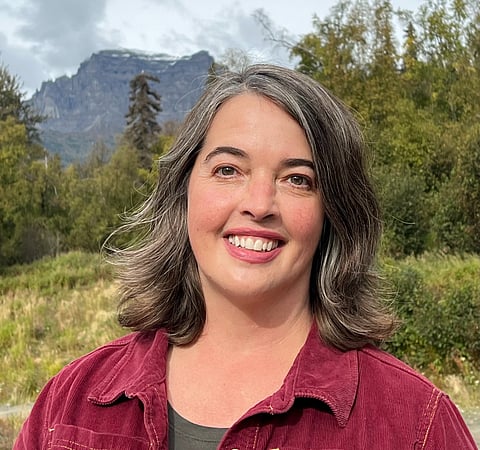
There’s a quiet solace in Eowyn Ivey’s novels. A soft magic, the kind that feels as if it could emerge from the snowdrifts of Alaska or the hushed corners of everyday life. Perhaps it comes her childhood of reading stories set in far away lands, like the British Isles, Ancient Greece or even Middle Earth.
In a recent conversation with us, Ivey shared how she blends fantastical elements with real-world settings, a skill that has earned her acclaim and drawn readers into worlds that feel utterly believable yet lightly dusted with wonder.
Balancing the fantastical with the everyday
Originally a newspaper reporter, a job that involved sticking to facts and conveying information in a straightforward manner, she longed to bridge the two extremes: The real world and the fantastical. And that’s what she did with The Snow Child. “In my stories, there is typically only one aspect that is fantastical, and I strive to ground that bit of magic in a very real Alaska.”
Ivey, who grew up in Alaska, explains that the landscape engulfs their lives, and slowly shaping her storytelling. “The mountains in all directions, the extremes of light and dark, the wild animals, the ruggedness of the weather and terrain. It’s impossible to ignore,” she says.
At first, she was worried that it would be a disadvantage in her writing career as it was far from literary centers like New York. Yet, she realised it was actually her strength. “Writing about the natural world comes more easily to me than other aspects of the process. I find that the more I write about the wilderness, the more I want to learn, and each of my novels has further focused my attention on the environment around me and given me an excuse to go on some incredible research trips around Alaska,” explains Ivey.
The pull of recognition and the discipline of writing
Ivey’s debut, The Snow Child, received a Pulitzer Prize nomination, an acknowledgment that opened doors and yet introduced new challenges. No doubt, it changes everything, as she says. “The trajectory of The Snow Child, opened many doors for me. It has enabled me to become a full-time writer and to visit places like Dubai, Hong Kong, Australia, France,” adds Ivey. “My family and I have had so many new opportunities and met wonderful people because of it.”
However, it tends to become a distraction, when it’s time to sit down and write. “I’m actively working on a novel, I have to stop thinking about any outside perceptions of my work, the praise or the criticism; it’s like I have to pretend no one has ever read my work before, that there never was a Snow Child, and it's just me, alone with a story I want to tell.”
Finding realism in fairytales
Even as her stories touch on magical or fantastical elements, Ivey draws heavily on observation and grounded reality. It circles back to Alaska, and her career as a reporter. “I was writing about my neighbours and my outdoor adventures, and that helped hone my senses and observation skills. I learned to look for the sharp little details that can help bring a person or scene to life. So now that’s my goal as a novelist – to create characters and a place that are as believable and vivid as possible to readers, with the hopes that they’ll be able to suspend their disbelief when something unexpected and fantastical happens.”
Themes of isolation, resilience, and connection
Her upbringing in rural Alaska, with its harsh winters and solitary expanses, naturally informs recurring themes in her work. As Ivey says, it can be ‘harsh and lonely’, but Alaskans take pride in being hardy, steely and independent. They help each other. “In retrospect, I see too that aspects of my childhood, both the good and bad, served to heighten that sense of isolation,” she adds.
As a young reader, she was in love with books like Little House in the Big Woods, Island of the Blue Dolphins and The Boxcar Children, which emphasise self-sufficiency, but also soft comfort and safety of home. “But I don’t think this is unique to Alaska or my upbringing. No matter where or how we live, these themes are part of the human experience.”
A peek into her writing process
Ivey’s creative method is part research, part inspiration, and part intuition. “So far with each of my novels, I have been initially inspired by a fairy tale or true story that then became the backbone of my novel. It’s not necessarily an outline per se, but a general idea of the arc of the story,” she says.
She pieces it all together by collecting images, snippets of poetry, photographs of art, places and people, anything seems like it’s a part of the world she envisions. And then she begins with a scene that evokes what drew her to the idea. “It’s almost like a heat I can feel at the core of the story and I try to write into that. I tend to write mostly from the beginning to the end of a novel, and I have an idea of where it’s going, but as the characters develop, as the themes reveal themselves and the story unfolds, it often leads me in unexpected places,” reveals Ivey.
And then of course, there is a lot of interaction with her early readers –her husband and daughters and longtime agent and editors. “They are critical in helping see where the story works and where it doesn’t, and that process shapes it as well.”
Fairytales as a universal lens
At the heart of Ivey’s novels are a simple story: An old man and woman build a girl out of snow. She comes to life. An explorer leaves his wife to venture into the mysterious heart of Alaska, and a woman falls in love with a man who is really a bear.
“As I begin writing and researching the tale that initially sparked the idea, I start seeing the themes pop up again and again in literature and art and music, all through time, because they touch on some universal longing or fear," explains Ivey.
She enjoys exploring the different angles of human emotion. "But the novel itself -- the time and place where it happens, the personalities of the individual characters, the arc of the plot – comes to dictate the structure and narrative voice.”
Through it all, Ivey’s work demonstrates that a little magic can exist in the most grounded, familiar places — you just need to know where to look.
The author is in the lineup of the 18th edition of the Emirates Airline Festival of Literature happening in Jan 21- Jan 27, 2026.


