Porcelain Queen
InsideOut meets up with Rosa Lladro
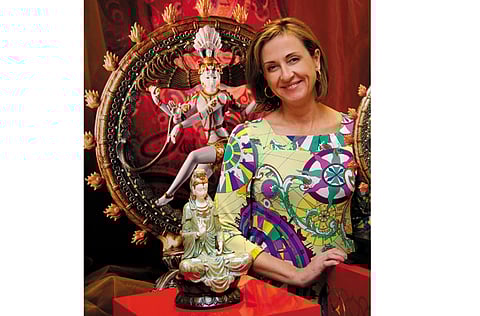
Rosa Lladro's unassuming air has a quiet dignity about it. She is, after all, porcelain royalty. Daughter of porcelain ‘kingpin' Juan Lladro (the eldest of the three brothers who founded the company Lladro), Rosa grew up with no other career ambition but to join the family business. "I didn't have a choice in the matter, but at the same time I really didn't want to do anything else. I joined the business at the age of 21 and was only too happy to learn."
With a Fine Arts degree from Valencia, several key courses from business schools and years of working under a perfectionist father, Rosa earned a position as a member of the Lladro Board of Directors and eventually became President in 2003.
Spanning continents, the Lladro brand is the indisputable reigning king of the porcelain world, and holds an esteemed position in the gifts and accessories sector. A Lladro piece in a home speaks of wealth and class amongst the international and affluent elite, and is a hot favourite with celebrities. But in keeping with the grace and attitude that is befitting of such brands, Rosa did not indulge in any celebrity name dropping.
"We do not like to disclose our clients out of respect for their privacy. I can, however, say that my father gifted Pope John Paul II The Three Wise Men, a Lladro classic, on one of his visits." Consequently, after the first successful Apollo mission in 1969, when the Pope received the three astronauts, he gifted them with The Three Wise Men. This is a matter of great pride for Lladro."
The company was first formed in 1953 by three brothers Juan, Vincent and Jose Lladro. Their dedication to and innovation in porcelain making techniques saw the tiny company evolve into a thriving enterprise with worldwide brand recognition and international clientele.
Lladro now has its base in Valencia in the City of Porcelain, an innovative complex which houses the factory, offices and production base as well Lladro's body of artists and craftsman. The City not only promotes the labour industry within the area, but also gives back to the community by keeping aside a set labour quota for disabled workers. Rosa launches into a passionate summary on the life of a Lladro porcelain piece, making it quite clear that their creations are far from ordinary or mass-produced.
"I would like people to understand and appreciate all the work that goes into each piece. It is a very lengthy and complex procedure that takes place in our factory in Valencia. We have been making porcelain for years, and we may have more colours now, but the process remains the same and is just as authentic. The journey from concept to finished product is a long and enduring one, but it's also a labour of love. I would really like to invite everyone to come to our factory in Valencia and see how the process actually takes place. After this, they would surely have a newfound respect for the finished product."
Rosa talks of her father's passion and penchant for detail, admitting that she too is a perfectionist. But she can also be relaxed when necessary. "We have to be, for our work involves a lot of travel and interaction with other cultures. We bring in inspiration from these cultures." She proudly admits that her father's vision is modern in its concept and its artistic flair. "I very rarely disagree with him. And he really knows what he wants. I learnt to pay attention to craftsmanship. My father was very much into quality and always pushing boundaries."
Whilst the company is open to diverse global inspirations ranging from classic ballerinas and horses to exotic Hindu deities, and their own team of artists continue to pitch and hone fresh ideas for new pieces, the Lladro family remains involved in the creation of each piece. "It is inherently a family business. We are big enough now to take risks, to try new things on the creative side. And all these decisions are still made within the family."
The Spirit of India along with the High Porcelain range were recently unveiled at Tanagra Wafi City where we caught up with Rosa. The Spirit of India range features bright colours and gold pigment-covered porcelain representations of symbols, figurines and everyday scenes from Hindu mythology and traditional India. The Shiva Nataraja, the star piece, grabs the eye. This is a complex creation even by experienced craftsman's standards, and there is a painstaking process that goes into making such a work, as Rosa explains.
"Each figurine is initially sculpted in clay and a mould is created from that. The finished mould could be made from anywhere between 100 to 300 individual moulds. This mould can be reused, but not endlessly, and each time it is used, it has to be recleaned, dried and resealed." The Shiva Nataraja was an unusual challenge for Lladro's artists and craftsmen as it was the first Lladro creation to have a secondary freestanding frame around the main figurine in a traditional dance pose. The vast palette of exotic colours used in the minutest of details posed further challenges in glazing and firing.
The City of Porcelain produces over 800 models, and Rosa admits that all these cannot be showcased in each store worldwide. A select range is carefully picked based on the culture, demands and trends of each region. For the Dubai clientele, the selection process was easy.
"Dubai is an interesting mixture of cultures," says Rosa. "In some ways, it is very open-minded and modern. I was driving past amazing buildings and was truly impressed. In a city like this, we can pretty much feature any range and it will be well received."

