An Artist's Enclave
Filled with the artist and homeowner's work, this home is a living gallery
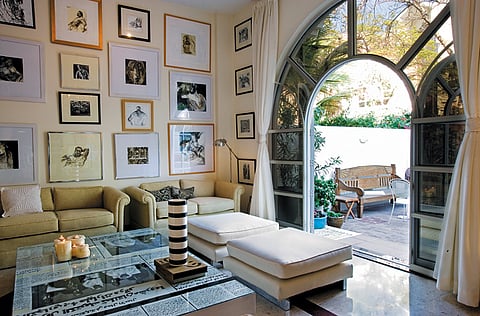
Samar and Seemita Roy's move from their apartment at the Golden Sands was rather unexpected. When the management of the building decided that residents with pets would have to vacate, the Roys found themselves in a dilemma. The apartment in which they had lived was large, the living room went on and on, and more importantly, they were well ensconced in it, never entertaining any thoughts of moving. In a whirlwind of visits to real estate offices and checking out potential residences, they decided to move into this double-storey townhouse in Umm Suqeim with high ceilings, a pretty patio and enough room for all the belongings they had gathered over their long stay in Dubai.
Seemita, a well established artist, was the one in charge of decorating the space. Like her old apartment, the new home's décor would be underpinned by her huge collection of art. Her initial quandary was how to contain bold, large canvases in a living room that was smaller than the one she had left behind. She didn't want the paintings to dwarf the space but provide a good base to showcase her skills. Enter the one staple that homeowners and designers rely on to lend an air of spaciousness - mirrors. She went about covering quite a few walls with large-sized mirrors and immediately the room began to look much more expansive whilst accommodating the imprimatur of its artistic resident.
As Seemita laboured to put her home together, one of the first things to be placed were paintings. These went up one by one and eventually the room evolved in the fashion that Seemita had envisioned. Seemita's design ethos has been one of metamorphosis. In the 20 plus years that she has lived in Dubai, she changed design styles, starting with very traditional Chinese and Indian furniture. "When I first came here in the 1980s, ornate Chinese furniture was available freely," she recalls. "I went through a phase and collected quite a few pieces. Then these warehouses opened up all over Dubai and Sharjah, and Indian ‘antique' furniture became the fad. I bought quite a few pieces and my home began to look very Indian in style." She has finally found her resting place - one where modern melds with some traditional flashes. "I have realised that modern contemporary décor with its streamlined furniture is so much smarter and easier to maintain. There isn't as much dusting involved and everything works in a far more efficient manner - no curlicue or fleur-de-lis corners to clean. However there are still pieces in the house that need changing." Her dining room is a case in point. With a traditional Chinese table and matching chairs, these are pieces that Seemita would love to swap for a more modern setting. "But this will take some time," she says. Meanwhile, she has assuaged her desire by covering the table with a pretty crochet table cloth topped up with Spode crockery from England in delicate shades of pale pink and green. Light floods the room during the day and the result is quite charming.
The living room is mostly modern in tone. Huge coffee tables covered in Arabic script anchor the space. "These tables have been painted by a student of mine who is a very gifted young man." Colours have been added by way of giant canvases that plaster almost every single wall and the room is further enlivened by the use of coloured glass. Beige and white linen covered sofas all around provide ample seating while a plexiglass cube holds her collection of coffee table books. Another wall is covered in little black and white images once again painted by Seemita, adding softness to the room. A giant hot pink and scarlet piece of art adds a whopping dose of vibrance, while myriad faces in it look down at the proceedings with doleful expressions. "I painted this at a time when I found myself painting images of catwalk models, perhaps inspired by too much Fashion TV," she laughs. At the other end of the room is another painting with a man's face, mostly in tones of deep blues and blacks. "I remember seeing this man in a bus lineup on one of my trips to Kolkata, and the sun picked out the lines on the his face very well. When I came back, I had to paint the image quickly before it left my mind." In a departure from a ubiquitous artist's abode, and in keeping with her mood, now decidedly minimalist, the home is devoid of artistic clutter, a fact that has long defined the genre.
Townhouses do have their advantages though - the landscaping outside is managed by the owners of the building, allowing residents to have the pleasure of looking at it, minus the travails and expenses of maintaining one's own garden. When the Roys moved in, their immediate patio bore the frisson of its desert location - it loomed bleached and bare, and there was little by way of greenery. Seemita busied herself, buying dozens of pots in varied colours and sizes, and filling them up with a variety of blooms. A wooden Buddha painted a vibrant shade of ultramarine blue adds quirkiness to the outdoor area.
The master bedroom is a peaceful space with pale shades of aqua and green in the paintings. The guest bedroom is a mixture of simplicity and ornamentation, the paradox working very well here with gold-leafed, ornate candelabra on either side of the bed flanking a massive canvas filled with colourful angels. A pink cushion in the shape of a rose is the only colour on the simply made up bed.
Inspiration for Seemita's art comes from just about anywhere. "I have always veered towards figurative art; I find it challenging to capture the myriad expressions of people. I did dabble in the abstract medium but realised it wasn't my forte, plus it didn't stimulate me during the process." She was tutored in Kolkata, her home town, by renowned Indian artist Bikash Bhattacharjee and considers herself lucky to have been able to work under the auspices of the clever maestro. "He pushed the boundaries then. I was also lucky to be brought up in a culture with the omnipresent spectre of aunts and uncles who streamed into our house day and night. Everyone would be there, peering at my work from the time I was a little girl to my years through art college, giving praise or advice. My grandmother, who died a few years ago, has left a large void in my heart; it was her encouragement that has got me where I am today. She would accompany me to classes - always there for me, extolling my artistic virtues every time I brought home a piece of finished work."

