Is there any solution for carnation corns other than surgery?
Corns and calluses are often confused, but they're not the same
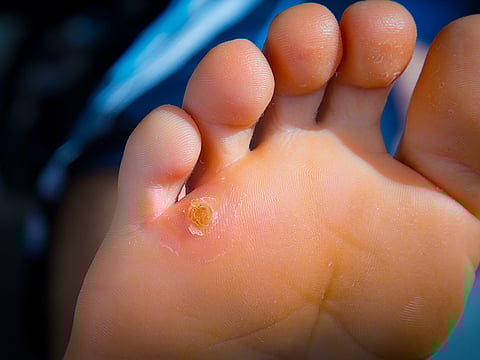
A readers asks: Is there any solution for carnation corns other than surgery?
Dr Rosamma Sabu, licenced homeopathic practitioner, Al Balsam Homeopathic Centre, Sharjah, replies: For corns, surgery is not the only option. It can be treated with homeopathic medications.
Corns and calluses are annoying and sometimes painful thickenings that form in the skin in areas of pressure. Corns and calluses can be prevented by reducing or eliminating the circumstances that lead to increased pressure at specific points on the hands and feet.
You may have a corn or callus if you notice a thick, rough area of skin a hardened, raised bump tenderness or pain under your skin. Flaky, dry or waxy skin.
Corns and calluses are often confused, but they're not the same: Corns are smaller than calluses and have a hard centre surrounded by inflamed skin. Corns tend to develop on parts of your feet that don't bear weight, such as the tops and sides of your toes, though they can also be found in weight-bearing areas. Corns can even develop between your toes. Corns can be painful when pressed. Calluses usually develop on the soles of your feet, especially under the heels or balls on your palms or on your knees. Calluses are rarely painful and vary in size and shape, though they're often larger than corns.
Common locations for corns are:
- On the sole, over the metatarsal arch (the 'ball' of the foot)
- On the outside of the fifth (small or 'pinky') toe, where it rubs against the shoe, between the fourth and fifth toes
Unlike other corns that are firm and flesh-coloured, corns between the toes are often whitish and messy; they are sometimes called 'soft corns' (heloma molles), in contrast to the more common 'hard corns' (heloma durums) found in other locations.
People with fragile skin or poor circulation in the feet (including many people with diabetes or peripheral arterial disease) should consult their health-care professional as soon as corns or calluses develop. The medical term for the thickened skin that forms corns and calluses is hyperkeratosis.
Why do corns and calluses develop?
Hyperkeratosis simply means thickening of the skin. This thickening occurs as a natural defense mechanism that strengthens the skin in areas of friction or excessive pressure. Abnormal anatomy of the feet, such as hammer toe or other toe deformities, can lead to corn or callus formation as can bony prominences in the feet. Footwear that is too tight or that exerts friction at specific points can also cause skin thickening that leads to corns and calluses.
Abnormalities in gait or movement that result in increased pressure to specific areas can also be the cause. It can be hard to know why finger corns develop since they often don't appear at sites of obvious pressure. Finger calluses may develop in response to using tools, playing musical instruments, or using work equipment that exerts pressure at specific sites.
Some of these risk factors are:
- Abnormalities in anatomy of the feet or toes
- Abnormalities in gait
- Bunions
- Poorly fitting footwear
- Using equipment, tools or instruments that exert pressure on specific locations on the fingers
- Certain occupations, such as farmers or garden workers
What are symptoms and signs of corns and calluses?
The area may be dry and may appear to be scaly or flaky. Corns and calluses can sometimes cause pain or discomfort if they interfere with walking or other activity, but they are typically painless.
How are corns and calluses diagnosed?
The diagnosis can be made by observing the characteristic changes in the skin. Specialized tests are not necessary.
HOMEOPATHIC TREATMENT
Homeopathy has good scope in the treatment of Corns and Calluses. The medication can help in reducing the corns over a period of time and also reduce the pain associated with the condition. It is important to note that removal of the causative factor is very essential for the treatment. If the corn has been caused due to ill-fitting shoes, the patient must change the footwear so as to remove the causative factor for more corns to develop. Some people have an inherent tendency to develop corns and calluses and homeopathy targets this tendency and strives to remove it from the roots.
Homeopathy is strongly suggested for all cases of corns and calluses. Homeopathy offers a safe and long-term remedy. Not only does it sidestep a painful and expensive procedure, but it assures a permanent cure. Corns do not recur once treated successfully with homeopathy. Painless and effective homeopathic treatment involves only natural medicines taken orally in the form of pills, making it easy to administer. There are no side-effects either.
Homeopathy treats the person as a whole. It means that homeopathic treatment focuses on the patient as a person, as well as his pathological condition. The homeopathic medicines are selected after a full individualizing examination and case-analysis
Following points should be noted for CASE-TAKING:
- Causation: wearing tight shoes with repeated shoe bites.
- History of previous treatment
- Location: like palms, soles
- Characteristic: Flat, soft, hard
- Whether corns are associated:
- With or without inflammation
- With or without itching
- With or without bleeding
- With or without suppuration
- With or without ulceration
- Tender or non-tender.
- Important characteristic sensation like: burning, stinging, stitching
It is strongly advised not to recommend any local application for the treatment of corns while using homeopathy.
Conventional treatment:
Trimming: Your doctor can pare down thickened skin or trim a large corn with a scalpel
Salicylic acid: Additionally, your doctor may apply a patch containing 40 per cent salicylic acid prescription. He or she will let you know how often you need to replace this patch, and may recommend that you use a pumice stone or a metal nail file to smooth away the dead skin before applying a new patch.
Shoe inserts: If you have an underlying foot deformity, your doctor may prescribe custom-made padded shoe inserts (orthotics) to prevent recurring corns or calluses.
Surgery: In rare instances, your doctor may recommend surgery to correct the alignment of the bone causing the friction.
What is the prognosis for corns and calluses?
Corns and calluses are not serious conditions and can be managed with home-care remedies or medical treatment. Surgery is rarely necessary. However, even with management, corns and calluses may recur if there is continued pressure or friction on the affected area.
How can corns and calluses be prevented?
- In many situations, calluses and corns can be prevented by reducing or eliminating the circumstances that lead to increased pressure at specific points on the hands and feet. Potential preventive measures therefore include the following:
- Wearing well-fitting, comfortable shoes is useful. The idea is to avoid having footgear press on the outside of the fifth toe or pressing the fourth and fifth toes together to prevent corns in these areas
- Another approach is to pad the potentially affected area. Many sorts of padding are available at the drugstore
- Cushions to put between the toes
- Foam or moleskin pads to put over the places where corns form
- Foam pads with holes in the center (like donuts or bagels), which redistribute pressure around the corn instead of right over it, cushioned insoles to pad your feet and alleviate mechanical pressure
- Through varied measures and precautions, corns and calluses can be fully treated
I hope that the above details will be sufficient for clearing your doubts.
Disclaimer: This blog is a conversation and is not an alternative for treatment. The recommendations and suggestions offered by our panel of doctors are their own and Gulf News will not take any responsibility for the advice they provide.

