A wealth of accomplishments
Shaikh Rashid Bin Saeed Al Maktoum's foresight and acumen propelled Dubai
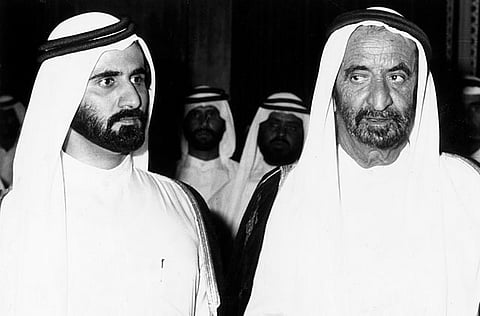
Last week marked the 20th death anniversary of Rashid Bin Saeed Al Maktoum. Shaikh Rashid (1912-1990) was one of those rare and truly impressive figures of the 20th century who, despite significant hurdles, managed to transform dreams into realities. While later efforts with his contender cousin, Shaikh Zayed Bin Sultan Al Nahyan, the ruler of Abu Dhabi and president of the United Arab Emirates before and after the establishment of the federation in 1971, are legendary, the older Rashid embarked on his highly perilous adventures to "invent" his emirate into a forward-looking economic powerhouse as early as 1939.
Born in 1912, Rashid was heir apparent, regent or ruler of Dubai for more than 50 years, time that was spent to secure his family's uncontested rule over Dubai. A highly intelligent man, Rashid understood long before the Arabian peninsula was awash in oil revenues about the commodity's limited shelf-life.
To avoid dependence on temporary wealth whose ultimate marketing and incomes were controlled by outsiders, the energetic Rashid, inspired by his equally gifted mother, Shaikha Hussah Bint Al Murr, settled on an alternative economic model, one that would transform a backwater hamlet into one of the world's most vibrant cities, all within a single generation.
He accomplished this without neglecting his duties within the UAE federation, as he committed himself to a genuine federation that empowered all seven shaikhdoms, even if a centralised federal government was the inevitable outcome he long dreaded.
The early years
Rashid was nestled into the Al Bu Falasah faction of the Bani Yas tribal federation in Abu Dhabi, controlled by the Al Falah — to which the Al Nahyan belonged. The break-up occurred in the 1830s with the Al Bu Falasah settling in what eventually became Dubai. Over the decades, the two emirates nurtured a healthy rivalry, clashing from time to time over territorial and other matters, which were common occurrences throughout the lower Gulf region.
In the case of Rashid and Zayed Bin Sultan Al Nahyan, the rivalry was heightened by contrasting personalities, one a cosmopolitan mercantile leader who disparaged badu culture, while the other embodied "the values of tribal society".
It would be accurate to write that most badu harboured inborn suspicion of mercantilists, misreading business cunning and bold flair as extravagance and, perhaps, overconfidence. Still, life was different in the first half of the 20th century when both Rashid and Zayed applied their respective plans.
Between the two men, Rashid ruled with urgency, anxious to do things in a hurry and, remarkably, seems to have inherited the bulk of his character from his determined mother. Though cerebral and shy like his father, his business acumen and economic savvy were not innate qualities but nurtured by his mother.
Hussah pushed the young men to frequent key merchants along the famous Creek to observe their activities and learn from ordinary but true masters. This was applied education par excellence which came in handy during the period of his regency between 1939 and 1958.
It was during this key period that Shaikh Rashid first displayed his resolve to change things. At the end of the Second World War, against the advice of the British political agent, Rashid decided to build an airport for Dubai. Simultaneously, in pursuit of his objective — to build basic infrastructure that would fuel economic strength and expand wealth — Rashid became the paradigm of the political leader who understood the value of business.
Only wealth could pay for health care and education and it was vital that he ensured steady resources to pay for the dispensaries, hospitals, schools and other basic requirements for his subjects.
Rashid recognised that rudimentary health facilities and basic education could only be guaranteed when his coffers were full. This pragmatism propelled him to expand the port of Dubai, establish a modern municipal administration that codified a rational development plan and embark on numerous other projects — all with the active involvement of the private sector.
News spread throughout the region that Dubai was open for business as Iranian and Indian merchants settled in droves. Highly tolerant and open-minded to the city's development, Rashid embraced both communities, whose sophistications added value long before oil-export earnings filled the emirate's coffers, starting in the 1960s.
Remarkably, Rashid did not sit on his laurels but quickly jumped on the construction of a modern harbour. Within a few years, Jebel Ali Port, the Dubai Drydocks, the Al Shindagha Tunnel, the Dubai World Trade Center and Port Rashid, not to mention a much-expanded airport, changed the city's architecture. To his credit, the ruler trusted his merchant leaders and persuaded them to pay initiatives that served each and every one. Rashid actually wanted his subjects to earn well because he instinctively knew that wealthy subjects ensured political stability.
Shaikh Rashid faced internal opposition in the late 1930s from two other branches of the Maktoum family — the Banu Rashid and Banu Suhayl — which schemed to reduce his authority. None of the multiple efforts to curtail the regent's power succeeded, as Rashid, assisted by his extraordinary mother, resisted the challenges.
After a harrowing episode when would-be usurpers were violently confronted at a wedding ceremony, members of the Banu Rashid and Banu Suhayl submitted, never to rise up against the Banu Hashar line again.
Secure on the home front and cognisant of favourable regional currents for independence, Rashid was persuaded that for practical reasons Zayed and Abu Dhabi would take the lead in seeking to draw the small shaikhdoms into a political federation. Between 1968 and 1971, that is after London announced that Britain intended to withdraw from the Gulf, Rashid set aside the rancour that past contentions generated among the cousins. He joined Zayed in forming a union of their two emirates, inviting the other seven "Trucial States" to join them.
Although Bahrain and Qatar opted for full independence, Rashid and Zayed managed to persuade four emirates to align with Dubai and Abu Dhabi. A few months after the UAE became independent in 1971, with Rashid agreeing to serve as vice-president and Zayed as president, the nascent alliance rejected Ras Al Khaimah's demands for a greater voice in the federation as the price for joining. In time, and under public pressure, the northern emirate became the seventh UAE member.
Interestingly, a modus vivendi emerged that quickly addressed particular crises. For example, one of earliest tests of federal authority arose in connection with an attempted coup in Sharjah, which resulted in the murder of its ruler in 1972. Rashid stood by Zayed, as the two leaders quashed the uprising and installed a member of the Sharjah ruling family, acceptable to both.
Limits to collaboration
Still, though Rashid anxiously cooperated, there were limits to his collaboration. The union was a common goal but only as long as he could "achieve a virtual equivalence of power with Abu Dhabi, despite the latter's far greater territorial extent, military power and wealth".
Within the UAE, Rashid insisted that Dubai and Abu Dhabi approve any and all substantive matters before they could be submitted to the Supreme Federal Council. Likewise, the two emirates held an equal number of votes in the Federal National Council, then a purely advisory body.
Securing an even greater concession, Rashid ensured that his sons were all granted important positions in the new federal government, which was eminently doable, given that most of Zayed's offspring were very young. Nevertheless, if Zayed accepted the vast majority of these recommendations, it was because of his firm belief that the federation required them. The Abu Dhabian probably thought that he would make a federalist of the Dubaian after all.
Rashid accepted and respected the UAE though he was first and foremost a caretaker of his emirate. According to those who knew him well and observed his public preferences at the time, the ruler single-mindedly looked after Dubai's interests above all else. His penchant, therefore, was for a very loose federation. While many educated Emiratis favoured a centralised federal government, which Zayed also supported, Rashid held back on finances and kept separate military institutions.
In time, and especially under Maktoum, both of these predilections would be reversed, though not while Rashid was in power. His insistence on genuine autonomy delayed the unification of the federal military establishment and his business-as-usual approach towards Iran after the 1979 Islamic Revolution and during the Iran-Iraq war emasculated Zayed's federal foreign policy initiatives.
To some, Rashid's actions were perceived as those of a spoiler, although his streak of independent thinking meant that no one in Abu Dhabi could take him for granted. Not only was he a maverick thinker, he actually concluded that his peculiarities helped the UAE forge an unorthodox line, one that empowered the federal government since few Arab leaders could make assumptions about Abu Dhabi's policy inclinations. Zayed was not always happy with the tension but appreciated the additional leeway in formulating UAE policies that would not have been possible otherwise.
Historians of the period noted that Rashid's independent courses provoked several political crises within the UAE, which led Zayed to resign from the presidency in 1976 and again in 1979. In both instances, the federal government gained strength, ironically on contradictory grounds.
Rashid and Zayed played off each other brilliantly, each "reluctantly" assuming their responsibilities for the greater good. The eternal search for a strong central government and Rashid's insistence that a weaker federal system served the UAE better meant that the Dubaian never wavered from his basic goals.
The creative legacy
The founding father of contemporary Dubai, Shaikh Rashid bequeathed his successors with a rich legacy, one that hovered around an efficient emirate that defined "free enterprise" in the Arab world.
The visionary ruler appreciated the genius of a city-state endowed with limited natural wealth. Early on, Rashid invested in development programmes, equipped the emirate with unparalleled infrastructure in the region and preferred to rely on economic accomplishments.
To be sure, Rashid took chances, especially when he authorised the construction of the world's largest dry dock.
His foresights confirmed that this would be a wise venture, which were buttressed by several other facilities, all of which were derided by critics allegedly for being extravagant and mostly useless.
Time proved that not one of his dreams qualified as being wasteful or ineffectual and while Dubai suffered from the global downturn, Shaikh Rashid's model proved to be as sound, if not sounder, than black gold.
Visionary leader
Shaikh Rashid Bin Saeed Al Maktoum was born in 1912 in the small hamlet of Dubai, then within the "Trucial States" administered by the United Kingdom, to Saeed and Hussah Bint Al Murr Al Maktoum, a truly formidable ruling couple.
Rashid's 32 years as ruler of Dubai was only topped by federal responsibilities as vice-president and prime minister of the United Arab Emirates after 1971.
Shaikh Rashid had four sons, Maktoum Bin Rashid Al Maktoum (1943-2006), Hamdan Bin Rashid Al Maktoum (b 1945), Mohammad Bin Rashid Al Maktoum (b 1949) and Ahmad Bin Rashid Al Maktoum (b 1950), who assumed the leadership mantle from their father.
A daughter married the then ruler of Qatar, Shaikh Ahmad Bin Ali Bin Abdullah Bin Jasem Bin Mohammad Al Thani (1917-1977).
Both Shaikh Rashid's predecessor as prime minister and his successor to that post was his son, Shaikh Maktoum Bin Rashid, who was the prime minister of the UAE from 1971 to 1979 and the ruler of Dubai from October 7, 1990, until his sudden death on January 4, 2006 in Australia.
Shaikh Rashid's third son, Mohammad, took over these positions following Shaikh Maktoum's death. Both Rashid and Maktoum were savvy visionary men who transformed Dubai from a small trading town into a major cosmopolitan city.
Still, the unsung heroine in contemporary Al Maktoum saga is Shaikh Rashid's incredibly brave mother, Shaikha Hussah, whose legendary business transactions — she owned land and engaged in successful trade — ensured that her offspring inherited her sophisticated ambitions to better serve her beloved Dubai.
Shaikh Rashid died after a long illness on October 7, 1990, at the age of 78.
Dr Joseph A. Kéchichian is an author, most recently of Faysal: Saudi Arabia's King for All Seasons, Gainesville, Florida: University Press of Florida, 2008.
Published on the third Friday of each month, this article is part of a series on Arab leaders who greatly influenced political affairs in the Middle East.


