How to make a success of failure
Sometimes hitting rock bottom is the perfect way to get back on top of your game
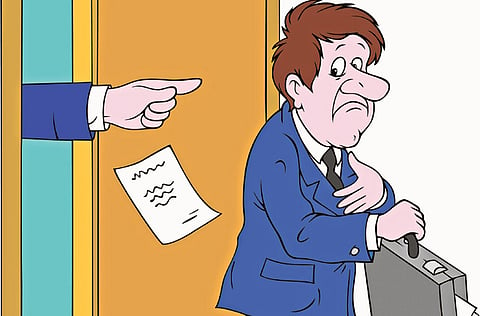
London: There's a grubby and battered sports bag I use every day. It holds my rudimentary gym kit, a novel and bitter memories of the most painful episode of my working life.
The bag was a marketing gimmick for Later magazine, which I created, loved and guided unwittingly to its demise 10 years ago this summer. My Later bag is an embarrassment, socks and shorts poke humiliatingly through gaping holes, but I like to carry it around I like to be reminded of my Big Failure. I have a lot of time for success, but when it comes to formative experiences, success just can't compete with failure.
Later closed after only 24 issues. It was supposed to be the publication readers grew into once their interests turned to Bordeaux and central heating.
The anniversary has made me think about it once more and puzzle over the effects this crashing defeat had on me, my family and my working life.
Nowadays, I swin around with an important-sounding job title at a booming independent publishing company but I never forget that I was once the editor of a battered sports bag.
The magazine closed months before the birth of my second child and I had no idea what I'd do next. The project I'd obsessed over, hung my reputation on, which had taken every ounce of my creativity and ingenuity, was over.
I remember the day the magazine was closed. The team I'd struggled with, drank with and shared the bulk of my waking hours with, were all out of a job.
There were stunned faces and tears. It was end of the project we had begun two years earlier amid launch parties and advertising campaigns.
What was I thinking at that moment? I was worried about feeding my family and I felt sad for my colleagues, but the overwhelming emotion was humiliation. It seems my sense of embarrassment was an entirely normal response. Professor James Pennebaker at the University of Texas neatly encapsulates the shock when your work leaves you.
Overwhelming
"Losing your job can be an overwhelming experience because it touches every part of your life," he says. "To make it even more difficult, it is the kind of experience that is often hard to talk to others about. It's embarrassing, humiliating, and shameful. Talking about it can make you uncomfortable and also other people nervous."
A truly big, public failure crashes through all the usual evasions we use when work is going badly. This wasn't "challenging" or "interesting" and we weren't "hanging in there" my defeat was total and press-released. So I'd discovered something about myself. My posture of easy-going, self-deprecating, Britishness my rubbishy Hugh Grant schtick was just a posture. I didn't like being a loser. I pictured my peers laughing at my downfall and enjoying my pain.
Ever since, I've embraced this slightly unappealing competitive side it took failure to teach me how important winning is. I now play the working life game hard, going out of my way to make it difficult for the opposition.
I coped with the shame by creating a story for myself and everyone else. Had you met me at that time I would have explained at length how the magazine closing wasn't my fault. Nope, nothing to do with me.
I was the talented creator of a product the world was too lacking in sensitivity and judgment to embrace.
It turns out my refusal to accept any responsibility — apart from being obnoxious and immature — was also quite helpful to my ability to bounce back.
Karoline Strauss, assistant professor at the Management School, University of Sheffield, says the way we view these difficult moments influences our ability to recover from them.
"One of the key factors in a successful recovery from a setback is an ability to find something positive in the situation," she says.
"If I think that a setback has taken place because of something about me or my personality, something I cannot change, that will hold me back in the future. If I believe that it's something I can alter, that will help. To view yourself as a victim of circumstance is natural."
It was my wife who nursed my fragile self-esteem back to full health.
Together we lived through the financially insecure years that followed, always ready to retreat to an imaginary rural location and live simple lives without latte or fashion. It was at this time I learned a truth about professional careers — they're just work in disguise. You can't afford to take them too seriously.
Growth worry
Prior to the closure of Later magazine I'd edited Men's Health. My only worry there was how fast it would grow. It was my first editorship and a roaring success. Unlike my subsequent disaster, I attributed this entirely to my own extraordinary abilities. I appeared on TV and radio a bit, ate out a lot and generally blurred the boundaries between professional me and private me.
It took a really serious failure to teach me that basing your self-worth on paid employment is a terrible idea. Your office, your desk and your pay cheque may not always be there. The tight survival unit of friends and family now take priority.
Which brings me to the other lesson hard work is vital; but obsessive, life-draining, relationship-straining hard work is pointless. I was checking the pages of Later magazine from home days after my first child was born.
Effectively I interrupted a precious and unrepeatable moment in my life for what is now a tatty sports bag.
The sense that hard work brings rewards is untrue. There was a naive part of me that believed that if I slogged, my magazine would turn into a success.
All the best ideas I've ever had and the best decisions I've ever made have come to me in moments of abstraction or relaxation loafing, shaving, running. Hard work on a bad idea will not turn it into a good one.
I found a job immediately after the closure but my worth had plummeted. Here, failure taught me the awful gap between your ability and your value on the labour market. I had previously been fought over, hot property but now I had a damaged reputation and was perceived very differently.
It was during this phase that I really battled to retain my confidence. One set of colleagues drily nicknamed me Iceberg in recognition of my ability to sink large vessels.
Back to work
Around this time I received a job offer in the post — I was excited, I was back! My suspicions were aroused by the phrase "you have a Midas touch". A friend had played brilliantly on my predicament. I laughed helplessly but this was my new status — loser.
It was old friends and colleagues who gave me a chance to prove myself again. They enabled a staged slog back to a decent career. They found me a tougher version of myself with a newly discovered interest in the commercial realities of my job (as well as a baffling attachment to an ageing gym bag). Now I'm often in the happy position of building teams and recruiting talented people. Trust me, if you have a really monstrous and demanding task to tackle, you're always much better off hiring a failure.
— Guardian
Phil Hilton is the editorial director of ShortList Media


