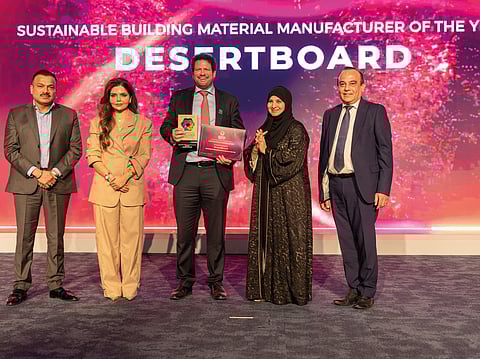
The Sustainability Excellence Awards 2025: DesertBoard wins Sustainable Building Material Manufacturer of the Year
Reimagining construction with upcycled palm fronds makes brand a winner
What inspired your organisation to focus on sustainability?
At DesertBoard, sustainability is not simply a corporate objective. It is part of our identity. Our inspiration comes from the palm tree, which has been central to life, culture, and survival in the region for generations. Historically, nearly every part of the palm was used for food, shelter, tools, and rituals, yet one element was consistently overlooked: the fronds.
For decades, discarded palm fronds were either burned or sent to landfills, releasing methane and CO2 into the atmosphere and creating an environmental problem hidden in plain sight. This practice continues today. Palm raw material in the UAE is still largely buried or burned, both of which are environmentally damaging and unsustainable.
What makes our PSB wooden boards particularly meaningful is their deep cultural connection to the UAE. Date palms are woven into the country’s identity, providing shade, food, building materials, and social value. This connection was strongly championed by the late Sheikh Zayed bin Sultan Al Nahyan, the founding father of the UAE, who encouraged palm cultivation through incentives in the 1970s and led conservation and cloning programmes in Al Ain.
With millions of date palms across the UAE, the raw material supply is abundant and renewable. The contradiction of having such a valuable natural resource with no meaningful reuse sparked the idea that ultimately became DesertBoard. Inspired by Sheikh Zayed’s vision, we set out to rethink what building materials could be, rooted in regional heritage while designed for a global sustainability future.
Which achievement in your sustainability journey are you most proud of?
The achievement we are most proud of is the development of a proprietary building board made entirely from upcycled palm fronds. After years of research and development, DesertBoard became the first to successfully convert this agricultural byproduct into a high-performance, construction-grade product suitable for large-scale use.
Historically, palm fronds were discarded or burned, contributing to emissions and environmental degradation. By transforming this overlooked waste stream into a valuable building material, we have shown that sustainability can deliver both environmental and commercial impact. It demonstrates that alternative materials can meet, and in many cases exceed, the performance standards required for modern construction.
Our PSB wooden board is not only sustainable but technically robust and commercially viable at scale. It has passed rigorous strength, shear, and fire-resistance testing and meets the UAE, Saudi Arabian, European, and American standards for structural and interior applications. Its lightweight yet high-strength properties also make it suitable for modular and prefabricated construction. What truly sets PSB apart is its alignment with Scope 3 emissions reduction, one of the most challenging benchmarks in corporate sustainability. Very few construction materials globally meet this standard, particularly in regions with limited access to sustainable forests. The product’s environmental performance has also been formally recognised through Dubai’s Al Sa’fat Green Building Evaluation System and local fire-resistance certification, reinforcing our belief that sustainability and performance must go hand in hand.
What was the biggest challenge you faced, and how did you overcome it?
The greatest challenge was the absence of any existing technology. There was no manufacturing system capable of producing boards from this type of raw material because no one had attempted it before.
To overcome this, we developed our own proprietary manufacturing process, enabling us to engineer a reliable and scalable solution from the ground up. This required extensive testing, refinement, and long-term investment, but it allowed us to maintain full control over quality and performance.
Equally important was market education. Introducing a new material into a conservative industry requires confidence from architects, developers, and contractors. We focused on transparency, performance data, and independent certification to demonstrate that PSB is not simply a sustainable alternative, but a high-performing construction material in its own right.
What advice would you give to others striving for sustainability excellence?
Innovation is essential. Real progress comes from challenging established methods and committing to long-term solutions. Sustainability is not achieved through shortcuts. It requires vision, persistence, and the courage to think differently.
My advice is to look beyond incremental improvements and focus on transformative ideas. The next major sustainability breakthroughs will come from those willing to question industry norms and commit to meaningful, lasting change.


