Precision medicine advances in UAE with 3D-printed guides for spinal surgery at Medcare Orthopaedics and Spine Hospital
The novel technology reduces operating times, lowers blood loss, and speeds up recovery
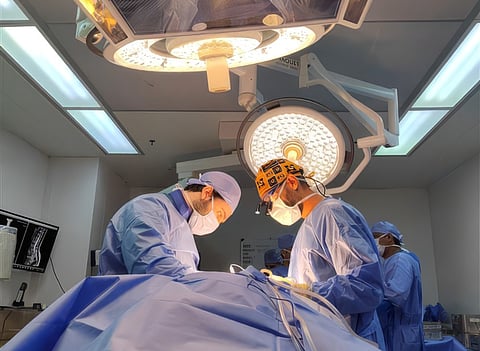
Medcare Orthopaedics and Spine Hospital in Dubai has made a significant advancement in spine care by introducing 3D-printed surgical guides for complex spinal surgeries. This novel technology reduces operating times, lowers blood loss, and speeds up recovery, offering new hope for people with severe scoliosis and spine deformities reinforcing the UAE’s position as a leader in advanced spinal treatment. Among the recent beneficiaries of the 3D-printed surgical procedure were 14- and 15-year-old girls and a 17-year-old boy, each of whom was diagnosed with severe scoliosis requiring complex corrective surgery.
Dr. Sameh Abolfotouh, Consultant Orthopaedic and Spine Surgeon at Medcare Orthopaedics and Spine Hospital, and Chairperson of AO Spine for the MEA region, remarked, “While every scoliosis case is unique, these three patients illustrate the real-world impact that advanced planning and 3D-printed surgical guides can have on outcomes. The 14-year-old girl came to us with severe spinal curvature affecting both the upper and lower portions of her spine after experiencing persistent back pain. Through detailed pre-operative planning and customised guides, we were able to achieve precise correction and help her return to normal activities.”
“The 17-year-old boy was facing a pronounced spinal deformity that affected his posture and long-term mobility. Using the same technology, we completed what would traditionally be a lengthy and demanding surgery in just four hours, with no post-operative complications. The 15-year-old girl, meanwhile, had a progressing spinal curve exceeding 50 degrees. The customised guides enabled us to navigate her complex anatomy with a high degree of accuracy, restoring spinal alignment and posture while ensuring a smooth recovery,” he elaborated.
According to Dr. Abolfotouh, cases like these demonstrate how personalised surgical planning is helping spine surgeons deliver safer procedures, faster recoveries, and better long-term outcomes for young patients with complex spinal deformities. “The custom-designed 3D-printed surgical guides reduces duration of the surgery by more than half, while improving precision in procedures to correct severe spinal curvature among young patients to return more quickly to school, work, sports, daily activities, and normal life with no major complications.”
“We have integrated a highly specialised digital workflow that allows surgeons to virtually plan the procedure before entering the operating room. Advanced imaging is used to create patient-specific 3D-printed surgical guides that match the exact anatomy of the patient's spine,” said, Dr. Azzam Fayyad, Consultant Orthopaedic and Trauma surgeon, Medical Director and Head of Orthopaedics at Medcare Orthopaedics & Spine Hospital.
Dr. Fayyad, added, “The 3D-printed surgical guides combine detailed pre-operative planning with customised surgical tools tailored to each patient's anatomy. During surgery, the surgical guides help ensure precise placement of surgical implants and reduce the margin of error to less than two per cent.”
“Our approach is to help reduce operating time, minimise blood loss, and support faster recovery for paediatric and adult patients facing life-altering spinal conditions. At Medcare Orthopaedics and Spine Hospital one of our major focus areas is treating mainly Adolescent Idiopathic Scoliosis (AIS), which is a progressive condition that causes an abnormal curvature of the spine during a child's growth years,” he said.
“In more serious instances, the condition can impact posture, mobility, self-esteem, and overall quality of life, often necessitating major corrective surgery. Typically, these corrective procedures last between eight and ten hours and are linked to considerable blood loss, prolonged hospital stays, and extended recovery times. With this innovative procedure, we are effectively conducting a virtual operation on the patient prior to their actual surgery. The specially designed guides fit onto the vertebrae like a lock and key, enabling us to implement the surgical plan with remarkable accuracy.," Dr. Abolfotouh noted.
The impact of the technology extends beyond reduced operating time. Blood loss has been reduced to less than 400 millilitres per procedure, significantly lowering the likelihood of complications and eliminating the need for major blood transfusions in these cases. These improvements contribute directly to faster recovery and a safer surgical experience for paediatric and adults patients.
“The ultimate goal is to give patients their normal lives back as safely and quickly as possible. When advanced technology is combined with surgical expertise, the benefits extend far beyond the operating room. It changes the recovery experience, reduces the physical burden of surgery, and allows people to return sooner to the activities that matter most to them,” Dr. Fayyad concluded.


