
Payal Singhal redefines bridal fashion with personal touches and timeless craftsmanship
Blending Indian craft, Persian grandeur and family influences in personal bridal wear
When Payal Singhal talks about the requests she receives from brides, one in particular still makes her smile. A bride wanted a matching wedding outfit for her puppy, bringing a much-loved member of the family into the celebrations. Singhal found the idea unexpected and incredibly sweet, and it gave her another way to think about the personal touches women want in their wedding wardrobes. Alongside decisions about colour, embroidery and silhouette, there was room for something as affectionate as dressing the family dog.
“It made me realise how much weddings have become about including every member of the family, even the four-legged ones,” she says. “Sometimes the most memorable details are the playful, personal ones that make the celebration feel uniquely yours.”
The founder, owner and creative director of Payal Singhal Design House describes a bride who wants to recognise herself in what she wears. That leaves plenty of room for Indian craftsmanship, elaborate embroidery and the emotional weight of tradition. It also gives pleasure a serious place in the design process, whether that means a bohemian sensibility, an unexpected print or the ability to dance comfortably for hours.
“I think a Payal Singhal bride should feel like herself, just a little more elevated,” she says.
History in the fabric
For Singhal, an unmistakable bridal outfit begins with Indian crafts, textiles and techniques, interpreted with a contemporary eye. She is interested in loosening the expectations surrounding familiar forms, preserving their history while allowing the clothes to belong to the present.
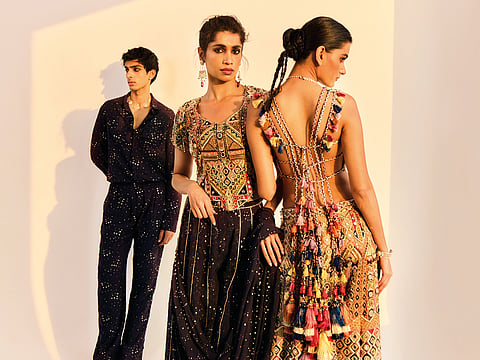
Her Spring/Summer 2026 collection, Shahnameh, extends that interest into Persian literature. The Book of Kings, written by Ferdowsi between the 10th and 11th centuries, draws her towards the relationship between artistic expression and cultural survival. She is fascinated by a civilisation preserving its identity through poetry, art and storytelling, alongside the grandeur of the epic itself.
“I translated that into the collection through rich silks, brocades, intricate embroidery and a certain sense of regal drama, but kept the silhouettes much cleaner and more contemporary,” she says.
The fabrics and embroidery supply the richness; the shapes allow the wearer to interpret it. For wedding celebrations, Singhal favours embellished lehengas, draped silhouettes and embroidered jackets with several styling possibilities. Fantasy enters through the sense of occasion, while the versatility of a jacket gives the bride something she can imagine wearing in different combinations.
That openness also informs her response to colour. Classic reds and pinks retain a strong emotional hold, and she expects that attachment to endure. Alongside them, she sees brides choosing ivory, champagne, deeper jewel tones, unusual colour combinations and prints. Tradition continues to matter as women become more confident about deciding how it will appear in their own wardrobes.
Room to dance
The changing silhouette has a practical impetus. Singhal sees brides seeking clothes that let them move, dance and feel like themselves, with less willingness to choose something simply because convention prescribes it.
A photograph can show the embroidery beautifully. The woman wearing it will experience its weight, the way her blouse holds her and the ease with which she can sit. These are decisions Singhal pays close attention to, along with the placement of embellishment, the fall of a skirt and the freedom to use her hands.
“I’m very conscious of movement because Indian weddings are not static,” she says. “The best bridal outfit is one you stop thinking about once you put it on and can’t stop thinking about it after the wedding is over!”
Her emphasis on comfort gives substance to the effortless quality she wants in her clothes. Fun, bohemian dressing still requires careful construction, especially when a garment must carry detailed craft through hours of celebration. Ease is something the designer has to build into it.
A wardrobe takes shape
The same attention applies when a bride arrives with a folder full of references. Singhal welcomes the images because they reveal what attracts her, then asks questions about each choice. Is the appeal in the colour, the silhouette, the embroidery, the mood or how the outfit feels on the body?
“Once you understand that, you can translate those ideas into something that belongs to her,” she says. “Sometimes the most important thing is also knowing what not to do.” The process allows the bride’s preferences to emerge from the collection of pictures. Across several celebrations, those preferences need enough flexibility to give each event its own character and enough connection to make the clothes feel like one woman’s wardrobe.
Singhal starts with the main bridal look, choosing something emotionally important and timeless. The other outfits develop around it, through changes in silhouette, colour, embroidery and styling.
“Maybe a lighter, more playful look for the mehendi, something more glamorous for the sangeet, and a sophisticated cocktail or reception look,” she says. “And I would always include at least one outfit that is less obviously ‘bridal’. Those are often the pieces you end up loving and wearing for years.”
After the wedding
That last choice invites the bride to think beyond the celebrations while she is still planning them. Singhal believes in pieces with a future, particularly garments whose craftsmanship make them adaptable to other occasion.
“An embroidered blouse can be worn with a simple sari. A beautiful jacket can completely transform a plain dress or a pair of pants,” she says. “Even a lehenga skirt can be separated and styled with a very simple shirt or knit.”
These combinations give wedding clothes a place among things a woman actually wears. The embroidery remains precious, and another occasion brings another way to enjoy it. A bride can carry the memory of her wedding into an outfit assembled years later, with pieces that still suit her life.
Singhal’s approach allows that life into the wedding from the beginning, with all its familiar, affectionate details. There is room for the colours a woman loves, the dancing she anticipates and the family she wants around her. Occasionally, one member of that family needs a matching outfit, and the designer finds herself making space for four paws.


