
Russian film industry explores the growing role of AI in cinema
Experts explore how AI is transforming film production while keeping creativity human
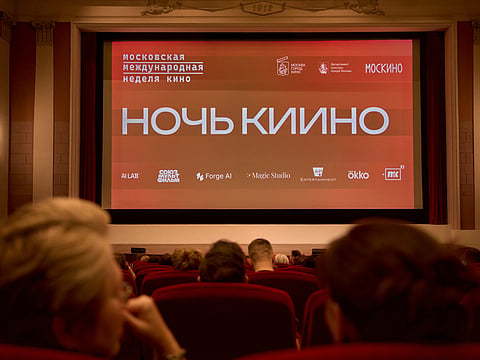
Artificial intelligence is being used across film production to create backgrounds, crowd scenes and secondary characters, automate routine tasks and reduce production time. The role of AI in filmmaking was discussed during an open session at the annual Cinema Night event, where participants highlighted that creative decisions remain with directors, artists and screenwriters.
Yulia Osetinskaya, General Producer of Soyuzmultfilm, said the studio uses AI to create short videos featuring characters such as Cheburashka, as well as to develop character prototypes, costumes, locations and props.
Dmitry Rudovsky, Director, Screenwriter and General Producer of AP Entertainment, highlighted the use of Unreal Engine, LED screens and generative content in large scale productions. He presented a teaser for Alaska, which was created in one day using an LED screen displaying Alaskan settings generated with Unreal Engine.
According to Sergey Ryabov, CEO of AI Lab, generative models are particularly suited to short formats such as trailers, promotional videos and vertical series. Experts stressed that project success continues to depend on the creative input of screenwriters, directors, artists and producers.
“Generative cinema should be made by people who know how to make films. Because AI is a tool. If a person has never done traditional filming or animation, they will not be able to create a film or an animated film, no matter what tool they are given,” Sergey Ryabov believes.
Yana Shmailova and Ekaterina Kononenko, co founders of the Forge Cinema AI platform, highlighted the importance of maintaining a balance between traditional filmmaking and AI tools. They noted that producing 1,000 minutes of AI generated video may be required to select one minute for an action scene, making the process resource intensive.
The speakers said combining traditional filming with generative technologies could help reduce production costs and speed up workflows while keeping AI use focused on practical applications.“In the series Kaifsk. City of Gnomes produced by Mesto Sily for Okko, we decided to combine filmed material and generation: we shot everything related to people — ‘humans’, as the gnomes call us — and generated everything related to the gnomes. We thought that the more real textures there were, the less rejection it would cause among viewers. Not everyone is ready to watch an hour and a half of generated content. That is why we chose this approach,” said Sergey Vasiliev, director of the series Kaifsk. City of Gnomes.
Ilya Shutov, creative producer of the series, highlighted the collaborative work behind Kaifsk, a fictional town generated with new technologies and developed with contributions from dozens of artists.
Yulia Lipatova and Makar Kozhukhov, co founders of Magic Studio, shared their experience using new technologies to streamline film production processes.
“Everything you enter into prompts, our software does automatically. The script is broken down into scenes. Each scene is broken down into shots. Each shot contains more than 100 parameters: what happens in it, how many characters there are, how they interact with each other, how the camera moves and how the lighting is set. The machine takes over the main routine work. But our people — AI operators, directors, screenwriters and storyboard artists — actively monitor everything,” Yulia Lipatova said.
AI can break down a script into shots in just 1.5 seconds, prompting production companies to develop software that automates routine tasks.
These tools are helping reduce production costs and enable new content formats, as the industry explores greater collaboration between humans and AI.


