
Mark Fuller’s Water Birds set to bring a new dimension to water performances in UAE
The Bellagio fountains creator unveils autonomous water sculptures that ‘fly’ in formation
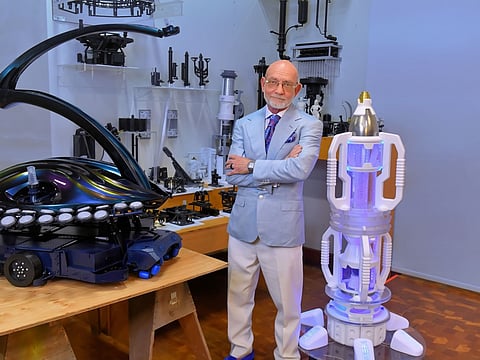
Water is set to become a moving performer in the UAE as Mark Fuller, the engineer and founder of WET behind the famous Fountains of Bellagio in Las Vegas, prepares to introduce a new generation of autonomous Water Birds.
The installation, which is set to debut at the UAE’s National Museum, is designed to transform a lake into a stage where water, movement, robotics, music and choreography come together.
Unlike conventional fountains, where jets are fixed in position and connected to pipes and pumps beneath the surface, the Water Birds are designed to move independently through the water.
Each Water Bird can travel across and beneath the lake according to programmed choreography. A long, curved neck can rise above the surface and spray water, while articulated wings extend and move, releasing water in broad patterns that create the impression of a bird taking flight.
The birds do not physically leave the lake. Instead, their movement, water effects and coordinated choreography are designed to create the illusion that they are floating and flying across its surface.
The system also allows the Water Birds to interact as a group.
Each performer can determine the location of the others, allowing multiple birds to gather, separate and move in synchronised formations. One bird can follow an individual path across the lake while others perform together before the group reunites.
The result is a water performance in which the location of the spectacle itself becomes part of the choreography.
From fixed fountains to moving water
For centuries, fountains have relied largely on the same basic principle: water is moved through fixed infrastructure and projected into the air.
Modern fountain engineering has expanded that idea through sophisticated pumps, computer controls, lighting and choreography. But the point from which the water emerges has generally remained fixed.
The Water Birds introduce another dimension — mobility.
Instead of controlling only the height, pressure, direction and timing of water, WET’s system allows the source of the performance to move through the lake.
That means a sequence can begin in one part of the water and continue somewhere else. A group can spread across the surface, converge in formation or allow an individual performer to take centre stage.
For Fuller, however, the technology is ultimately intended to disappear behind the experience.
“The purpose of engineering is to make people feel something they have never felt before,” he says.
Four decades of engineering emotion
Fuller is an engineer by training, but his career has been defined as much by the emotional response to engineering as by the technology itself.
For more than four decades, his work has combined water, fire, light, music, movement, software and mechanical engineering to create large-scale public experiences.
The philosophy became the foundation of WET, whose projects have appeared in some of the world’s most prominent public spaces and destinations.
The Fountains of Bellagio remain perhaps the best-known example.
In a city filled with replicas and interpretations of famous landmarks, the Bellagio fountains became an original spectacle in their own right. Their choreographed performances helped turn the fountains into one of the defining visual experiences associated with Las Vegas.
The project also illustrated how public art and engineering can influence the identity of a destination.
A spectacle that people can watch without an admission fee can nevertheless encourage visitors to spend more time in a location, return to it and associate their memories with the surrounding hotel, restaurants and public spaces.
For Fuller, that commercial impact follows the experience rather than replacing it.
His proposition to clients has been straightforward: “We will bring more people to your site than you dreamed of; they will stay longer than you imagined.”
The next part, he says, is for the client to determine.
When engineering becomes theatre
Fuller’s approach has extended beyond water.
For the 2002 Winter Olympic Games in Salt Lake City, he created a transparent Olympic cauldron that combined fire and water in a single installation.
The Games were held under the theme “The Fire Within”, and Fuller’s design translated that concept into a monumental flame housed inside a clear structure while water continuously flowed down its inner walls.
The water served both a visual and practical function, helping protect the transparent structure from the intense heat of the flame.
Fire and water, two elements traditionally viewed as opposites, became part of the same engineered performance.
That project reflected a broader principle behind Fuller’s work: engineering can be used not only to solve technical problems, but also to make an artistic idea physically possible.
The Water Birds take that approach into a new setting.
Giving water freedom to move
Traditional fountain choreography controls what water does from a fixed location.
The Water Birds allow choreography to control where the performance takes place.
A bird can approach another performer before changing direction. Several birds can move together in formation. A single performer can separate from the group and cross open water before returning.
The movement of the machines becomes part of the visual language.
Their necks can rise from the surface and release water, while their wings can extend and create sweeping sprays. Together, those movements are intended to produce the visual impression of living creatures moving across the lake.
The engineering required to create the illusion is complex, but the concept presented to the audience is deliberately simple.
Water appears to have acquired a new freedom.
A shared experience in a screen-filled world
The project also comes at a time when many spectacular experiences are increasingly consumed through digital screens.
Images and videos can capture the appearance of a water display, but a live performance creates a different kind of response.
Standing beside a lake as a Water Bird unexpectedly rises from the surface brings together movement, sound, spray, scale and the reactions of the people watching.
For Fuller, that collective response has always been an important part of the experience.
The objective is not for audiences to study the pumps, motors, software or mechanical systems behind the performance. Instead, the technology is expected to become almost invisible.
What remains is the reaction.
A child seeing water appear to come alive. A visitor watching an entire formation move across a lake. Hundreds of people turning towards the same unexpected spectacle.
That shared sense of discovery is central to Fuller’s approach.
From the Fountains of Bellagio to the Olympic cauldron and now the autonomous Water Birds planned for the UAE, his work has continued to explore the relationship between engineering and emotion.
The Water Birds represent another step in that evolution — shifting water from something that simply rises, falls or moves in place into something that can travel through a landscape and become part of a choreographed performance.
For audiences, the technology may be difficult to see.
The intended effect is much easier to understand: water moving in a way it has never appeared to move before.

